

Quick Answer: Laboratory glass plates are flat, square sheets of glass used as covers, work surfaces and simple apparatus in school science. The listing photograph shows plates of more than one size, used for covering gas jars and dishes, mineral hardness tests, capillarity demonstrations and germinating seeds between two sheets.
Common Practical Uses
- Covering gas jars, beakers and evaporating dishes to keep gases in or dust out
- The scratch step of mineral identification, testing whether a specimen is harder than glass
- Showing capillary rise between two plates held at a narrow angle in coloured water
- Germinating seeds on moist blotting paper held between two plates, so root growth can be watched
- A flat, easily cleaned surface for mixing small amounts of stain or modelling clay
Plain Glass, Many Jobs
A flat glass plate is one of the simplest items in a science store, but it turns up in chemistry, biology and earth science. Smeared lightly with petroleum jelly, it seals the ground rim of a gas jar. Laid over a beaker of pond water or an evaporating dish, it keeps dust out while letting students see inside. Because glass is harder than many common minerals and softer than others, it also serves as a reference surface when students test whether a mineral can scratch it.
In biology, two laboratory glass plates held together with rubber bands around a sheet of wet blotting paper make a germination chamber. Seeds tucked between paper and glass grow in view, so students can follow roots turning downwards and root hairs forming, and can rotate the plates to study gravitropism. Two plates touching along one edge and slightly open along the other also show capillary action: coloured water climbs highest where the gap is narrowest.
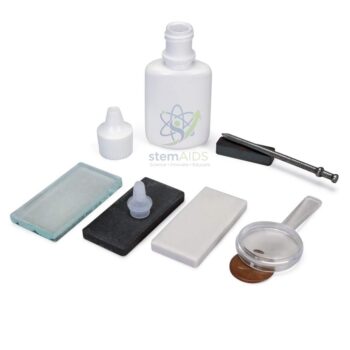
The listing photograph shows square plates in at least two sizes, with the slight green tint at the edges that ordinary sheet glass often has. The smaller glass streak plates in this range suit bench kits.
Care & Handling
- Handle plates by the faces with dry hands until you know the edges are ground; cut glass edges can be sharp.
- Store plates on edge in a rack or flat with paper between them, never loose in a drawer where they scratch and chip.
- Remove grease with warm water and detergent, then rinse; a scratched or chipped plate should be taken out of use.
Specifications
| Item | Flat square glass plates |
| Sizes | More than one size shown in the listing photograph |
| Surface | Smooth, transparent, easy to clean |
| Heat | Not for direct heating; plain sheet glass can crack with sudden temperature change |
Why Choose LabEquip
Science stores buy glass plates in quantity because many departments share them. LabEquip lists them in Biology Lab Products, and earth-science teachers often add a Mineral Test Kit for hardness practicals. Use the LabEquip contact page to confirm size, thickness and edge finish.
Related Products
- Streak Plates, Glass: Small glass squares used as the reference surface in mineral scratch-hardness tests.
- Mohs Hardness Set, Collection of 9 Mohs Hardness Set: Nine numbered reference minerals for the scratch tests in which a glass plate is used.
- Gas Jar With Ground Flange and Foot: A gas jar whose ground rim is sealed with a flat glass cover plate.
- Petri Dishes, Clear Glass: Clear glass Petri dishes for germinating seeds and observing specimens, an alternative to two plates.
Frequently Asked Questions
What are glass plates used for in a science lab?
Flat glass plates cover gas jars, beakers and evaporating dishes, act as the glass reference in mineral hardness tests, show capillary rise between two sheets and hold seeds between two sheets so root growth can be watched. The product photo shows plates of more than one size.
How is a glass plate used in a mineral hardness test?
Glass has a hardness of about 5.5 on the Mohs scale. Press a sharp edge of the mineral firmly across the plate: a mineral that leaves a true scratch is harder than glass, while one that leaves only a powder line that wipes away is softer.
How do two glass plates show capillary action?
Hold two clean plates together along one edge with a thin spacer at the other, forming a narrow wedge, and stand them in coloured water. The water rises highest where the gap is narrowest and traces a curve, showing that narrower spaces draw water higher.
How do you germinate seeds between glass plates?
Line one plate with moist blotting or filter paper, place seeds on it, cover with a second plate and hold the pair together with rubber bands. Stand them upright in a little water so the paper stays wet; roots and shoots can then be watched through the glass.
Can laboratory glass plates be heated?
Plain sheet glass is not for direct heating and can crack with a sudden temperature change. Use the plates at room temperature or for gentle warming only, and never put a warm plate down on a cold, wet bench.
How should glass plates be cleaned?
Wash them in warm water with detergent, rinse well and dry them standing on edge. For greasy residues such as petroleum jelly from gas-jar seals, wipe off the grease with paper first, then wash. Handle by the edges and check for chips before use.
Last Updated: November 2026






Reviews
There are no reviews yet.