
In Stock
Glass Coverslips
₹569.00
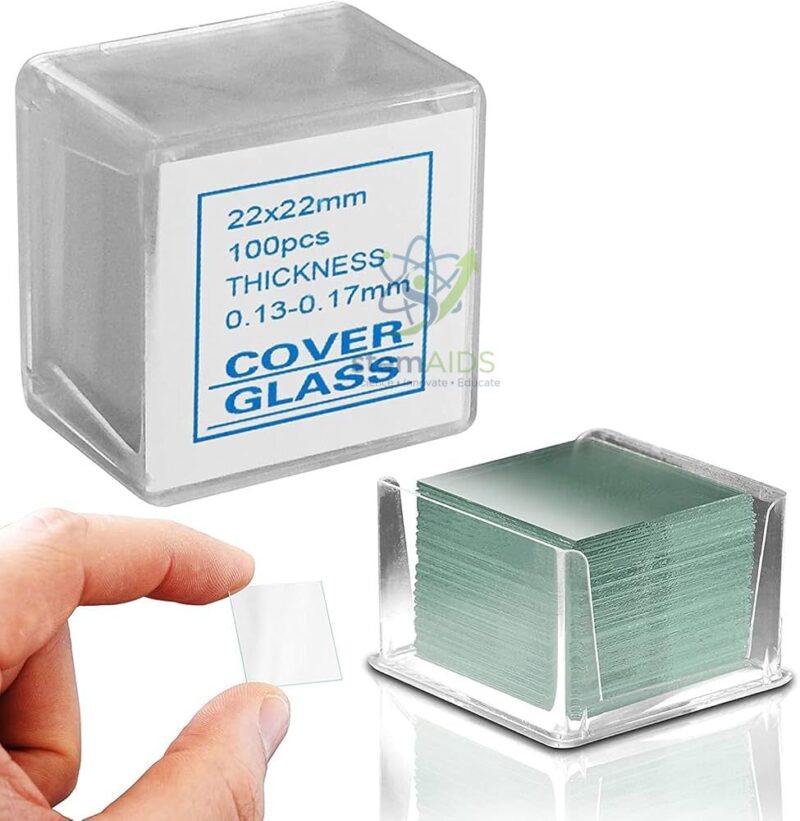
The StemAids Glass Coverslips are thin, transparent microscope cover glasses designed to cover and protect specimens mounted on microscope slides. They help flatten the specimen, reduce evaporation, improve optical clarity, protect microscope objective lenses, and support clean observation during biology, microbiology, botany, zoology, pathology, and STEM microscopy practicals.
Product Description
The StemAids Glass Coverslips are used with microscope slides to prepare wet mounts, stained slides, smear preparations, temporary mounts, and routine educational specimens. A coverslip is placed gently over the sample to create a thin, even layer for microscopic observation.
These cover glasses are suitable for observing onion peel, cheek cells, pond-water organisms, pollen grains, fibres, plant sections, microbiology smears, pathology training samples, and prepared laboratory specimens. Their clear glass surface allows light to pass through the specimen for accurate viewing under a compound microscope.
StemAids Glass Coverslips are available in common square, rectangular, and circular formats depending on laboratory requirement. They are suitable for school laboratories, college biology departments, pathology training labs, research laboratories, STEM classrooms, and microscopy kits.
Product Specifications
| Parameter | Details |
|---|---|
| Product Name | Glass Coverslips |
| Brand | StemAids |
| Product Type | Microscope cover glass / glass coverslip |
| Material | Clear optical glass or borosilicate glass depending on supplied grade |
| Shape Options | Square, rectangular, or circular depending on selected model |
| Common Square Sizes | 18 × 18 mm, 20 × 20 mm, 22 × 22 mm, 24 × 24 mm |
| Common Rectangular Sizes | 22 × 40 mm, 22 × 50 mm, 24 × 40 mm, 24 × 50 mm, 24 × 60 mm depending on requirement |
| Common Circular Sizes | 18 mm, 19 mm, 22 mm, or 24 mm diameter depending on configuration |
| Typical Thickness | No. 1: approx. 0.13–0.16 mm; No. 1.5: approx. 0.16–0.19 mm depending on grade |
| Surface | Clean, transparent, smooth glass surface for microscopy |
| Compatibility | Compatible with standard microscope slides, wet mounts, stains, and most compound microscopes |
| Packaging | Supplied in box, packet, or bulk pack depending on selected configuration |
| Application | Wet mount preparation, specimen covering, slide protection, staining, microscopy observation, and educational biology practicals |
| Suitable For | Schools, colleges, biology labs, pathology labs, microbiology labs, research labs, STEM labs, and educational laboratories |
Key Features
- Thin transparent glass for clear microscopic observation
- Helps protect specimens and microscope objective lenses
- Supports wet mounts, stained slides, smears, and prepared specimens
- Available in square, rectangular, and circular formats
- Commonly available in No. 1 and No. 1.5 thickness grades
- Useful for biology, microbiology, botany, zoology, pathology, and STEM practicals
- Helps spread liquid samples into a thin viewing layer
- Suitable for school, college, and research microscopy use
How to Use
- Place a clean microscope slide on a flat laboratory surface.
- Add a small specimen, liquid drop, smear, or stain to the centre of the slide.
- Hold the StemAids Glass Coverslip carefully by the edges using forceps or clean fingers.
- Touch one edge of the coverslip to the slide near the specimen drop.
- Lower the coverslip slowly at an angle to reduce air bubble formation.
- Blot excess liquid from the slide edge using tissue or filter paper.
- Place the slide on the microscope stage and begin focusing with the low-power objective.
- After observation, dispose of contaminated coverslips safely or clean reusable non-contaminated material according to laboratory SOP.
Applications
- Wet mount preparation
- Onion peel cell observation
- Cheek-cell observation under supervision
- Pond-water organism observation
- Botany and zoology slide preparation
- Microbiology smear covering
- Pathology training slide preparation
- Staining and temporary mount work
- Prepared-slide protection
- STEM classroom microscopy activities
Safety and Handling Guidelines
- Handle coverslips carefully because they are very thin and fragile.
- Do not use cracked, chipped, or broken coverslips.
- Use forceps when handling coverslips for better control and cleanliness.
- Wear gloves when working with stains, biological samples, or unknown specimens.
- Do not press hard on the coverslip while focusing or preparing a slide.
- Dispose of broken coverslips in a suitable sharps container.
- Dispose of contaminated coverslips according to biohazard or laboratory waste rules.
- Keep coverslips dry, dust-free, and protected in their original box.
- Keep away from very young children unless supervised.
- Use under teacher or laboratory supervisor guidance in educational settings.
Quality and E-E-A-T Notes
The StemAids Glass Coverslips support evidence-based microscopy by helping create a thin, even specimen layer for clearer observation. Correct coverslip placement reduces air bubbles, protects microscope objectives, limits specimen movement, and improves slide-preparation consistency during classroom and laboratory work.
FAQ
1. What are StemAids Glass Coverslips used for?
They are used to cover specimens on microscope slides during wet mount preparation, staining, smear observation, and routine microscopy.
2. Why is a coverslip used on a microscope slide?
A coverslip protects the specimen, helps flatten the sample, reduces evaporation, improves clarity, and protects the microscope objective lens from direct contact with the sample.
3. What sizes are available?
Common sizes include 18 × 18 mm, 20 × 20 mm, 22 × 22 mm, 24 × 24 mm, and several rectangular or circular sizes depending on laboratory requirement.
4. What is the typical thickness of a coverslip?
No. 1 coverslips are commonly around 0.13–0.16 mm thick, while No. 1.5 coverslips are commonly around 0.16–0.19 mm thick.
5. Can coverslips be reused?
Coverslips are often treated as consumables. Non-contaminated coverslips may be cleaned carefully for educational reuse, but contaminated or broken coverslips should be disposed of safely.
6. Can they be used with concavity slides?
Yes, coverslips can be used with concavity slides when the experiment requires covered observation of liquid or thicker samples.
7. How can air bubbles be avoided?
Lower the coverslip slowly at an angle over the specimen drop instead of dropping it flat onto the slide.
8. Are these suitable for school laboratories?
Yes, they are suitable for school biology labs, college labs, STEM classrooms, microscopy kits, and routine educational practicals.
9. Can coverslips protect microscope objectives?
Yes, a coverslip creates a barrier between the specimen and the microscope objective, helping reduce contamination and accidental contact.
10. What should be done with broken coverslips?
Broken coverslips should be placed in a sharps container or suitable broken-glass disposal container according to laboratory SOP.
11. Are coverslips used for stained slides?
Yes, coverslips are commonly used after staining to protect the specimen and improve microscopic viewing.
12. How should coverslips be stored?
Store them in the original box in a clean, dry, dust-free place away from moisture, impact, and chemical fumes.
Why Choose StemAids?
StemAids microscopy supplies are selected for practical classroom learning, laboratory reliability, and curriculum-supportive science work. The StemAids Glass Coverslips support wet mount preparation, specimen protection, microscopy clarity, biology practicals, staining activities, and routine laboratory observation for schools, colleges, pathology training labs, research labs, and STEM education programs.
SEO Keywords
StemAids Glass Coverslips, Microscope Cover Glass, Glass Cover Slips, Microscope Coverslips, 22 x 22 mm Coverslips, 18 x 18 mm Coverslips, No. 1 Cover Glass, No. 1.5 Cover Glass, Biology Lab Coverslips, Wet Mount Coverslips, School Microscope Coverslips, STEM Microscopy Supplies
You must be logged in to post a review.
Bestsellers




Reviews
There are no reviews yet.