




In Stock
Genetic Set Student
Ensemble génétique élève Features color-coded Purine and Pyrimidine components with proprietary mechanical locking mechanisms that strictly enforce Adenine-Thymine and Cytosine-Guanine hydrogen bond simulations.
Flexible Phosphodiester Backbone Engineered from high-tensile, UV-stabilized polymers that allow for realistic 3D double-helix torsion without material fatigue, facilitating repeated laboratory assembly and disassembly cycles.
₹1,065.00
Quick Answer: The Genetic Set Student is a student genetics set: model chromosomes that learners handle themselves to act out how genes pass from parents to offspring. It is used to connect meiosis and fertilisation with the inheritance patterns students predict with Punnett squares.
From Chromosomes to Punnett Squares
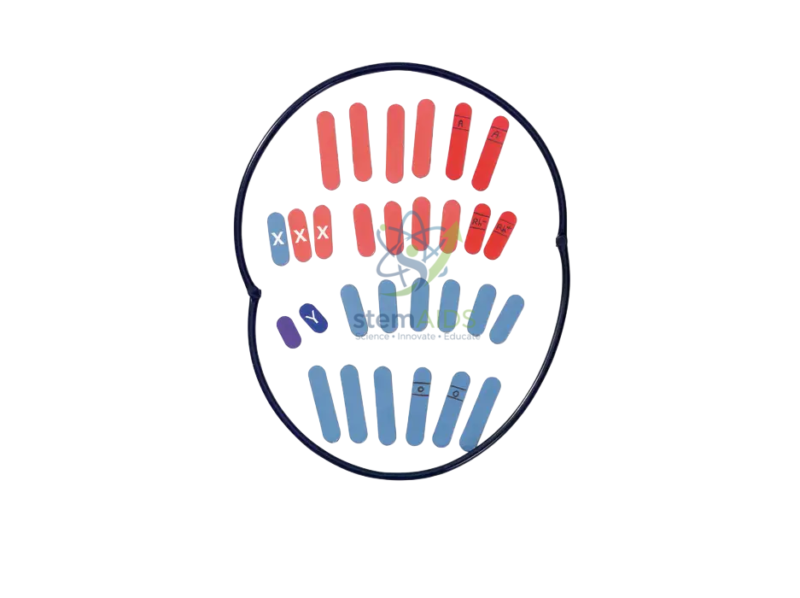
Inheritance is usually taught on paper, with letters in a Punnett square, and many students never connect the letters to anything physical. This set works the other way round. The product photo shows a cell outline containing red and blue bar-shaped chromosomes of different lengths, some of them marked, which is how student genetics sets usually represent the chromosomes from each parent. Students hold the chromosomes, pass one from each pair into a gamete and combine gametes to make offspring.
Done this way, Mendel’s laws become visible. Segregation is simply the two members of a pair going to different gametes; independent assortment is the fact that it does not matter which way each pair lines up. When students mark alleles on the chromosomes, say a dominant and a recessive allele for one trait, a monohybrid cross gives roughly a 3:1 ratio of phenotypes over many repeats, and the Punnett square becomes a record of what they have just done.
Student in the title suggests a version for learners to use at their desks rather than a large demonstration set, although the listing gives no piece count, size or number of students served. For the stages of cell division in more detail, see the chromatid chromosomes set; a genetics and evolution chart gives a wall reference.
Activities
- Making gametes from a diploid cell and counting the chromosome number
- Monohybrid and dihybrid crosses, checked against Punnett square predictions
- Sex determination and X-linked inheritance, such as red-green colour blindness
- Showing why siblings with the same parents are genetically different
Care & Handling
- Keep each student set in its own labelled bag or box so pieces from different sets do not mix.
- Wipe the pieces with a damp cloth and let them dry before storing.
- Check the piece count at the end of each lesson, because a missing chromosome spoils the next group’s activity.
Specifications
| Type | Student model set for inheritance and meiosis |
| Shown in the product photo | Cell outline with red and blue bar-shaped chromosomes of different lengths |
| Concepts | Gametes, segregation, independent assortment, fertilisation, alleles |
| Use | Hands-on work by individual students or small groups |
| Piece count and number of students served | Confirm at enquiry |
Why Choose LabEquip
Teachers buy student sets so every group can run its own crosses and compare results, which makes probability real in a way a single demonstration cannot. The set is part of LabEquip’s biology lab products; ask about class quantities through the contact page.
Frequently Asked Questions
What does segregation mean in genetics?
It is Mendel’s first law: the two alleles of a gene separate when gametes form, so each gamete carries only one of them. In the model, it is the two chromosomes of a pair going into different gametes.
Why does a monohybrid cross give a 3:1 ratio?
When two heterozygous parents, Aa and Aa, are crossed, the offspring are AA, Aa, Aa and aa in a 1:2:1 ratio. Because A is dominant, three of those four combinations show the dominant trait.
Why do real results differ from the predicted ratio?
Each fertilisation is a chance event, so small numbers of offspring rarely match the ratio exactly. Pooling results from the whole class brings the totals closer to the prediction, which is a useful lesson in probability.
How is sex determined in humans?
Females have two X chromosomes and produce eggs that each carry an X. Males have one X and one Y and produce sperm carrying either X or Y, so the sperm decides the sex of the child, with roughly equal chances.
What is X-linked inheritance?
Genes on the X chromosome show a different pattern because males have only one X. A recessive allele there, such as for red-green colour blindness, shows up in males with a single copy, so these conditions are more common in males.
How does this set differ from a DNA model?
A DNA model shows the structure of the molecule. This set works at the level of whole chromosomes, showing how they are shared out into gametes and combined at fertilisation to produce inheritance patterns.
Last Updated: September 2026
You must be logged in to post a review.
Bestsellers




Reviews
There are no reviews yet.