
Quick Answer: Embedding blocks are small, cube-shaped blocks to which a trimmed paraffin wax block containing a tissue specimen is attached, so it can be clamped in a microtome for cutting sections. They are used in histology and botany section-cutting practicals.
Where Embedding Blocks Fit in Histology
Before a soft tissue can be cut into slices a few micrometres thick, it has to be made firm. In the paraffin method, the fixed tissue is dehydrated through graded alcohols, cleared in a solvent such as xylene, soaked in molten paraffin wax and then set in a mould so that it ends up inside a solid wax block. That wax block is too small and too smooth to clamp directly in most microtomes, so it is fixed onto a holder first.
Traditionally the holder is a small hardwood or fibre block. The face of the embedding block and the base of the wax block are warmed with a heated spatula, pressed together and cooled, which welds them firmly. The block is then clamped in the microtome’s chuck, the wax face trimmed square, and sections cut and floated on warm water before being picked up on slides. In many modern labs, plastic embedding cassettes do the same job, forming part of the block during embedding.
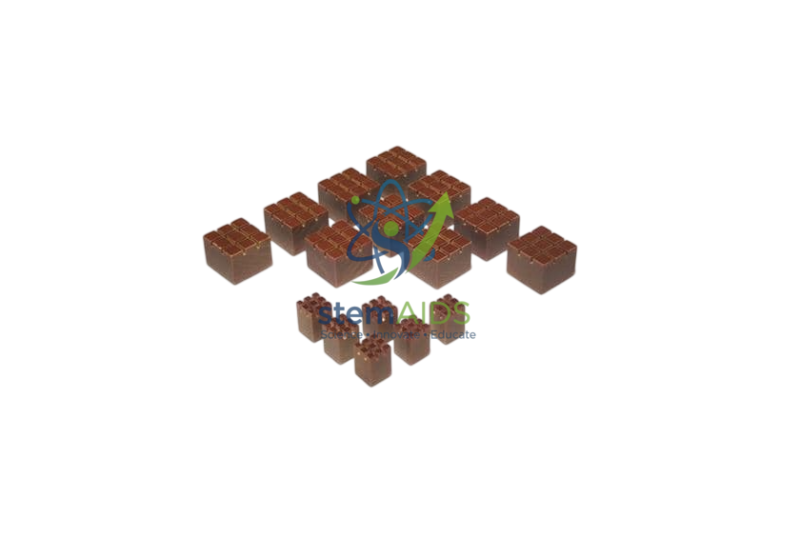
The product photo shows small brown cube-shaped blocks with a ridged top face, which gives the molten wax something to grip.
Uses in Section Cutting
- Mounting paraffin blocks of animal tissues for cutting on a rotary microtome
- Preparing plant stem and root blocks for sectioning in botany practicals
- Teaching the full histology workflow from fixation to stained slide
- Keeping archived wax blocks attached to their holders, labelled for later sectioning
Specifications
| Item | Blocks for mounting paraffin-embedded specimens |
| Appearance (from product photo) | Small brown cubes with a ridged upper face |
| Purpose | Holding the wax block firmly in the microtome clamp |
| Used with | Paraffin wax, heated spatula, rotary or sliding microtome |
Handling and Reuse
- Label each embedding block with the specimen code before attaching the wax, since blocks look identical once mounted.
- Scrape off old wax and wipe the block clean before reusing it for a new specimen.
- Store mounted blocks in a cool place so the wax does not soften and loosen from the holder.
- Keep the ridged face free of dust and grease, which weaken the wax bond.
Why Choose LabEquip
Histology and botany departments that cut their own sections need a steady supply of these holders for each new specimen. LabEquip lists them with its biology lab products; send the microtome model you use through the contact page so the block size can be checked against its clamp.
Related Products
- Rotary Microtome: A rotary microtome that cuts serial sections from paraffin blocks held in its clamp.
- Automatic Tissue Processor with Thermostat: Takes fixed tissue through alcohols, clearing agent and molten paraffin, the stages before blocks are mounted.
- Freezing Microtome: Cuts frozen tissue with no paraffin, an alternative when wax embedding is not wanted.
- Microscope Slides, Glass, Plain: Plain glass microscope slides for picking up the sections cut from the mounted block.
Frequently Asked Questions
What are embedding blocks used for in histology?
Embedding blocks hold a trimmed paraffin wax block containing tissue firmly in the microtome clamp. The wax block is too small and smooth to clamp on its own, so it is fixed to the embedding block first. The product photo shows small brown cubes with a ridged upper face.
How is a paraffin wax block attached to an embedding block?
Warm the face of the embedding block and the base of the wax block with a heated spatula, press them together and run a little molten wax around the join. Let it cool fully before clamping; a block that is still warm can come loose during cutting.
Why should a paraffin block be trimmed before sectioning?
Trim the face so the top and bottom edges are parallel, leaving a narrow margin of wax around the tissue. Parallel edges let each section stick to the next and form a straight ribbon on a rotary microtome; uneven edges make the ribbon curve or break.
What is the difference between embedding blocks and embedding cassettes?
Embedding blocks are solid holders onto which a finished wax block is fixed. Cassettes are perforated plastic boxes that hold the tissue through processing and then form the base of the wax block itself, so they clamp directly in microtomes made to take them.
Can histology embedding blocks be reused?
Yes. When sectioning is finished, the old wax can be warmed off and the face scraped clean for the next specimen. Blocks that must be kept for re-cutting are left attached, with the specimen details written on the side of the embedding block.
What is paraffin embedding and why is it needed?
Soft tissue cannot be cut into very thin slices on its own. Fixed tissue is dehydrated in graded alcohols, cleared in a solvent such as xylene, soaked in molten paraffin and set in a mould, so the wax fills and supports it and it can be cut on a microtome.
Last Updated: November 2026




Reviews
There are no reviews yet.