







In Stock
Cro Magnon Skull Eco
Crâne de Cro-Magnon éco Replicates diagnostic Early Modern Human (EMH) features, including a prominent chin, high forehead, and reduced supraorbital ridges, ensuring accurate craniometric data for comparative evolutionary studies.
Sustainable Polymer Matrix Fabricated from high-density, eco-conscious resin that preserves fine-grain bone textures and suture patterns while offering enhanced structural durability for high-frequency classroom handling.
₹12,560.00
Quick Answer: The Cro Magnon Skull Eco is an economy version of a Cro-Magnon skull cast, representing the early modern humans (Homo sapiens) who lived in Europe during the Upper Palaeolithic. It is used in biology and anthropology lessons on human evolution, especially to compare early modern humans with Neanderthals and apes.
Who the Cro-Magnon People Were
Cro-Magnon is the name given to early modern humans in Europe, after the Cro-Magnon rock shelter at Les Eyzies in the Dordogne, France, where skeletons were found in 1868. They were Homo sapiens, anatomically like people today, and are associated with Upper Palaeolithic tools, ornaments and, in the same region, cave art. A Cro-Magnon skull therefore shows the modern human pattern in an ancient individual, which makes it a reference point when older human fossils are compared.
The features to point out are the high, rounded braincase, a near-vertical forehead, small brow ridges, a relatively flat face tucked under the braincase and a projecting chin. A Neanderthal skull, by contrast, is long and low, with a heavy double-arched brow ridge, a forward-projecting midface, a bulge at the back called the occipital bun and no true chin. Setting the skull beside an adult chimpanzee skull widens the comparison to a living ape, whose braincase is small and whose jaws and canines are large.
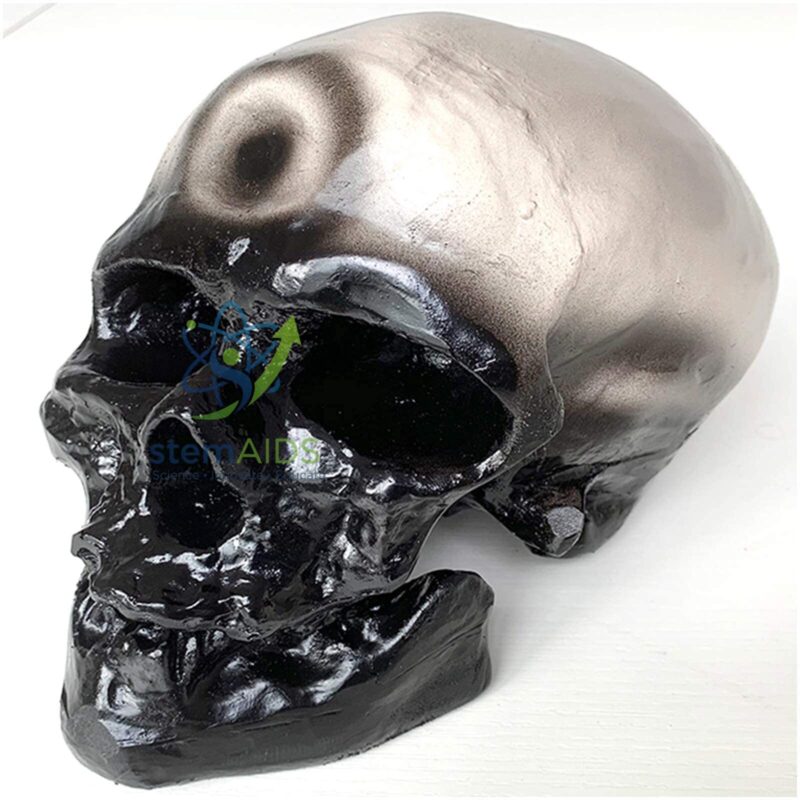
“Eco” marks this as the economy version of the skull. The product photo shows a cast with a dark, metallic-looking finish. The listing does not state the material, the size or whether a lower jaw is included, so confirm these if a lesson depends on the teeth or jaw.
Human Evolution Lessons
- Comparing early modern human, Neanderthal and chimpanzee skull features
- Discussing how skull shape is used to classify fossil hominins
- Anthropology and archaeology introductions to the Upper Palaeolithic
- Museum-style displays for school science weeks and open days
Specifications
| Model of | Skull of an early modern human (Cro-Magnon, Homo sapiens) |
| Version | Eco (economy) |
| Finish in the product photo | Dark, metallic-looking cast |
| Comparative features | Rounded braincase, vertical forehead, small brow ridges, chin |
| Material, size and lower jaw | Confirm at enquiry |
Care & Handling
- Hold the cast with both hands around the braincase rather than by the eye sockets or cheekbones.
- Dust with a soft brush; water and cleaning sprays can dull or strip a painted metallic finish.
- Store it on a padded shelf or in a box where it cannot roll off.
Why Choose LabEquip
Biology and anthropology teachers buy this economy Cro-Magnon cast when they want a modern human fossil reference for a class or display without the cost of a museum-grade cast. LabEquip lists it with its biology lab products; ask about material and size via the contact page.
Frequently Asked Questions
Were Cro-Magnon people a different species from us?
No. Cro-Magnon people were Homo sapiens, the same species as people alive today. The name refers to early modern humans in Europe, after the French rock shelter where their remains were first described.
How can a Cro-Magnon skull be told apart from a Neanderthal skull?
Early modern humans such as Cro-Magnon had a high, rounded braincase, a steep forehead, small brow ridges and a chin. A Neanderthal skull is longer and lower, with a heavy brow ridge, a projecting midface, a bulge at the back and no true chin.
Where was the Cro-Magnon skeleton found?
In the Cro-Magnon rock shelter at Les Eyzies in the Dordogne region of south-west France, uncovered by workers in 1868. Several skeletons were found there, and the name has since been used for early modern Europeans generally.
What does Eco mean in the product name?
It indicates the economy version of the skull, a lower-cost cast intended for classroom use. Details such as the material and whether the lower jaw is included should be confirmed at enquiry.
Is this a real fossil?
No. It is a reproduction for teaching. Real Cro-Magnon remains are held by museums and research institutions, and reproductions let students handle and compare the skull shape safely.
Which other skulls work well alongside it?
A modern human skull shows how little the basic shape has changed, and a chimpanzee skull shows the differences between humans and a living ape. Together they give a clear three-way comparison for evolution lessons.
Last Updated: September 2026
You must be logged in to post a review.
Bestsellers




Reviews
There are no reviews yet.