
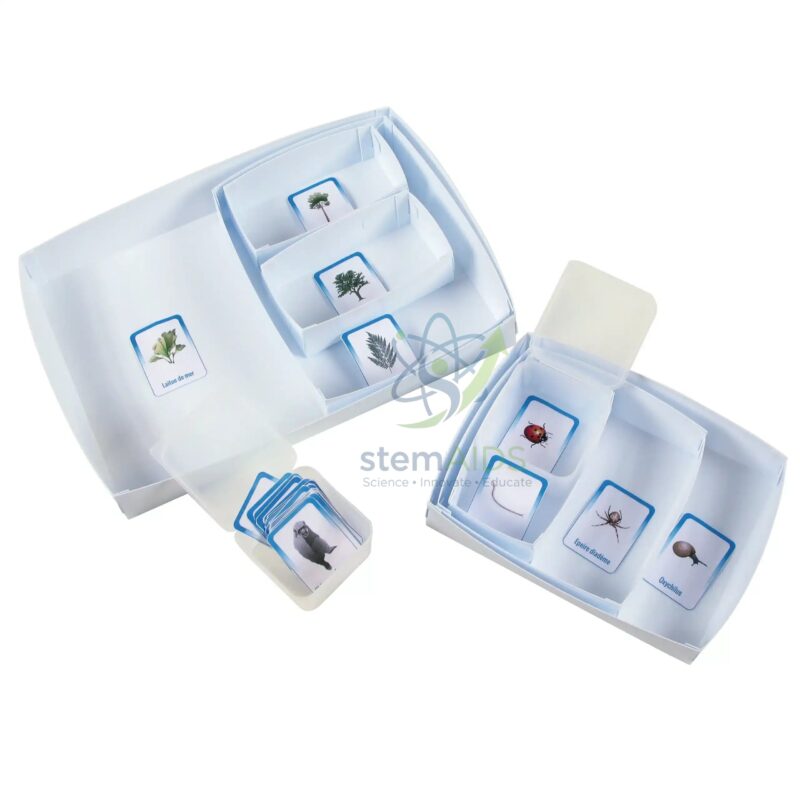
Quick Answer: Classification of Living Organisms is a classroom resource for sorting organisms into groups according to the features they share. The product photo shows compartment trays and picture cards of animals and plants, used to build groups within groups in the way biologists classify life.
Sorting Life into Groups Within Groups
Classification begins with a question students can answer by looking: what features does this organism have? A backbone, four limbs, hair, feathers, a shell, leaves, flowers? Organisms that share a feature go into the same group, and groups that share a broader feature go into a larger group around them. The result is a set of nested boxes, which is how the compartment trays in the product photo appear to be used, with cards placed in smaller compartments inside larger ones.
This nested approach reflects modern classification. Groups are defined by features their members have in common, inherited from a shared ancestor, rather than by what they lack. That is why invertebrates is a handy everyday word but not a true group: it collects animals only by the absence of a backbone. Students discover this for themselves when they look for a feature that every invertebrate card shares and cannot find one.
A classification wall chart gives a printed summary of the same groups for display.
Specifications
| Topic | Classification of living organisms by shared features |
| Format shown in the product photo | Compartment trays with picture cards of organisms |
| Method | Nested grouping: smaller groups placed inside larger ones |
| Level | Primary to lower-secondary life science |
Classroom Activities
- Sorting organisms into vertebrates, arthropods, flowering plants and other groups by visible features
- Building a nested classification and comparing it with the class’s first guesses
- Introducing the ranks from kingdom down to genus and species
- Writing simple dichotomous keys from the groups the class has made
Care & Handling
- Return cards to their trays by group at the end of each lesson, and keep a list so missing cards are spotted.
- Wipe the trays with a damp cloth; keep the cards dry and flat so they do not curl.
- Store the resource away from direct sunlight, which fades printed images over time.
Why Choose LabEquip
Primary and middle-school teachers use a hands-on sorting resource so pupils build the classification themselves instead of copying it from a chart. It is part of LabEquip’s biology lab products; ask about the organisms included through the contact page.
Related Products
- Poster Classification of Living Beings: A wall poster of the major groups of life, from bacteria to fungi, plants and animals, arranged by shared characteristics.
- Classification of living Beings, Animals or Plants: A poster classifying one kingdom, animals or plants, in more detail by the features its groups share.
- Botany Specimens: Preserved plant specimens for recognising plant groups by the external features used in classification.
- Large Diameter Magnifying Glass: A wide-lens magnifier for examining insects, leaves and seeds closely before sorting them into groups.
Frequently Asked Questions
How is the classification of living organisms resource used in class?
Students sort picture cards of animals and plants into the compartment trays by features they can see, such as a backbone, feathers, a shell, leaves or flowers. Smaller groups go inside larger ones, so the finished trays show classification as groups within groups, as in the product photo.
Why do biologists classify living organisms?
Classification organises the huge variety of life so that organisms can be named, identified and studied. Grouping by shared features also reflects how organisms are related, and lets scientists predict the features of a newly found species from the group it belongs to.
What are the main ranks of classification from kingdom to species?
The traditional ranks are kingdom, phylum, class, order, family, genus and species, with domain above kingdom in modern schemes. Each rank sits inside the one above it, and a species is named with two words, its genus and species, as in Homo sapiens.
Why are ‘invertebrates’ not a true classification group?
Invertebrates are defined by something they lack, a backbone, rather than by a feature they share. The group includes animals as different as sponges, insects, worms and octopuses, and some of them, such as starfish, are more closely related to vertebrates than to insects. Groups based on shared features, such as arthropods or molluscs, are used instead.
How does sorting organisms into groups lead on to identification keys?
An identification key turns classification into a series of yes-or-no questions about visible features, such as legs or no legs, leading step by step to a group or a name. Sorting cards into nested groups first builds the habit of looking for exactly those features.
Can the classification cards be used alongside real specimens?
Yes. Pressed plants, shells, preserved specimens or invertebrates found in the school grounds can be placed beside the cards and sorted by the same features. Handling real organisms shows the variation within a group that a single picture card cannot.
Last Updated: November 2026




Reviews
There are no reviews yet.