
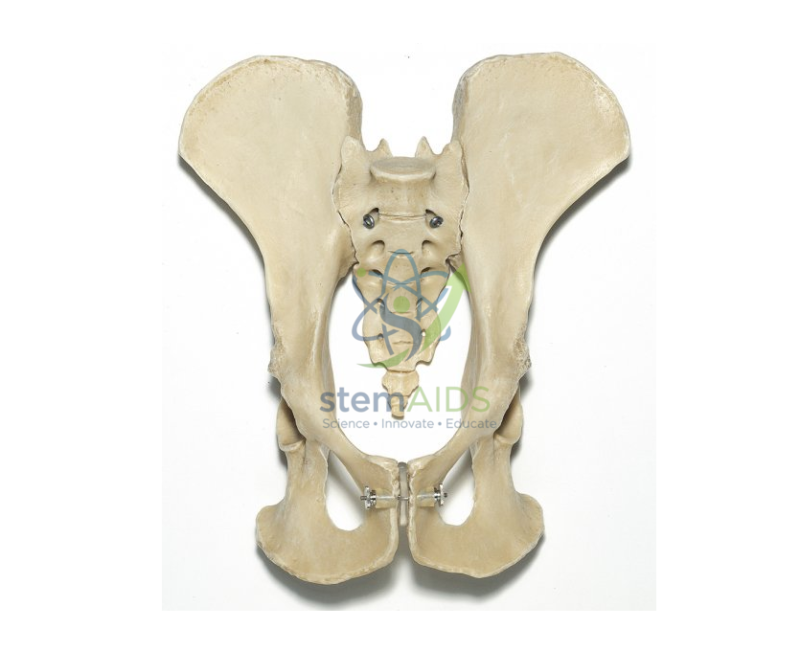
Quick Answer: The Chimpanzee Pelvis Skeleton is a chimpanzee pelvis, the two hip bones and the sacrum joined as in life, used in biology and anthropology to compare an ape’s pelvis with a human one. The contrast in shape is one of the clearest skeletal signs of the change to walking upright.
What the Chimpanzee Pelvis Reveals About Walking
The product photo shows the pelvis from the front: two tall, flat iliac blades rising high on either side of a narrow sacrum, with the hip bones joined at the front by a wire at the pubic symphysis. In a chimpanzee the iliac blades are long and face mostly backward, the ischium below the hip socket is long, and the whole pelvis looks tall and narrow from the front.
A human pelvis is short, broad and bowl-shaped. Its iliac blades are short and curve around to the sides, which places the gluteus medius and minimus at the side of the hip, where they act as abductors: each time a person stands on one leg while walking, these muscles stop the pelvis dropping on the other side. A chimpanzee lacks this arrangement, so when it walks upright it rolls its body from side to side. Its long ischium instead gives the hamstrings good leverage for climbing and for powerful extension of the hip on all fours.
The pelvis is also part of the story of human birth. In humans the birth canal is only a little larger than the baby’s head, which has to turn as it passes through, while in chimpanzees the canal is roomy compared with the newborn’s head. For the skull of the same species see the adult chimpanzee skull, and for a human comparison the Female Pelvic Skeleton.
Evolution and Anatomy Lessons
- Comparing ape and human pelvis shape in evolution lessons
- Explaining how the gluteal muscles steady the human pelvis during walking
- Discussing fossil pelvises of early hominins and what they reveal about bipedalism
- Linking pelvis shape to childbirth in humans and apes
Specifications
| Specimen | Chimpanzee pelvis: two hip bones and sacrum |
| View in the product photo | Front view, hip bones joined by wire at the pubic symphysis |
| Features to compare | Tall, narrow iliac blades, long ischium, narrow sacrum |
| Subjects | Comparative anatomy, human evolution, primatology |
Care & Handling
- Lift the chimpanzee pelvis with both hands under the sacrum and hip bones rather than by one iliac blade, which acts as a lever on the joints.
- Check the wire at the pubic symphysis from time to time and avoid twisting the two halves against each other.
- Dust with a soft brush and store it on a padded shelf.
Why Choose LabEquip
Anthropology and biology departments pair an ape pelvis with a human one because the difference in shape explains upright walking better than a diagram does. LabEquip lists it among biology lab products; for material and size, send a question through the contact page.
Related Products
- Adult Chimpanzee Skull: A chimpanzee skull for comparing the brow ridge, jaw and foramen magnum position with a human skull.
- Human Pelvis, Female: An adult human female pelvis for side-by-side comparison of pelvic shape and the inlet and outlet of the birth canal.
- Human Adult Female Pelvis Structural Model: Shows the bony human pelvis and its joints, including the wide inlet and broad subpubic angle of the female form.
- Cro Magnon Skull Eco: An early modern human (Cro-Magnon) skull cast for lessons comparing Homo sapiens with apes in human evolution.
Frequently Asked Questions
How does a chimpanzee pelvis differ from a human pelvis?
A chimpanzee pelvis is tall and narrow, with long, flat iliac blades facing mostly backward, a long ischium and a narrow sacrum. A human pelvis is short, broad and bowl-shaped, with short iliac blades that curve round to the sides. Seen from the front, as this specimen is shown, the contrast is immediate.
How does the shape of the pelvis show that humans walk upright?
In humans the short, curved iliac blades place the gluteus medius and minimus at the side of the hip, where they stop the pelvis dropping when one foot is off the ground. In a chimpanzee these muscles lie behind the hip and work mainly as extensors, so it cannot balance this way and walks upright with a side-to-side lurch.
What does the long ischium do for a chimpanzee?
The long ischium gives the hamstring muscles a long lever, which makes them powerful for extending the hip when climbing and walking on all fours. Humans have a shorter ischium, suited to the long, efficient strides of upright walking.
How is a chimpanzee pelvis used to study human evolution?
Students compare it with a human pelvis and with casts or images of fossil hominins such as australopithecines, whose broad, flared pelvis already looks more human than ape-like. Placing the three side by side shows how the pelvis changed as our ancestors became habitual upright walkers.
Why is childbirth harder for humans than for chimpanzees?
The human birth canal is shaped by the demands of upright walking yet must pass a baby with a large head, so the fit is tight and the baby has to rotate on its way through. In chimpanzees the birth canal is roomy compared with the newborn’s head, and birth is usually quicker.
How should a chimpanzee pelvis specimen be handled in class?
Lift it with both hands under the hip bones rather than by one iliac blade, because the hip bones are joined at the front by a wire at the pubic symphysis and can twist. Keep it on a padded surface during comparisons and store it away from heat and direct sunlight.
Last Updated: November 2026







Reviews
There are no reviews yet.