
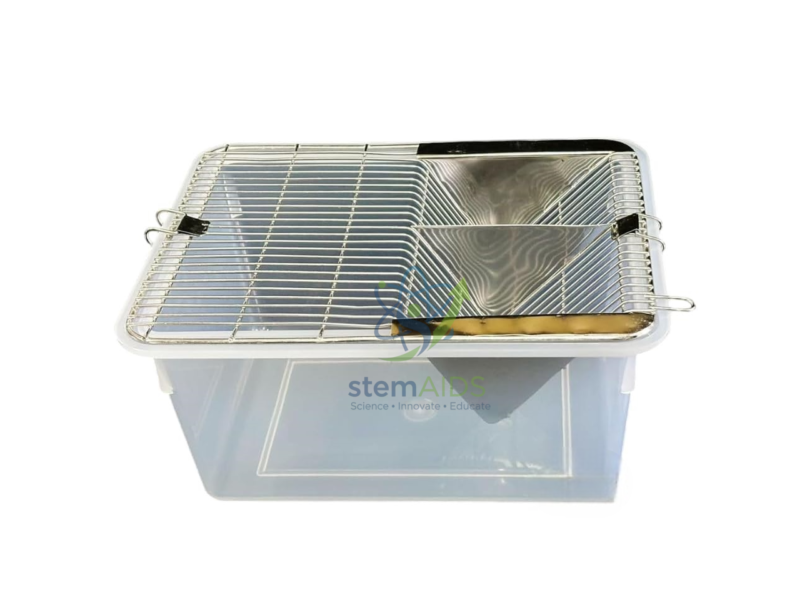
Quick Answer: A twin grill animal cage is a tub-style cage for laboratory rodents whose lid is made of two grill sections rather than one. It houses rats or mice on bedding in an animal house, with the grill carrying feed and a water bottle above the animals.
What the Twin Grill Adds
In cages of this style the lid usually has two parts: a hopper section where pellets rest in a V-shaped trough, and a flat section that supports the water bottle, sometimes allowing one part to be opened without lifting the other. Keeping them apart stops pellets falling into the water area and lets staff top up food or change the bottle with less disturbance to the animals.
Compared with the single-grill animal cage, the twin grill suits routines where food and water are handled separately, for example studies that record food intake or give a treatment in drinking water under an approved protocol. Animal houses often standardise on one design so lids and bottles are interchangeable across racks.
The same husbandry rules apply as for any rodent cage: enough floor space for the number and size of animals, clean bedding, fresh water every day, secure lids and a cleaning schedule set by the facility. Work with the animals must be approved by the institution’s animal ethics committee.
Daily and Weekly Care
- Keep the hopper filled so pellets never spill onto the water side.
- Swap water bottles for clean, filled ones rather than topping up old water.
- Clean both grill sections along with the tub at each cage change.
- Make sure both lid sections close securely after every handling.
Specifications
| Type | Rodent cage with two-section (twin) grill lid |
| Lid | Grill sections for feed and water bottle (typical layout) |
| Base | Plastic tub for bedding |
| Species | Laboratory rats or mice, depending on size |
Applications
- Housing rats and mice in pharmacy and medical college animal houses
- Studies in which food or water intake is recorded
- Holding animals that receive a treatment in drinking water under an approved protocol
- Breeding pairs or small groups that need frequent feeding checks
Why Choose LabEquip
Animal house managers at pharmacy colleges and research institutes choose twin grill cages when feeding and watering routines must be quick and tidy. LabEquip lists the cage in the Biology Lab Products range; share species and colony size through the contact page.
Related Products
- Animal Cage: The single-grill animal cage in the same range, a tub cage with one grill lid for feed and water.
- Water Bottle, Plastic: A plastic drinking water bottle that hangs upside down on a cage lid, for the water section of the grill.
- Gloves: Protective gloves for handling animals, bedding and cage parts during daily care.
Frequently Asked Questions
What is a twin grill animal cage?
A twin grill cage is a tub-style rodent cage whose lid is made of two grill sections instead of one. In the typical layout one section holds feed pellets and the other supports the water bottle, while the plastic tub below holds bedding. It houses laboratory rats or mice, depending on its size.
Why are feed and water kept in separate sections of a cage lid?
Separating them stops pellets from falling into the water area and lets staff top up food or change a bottle with less disturbance to the animals. It also suits studies that measure food intake, or that give a treatment in drinking water under an approved protocol, because each can be handled on its own.
Can the same twin grill cage house mice as well as rats?
Only if the grill suits the smaller animal. Mice can squeeze through gaps that keep rats in securely, and they need less floor space, so the bar spacing and the tub size decide which species a cage is right for. Animal houses usually keep rat and mouse cages as separate types.
How should water bottles on a rodent cage be looked after?
Check every bottle daily for level and for a blocked or dripping sipper tube. Replace bottles with clean, freshly filled ones rather than topping up old water, and wash the used bottles and sipper tubes before refilling. A dripping bottle soaks the bedding, which chills the animals and spoils the cage.
How is food intake measured in a laboratory rodent cage?
Weigh the pellets placed in the hopper, then weigh what remains after a set period, such as 24 hours. Pellets crumbled into the bedding must be collected and allowed for, or intake will be overestimated. Keeping the food in its own grill section, as in a twin grill cage, makes this easier.
Why is environmental enrichment added to rodent cages?
Nesting material, shelters and items to gnaw let rats and mice build nests, hide and behave naturally. Enrichment reduces stress and abnormal behaviour, which improves welfare and makes experimental results more consistent. Most welfare guidelines now expect some form of enrichment in every cage.
Last Updated: November 2026







Reviews
There are no reviews yet.