Quick Answer: The Solar Energy Car Model is a STEM teaching aid that uses a small photovoltaic panel to drive a motor-powered toy-scale car, giving students a moving, visual example of solar electricity being converted into mechanical motion. It is designed for school and college science labs and is part of the LabEquip Solar Energy Kits range.
Product Description
This Solar Energy Car Model from LabEquip demonstrates the chain from sunlight to motion in a single, engaging model. A photovoltaic panel mounted on the car body generates electrical current when exposed to light, and that current drives a small motor connected to the wheels, moving the car forward without any external battery or plug-in power source.
In a typical classroom session, students place the car under a light source or in sunlight and observe how quickly and consistently it moves, then experiment with shading part of the panel or changing the angle of light to see the effect on speed. This gives a memorable, competitive-friendly way to introduce solar energy conversion alongside basic ideas of friction, load and motor efficiency.
The model is intended as a demonstration and activity tool for physics and STEM lessons on renewable energy. Exact panel wattage, motor rating and car dimensions are best confirmed directly with LabEquip if your lesson plan depends on precise values.
What This Kit Helps Students Learn
- Explain how a photovoltaic panel converts light directly into electrical energy.
- Describe how electrical energy from the panel is converted into motion by a motor.
- Relate light intensity and panel angle to vehicle speed and performance.
- Discuss the advantages and limitations of solar-powered transport.
- Design a simple, fair test to compare solar-car performance under different lighting.
Specifications
| Attribute | Detail |
|---|---|
| Product Name | Solar Energy Car Model |
| Brand | LabEquip |
| Product Type | Solar-powered motorised car demonstration model |
| Core Concept | Photovoltaic energy conversion and motor-driven vehicle motion |
| Recommended For | School and college physics/STEM labs, renewable-energy teaching sessions |
| Panel & Motor Specification | Contact us for detailed specifications |
Safety Note
This model uses low-voltage solar-powered components intended for supervised classroom use. Run the car on a clear, flat surface away from table edges, keep fingers clear of moving wheels and gears, and avoid short-circuiting the panel leads.
Care & Maintenance
- Wipe the solar panel surface with a soft, dry cloth to keep it free of dust for consistent output.
- Check wheels, axles and the motor mounting periodically for wear before classroom use.
- Store the model indoors, away from direct moisture and extreme heat.
- Avoid dropping the model, as this can dislodge or crack the panel or body.
Why Choose LabEquip
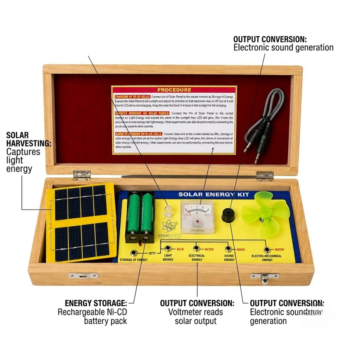
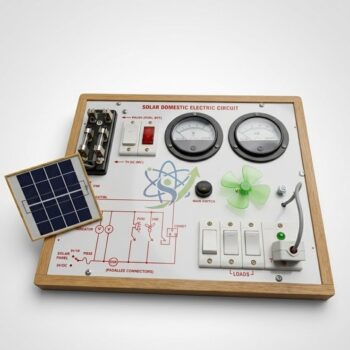
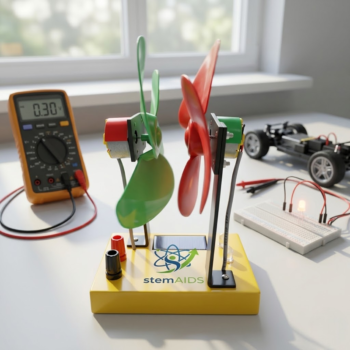
LabEquip supplies a full range of Solar Energy Kits for schools, colleges and technical training institutes, including the Solar Electricity Fan Model and the Solar and Wind Energy Dynamo Model. Browse our full Solar Energy Kits category for more renewable-energy demonstration models for classroom and laboratory use.
Frequently Asked Questions
What does the Solar Energy Car Model demonstrate?
It shows how a photovoltaic panel converts light directly into electrical energy that drives a motor, moving the car without any plug-in power source.
Why does the car move faster in some conditions than others?
Car speed generally depends on how much light reaches the panel; direct light usually gives a stronger output than shaded or angled light.
Is this suitable for a classroom competition or race?
Yes, many teachers use solar car models for simple, friendly races or timed trials as part of a renewable-energy lesson.
Does the car need batteries as well as the solar panel?
The model is designed as a light-driven demonstration; confirm with LabEquip whether any backup battery is included if this matters for your lesson.
Can this be used alongside other solar teaching aids?
Yes, it works well alongside other kits in our Solar Energy Kits range, such as the Solar Electricity Fan Model, for a broader renewable-energy unit.
Last updated: September 2026