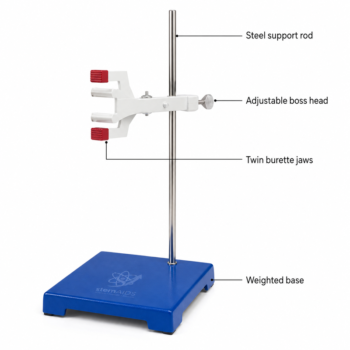
Quick Answer: The Adjustable Four Finger Clamp is a laboratory clamp that grips flasks, condensers and other apparatus at four adjustable contact points and attaches to a stand rod, usually through a boss head, to hold equipment at the height an experiment needs.
Why Four Fingers
A two-jaw clamp pinches from two sides, and a three prong clamp centres round vessels on three points. The four finger clamp adds one more contact point, and because the fingers adjust, it can close around vessels of different shapes and sizes, spreading its hold more evenly than a simple two-jaw grip.
That makes it a good choice for apparatus that is not perfectly round or that would tilt in a narrower grip: the neck of a flask on a distillation set-up, a condenser held at an angle, or a wide vessel supported from the side.
In use, the clamp is fixed to the rod of a retort stand with a boss head, set to the right height, and closed only until the apparatus no longer slips. Glass expands when heated, so a clamp that is just firm is safer than one that is fully tightened.
Specifications
| Type | Four-finger gripping clamp |
| Adjustment | Adjustable fingers for different vessel shapes and sizes |
| Mounting | Stand rod, typically through a boss head |
| Holds | Flasks, condensers and similar apparatus |
| Pairs with | Retort stand and boss head |
Applications
- Holding round-bottomed or conical flasks during heating and distillation
- Supporting a Liebig condenser at an angle in simple distillation
- Fixing apparatus at a set height in physics experiments
- Holding odd-shaped glassware that slips in a two-jaw clamp
Care & Handling
- Close the four fingers gently; over-tightening can crack glass, especially once it warms up.
- Wipe away spilled reagent promptly, particularly acids, to protect the adjusting screw.
- Dry the clamp after washing and store it away from acid fumes.
Why Choose LabEquip
Chemistry teachers equipping distillation benches usually order the Adjustable Four Finger Clamp with a Scientific Boss Head Clamp for each stand, and some add the Precision Three Prong Clamp for round flask necks. Send bench quantities through the contact page; both clamps and the boss head are in Metalware.
Frequently Asked Questions
How is a four finger clamp different from a three prong clamp?
The extra finger gives a fourth contact point, which spreads the grip around vessels that are not perfectly round or that sit at an angle. A three prong clamp centres neatly on round necks and condensers but can let wider or irregular items tilt.
How do I attach the clamp to a retort stand?
Fix a boss head on the stand rod at the height you need, slide the clamp’s arm into the boss head’s second opening and tighten both screws. Check that the clamp sits square to the rod before loading it.
Where should I clamp a flask?
Grip a round-bottomed or conical flask by its neck, not its body. The neck is stronger, stays cooler during heating and leaves the base free to sit in a heating mantle or above a burner.
How tight should the clamp be?
Just enough that the apparatus does not move when gently pushed. Glass expands when heated, and a clamp tightened hard on cold glass can crack it as the temperature rises.
Should the fingers be padded?
If the fingers are bare metal, slip short pieces of rubber tubing over them before holding glassware. Padding protects the glass and improves grip on smooth surfaces.
How do I keep the clamp working smoothly?
Wipe off spilled chemicals straight away, dry it after washing, and store it away from acid fumes. A drop of light machine oil on the adjusting screw keeps it turning freely.
Last Updated: October 2026