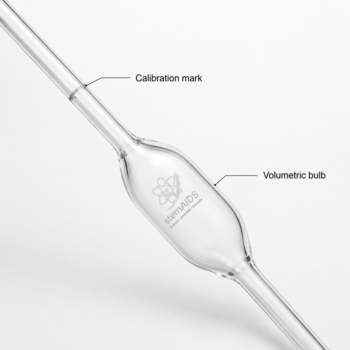
The Wilmott’s Bubbler Apparatus is a plant physiology apparatus used for demonstrating and studying the rate of photosynthesis through oxygen bubble evolution from an aquatic plant. It is intended for schools, colleges, botany laboratories and biology teaching laboratories conducting supervised photosynthesis practicals.
Product Description
The STEMAids Wilmott’s Bubbler Apparatus supports practical investigation of photosynthesis. In a typical experiment, an aquatic plant such as Hydrilla is immersed in water and exposed to light. Oxygen released during photosynthesis appears as bubbles that can be observed and counted over a defined period.
This setup helps students investigate how experimental conditions such as light intensity influence the observed rate of oxygen evolution. The exact flask capacity, glass specification, tube dimensions, stopper material and supplied components have not been verified for this STEMAids model. Explore related biology laboratory products.
Key Features
- Designed for photosynthesis experiments: Supports observation of oxygen bubbles released by an aquatic plant under illumination.
- Demonstrates photosynthetic rate: Bubble counts over a fixed time provide a practical comparative indicator of oxygen evolution.
- Supports light-intensity investigations: Useful for comparing photosynthetic activity under different illumination conditions.
- Hands-on biology learning: Converts an abstract plant physiology process into an observable laboratory experiment.
- Suitable for teaching laboratories: Applicable to supervised school, college and introductory plant physiology practicals.
- Reusable apparatus: Can support repeated demonstrations when properly assembled, cleaned and stored.
- Specification transparency: Capacity, glass grade and exact supplied components should be confirmed before procurement.
Technical Specifications
|
Specification |
Detail |
|
Product Name |
Wilmott’s Bubbler Apparatus |
|
Brand |
STEMAids |
|
Primary Experiment |
Study of photosynthesis through oxygen bubble observation |
|
Typical Biological Material |
Aquatic plant such as Hydrilla |
What’s Included in the Kit
- Wilmott’s bubbler assembly
- Bottle or flask
- Glass tube / bubble jet assembly
- Water reservoir component
- Stopper or cork assembly
- Aquatic plant specimen
Related vessels and laboratory accessories can be sourced through STEMAids Laboratory Glassware & Plasticware.
Applications / Uses
- Demonstrating oxygen evolution during photosynthesis.
- Comparing photosynthetic rate under different light intensities.
- Teaching plant physiology and botany practicals.
- Observing gas-bubble formation from aquatic plants.
- Conducting school and undergraduate biology demonstrations.
- Developing skills in observation, timing and comparative experimental measurement.
How to Use the Wilmott’s Bubbler Apparatus
- Inspect all apparatus components for cracks, damage or contamination.
- Fill the required vessel and bubbler assembly with water according to the practical method.
- Prepare a healthy aquatic plant specimen such as Hydrilla according to the laboratory protocol.
- Position the plant correctly within the bubbler setup and assemble the apparatus securely.
- Place the apparatus under the specified light condition.
- Allow the setup to stabilize before recording observations.
- Count oxygen bubbles over a fixed time interval using the same procedure for each experimental condition.
- Compare bubble counts when studying variables such as light intensity.
Safety note: Handle glass components carefully and keep the apparatus stable during observation. Use only supervised laboratory procedures and remove cracked or chipped glassware from service.
Care & Maintenance
- Rinse the apparatus thoroughly after plant physiology experiments and remove biological residue.
- Keep narrow tubes and the bubble outlet free from blockage.
- Store glass components securely to prevent impact and breakage.
- Inspect corks, stoppers and seals before use to ensure the assembly functions correctly.
Why Choose STEMAids
STEMAids supplies educational science equipment for schools, colleges and institutional laboratories and states that its products are supported by in-house R&D and quality assurance. Its current Biology Lab Products range covers practical teaching equipment, biological models, prepared specimens and supporting laboratory items. STEMAids also supports institutional and bulk procurement for educational projects.
Institutions building complete science laboratories can explore the STEMAids product catalogue and complete laboratory and educational product categories.
Frequently Asked Questions
What is Wilmott’s Bubbler Apparatus used for?
Wilmott’s Bubbler Apparatus is used to demonstrate and compare the rate of photosynthesis by observing oxygen bubbles evolved from an aquatic plant under controlled conditions.
Which plant is used in the Wilmott’s bubbler experiment?
Hydrilla is commonly used in educational Wilmott’s bubbler experiments because it is an aquatic plant that allows oxygen bubbles produced during photosynthesis to be observed.
How is the rate of photosynthesis observed?
The number of oxygen bubbles produced over a fixed time can be counted and compared between experimental conditions. Bubble count is a practical comparative indicator rather than a direct high-precision measurement of oxygen volume.
Can Wilmott’s bubbler be used to study light intensity?
Yes. A standard educational experiment compares bubble production under different light intensities while other relevant conditions are kept as consistent as possible.
What capacity is the STEMAids Wilmott’s Bubbler?
The exact capacity of this STEMAids apparatus has not been verified. Confirm the flask or bottle capacity before ordering.
Is the Hydrilla plant supplied with the apparatus?
This has not been verified. Buyers should confirm whether biological material is supplied or must be obtained separately for the practical.