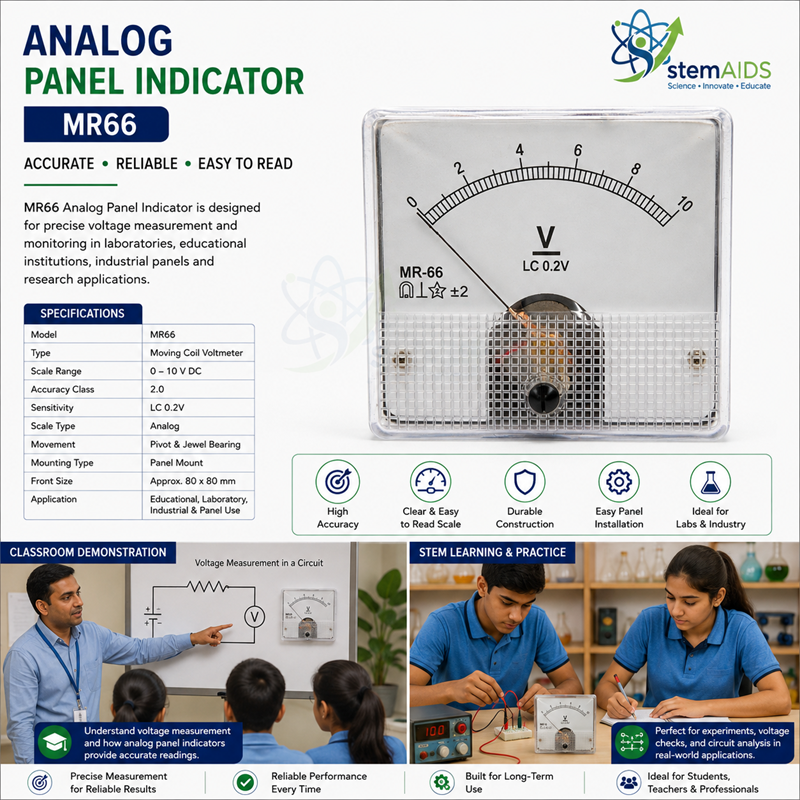
Quick Answer: The Analog Panel Indicator MR66 is an MR66 analog panel indicator: a panel-mounted meter whose pointer indicates one electrical quantity against a calibrated scale, designed to be fitted into trainer boards and demonstration panels rather than used as a loose bench meter.
Fitting and Wiring a Panel Indicator
A panel indicator becomes part of the equipment it sits in, so installation decisions matter more than with a bench meter. The meter is held in a cut-out in the panel, and the opening must match the MR66 case pattern. Analog meters are also calibrated for a particular mounting position, usually upright on a vertical panel or flat on a horizontal one, and many dials carry a small symbol showing which; fitting a meter at a different angle can shift its readings.
Wiring follows the basic rules of measurement. An indicator used as an ammeter goes in series with the load so that the same current flows through it, while a voltmeter goes in parallel across the component. For direct current, polarity matters: the positive terminal must connect towards the positive side of the supply, or the pointer will try to swing below zero and can be damaged. Meters for alternating current use different movements and scales, so the type should match the circuit.
The range should sit comfortably above the largest value expected on the trainer, with normal readings falling in the upper half of the scale, where the pointer’s position can be read most precisely.
Applications
- Fixed current or voltage indication on electronics and electrical trainer boards
- Demonstration panels for Ohm’s law, series and parallel circuits
- Power-supply panels in teaching labs that need a constant visible reading
- Teaching students how panel instruments are wired and mounted
Specifications
| Instrument | Analog panel indicator |
| Model / case | MR66 |
| Indication | Pointer and calibrated scale |
| Installation | Panel cut-out in trainer boards and demonstration equipment |
| Measured quantity and range | Confirm at enquiry |
Care & Handling
- Switch off and discharge the circuit before connecting or removing the indicator.
- Tighten mounting fixings evenly so the case is not stressed.
- Keep the trainer free of dust and moisture, and cover it when not in use.
Why Choose LabEquip
Labs that build or refurbish their own trainer panels order the MR66 alongside other fitted instruments; the MO65 meter, listed as Analog Panel Indication Meter MO65, uses a different case pattern in the same range. Both are listed under Measuring Instruments, and panel requirements can be shared on the LabEquip contact page, including the cut-out size you have.
Frequently Asked Questions
What is the MR66 analog panel indicator designed for?
It is designed to be mounted in a panel, such as a trainer board or demonstration unit, where it gives a continuous pointer reading of one electrical quantity during experiments.
How should a panel ammeter or voltmeter be connected?
An ammeter goes in series with the load so the measured current passes through it. A voltmeter goes in parallel across the component whose voltage is being measured.
Why does polarity matter when wiring a DC panel meter?
A DC meter’s pointer deflects according to the direction of current. Reversed connections drive the pointer backwards against its stop, which gives no reading and can bend the pointer.
Does mounting position affect a panel meter’s reading?
It can. Analog meters are calibrated for a stated position, usually vertical or horizontal, and the dial often carries a symbol showing it. Mounting at a different angle can introduce small errors.
How do I choose the right range for a trainer panel?
Choose a full-scale value a little above the highest reading the circuit will produce, so normal readings fall in the upper part of the scale. The quantity and range of this indicator are confirmed at enquiry.
What does MR66 mean in the product name?
MR66 is the model and case designation of the indicator, not its range. It tells you which case pattern and panel cut-out the meter uses, which is why it differs from the MO65 meter in the same range.
Last Updated: October 2026