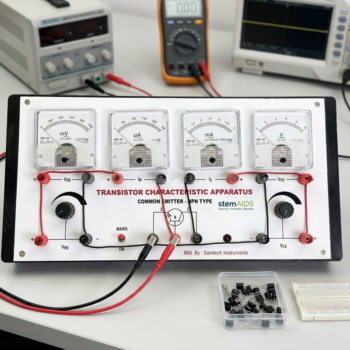
Quick Answer: The Digital Zener Diode Study System is a bench apparatus for measuring the voltage-current characteristic of a Zener diode on digital meters, in forward bias and in reverse breakdown. Students use it to find the Zener voltage and dynamic resistance, and to see how well the diode holds a voltage steady as a simple regulator.
What Makes a Zener Diode Different
An ordinary rectifier diode is meant to block reverse voltage and can be damaged if pushed into breakdown. A Zener diode is heavily doped so that it breaks down sharply at a designed reverse voltage and can work there continuously, provided the current is limited. Forward-biased, it conducts like any silicon diode once the voltage passes about 0.6 to 0.7 V.
Two mechanisms produce the breakdown. In diodes rated below roughly 5 V the true Zener effect dominates: the junction is so thin that electrons tunnel straight through it. Above about 6 to 7 V, avalanche multiplication takes over. The two have opposite temperature coefficients, which is why diodes rated near 5 to 6 V drift least as they warm up.
Reading the Reverse Characteristic
In reverse bias the current stays close to zero until the knee, then rises steeply while the voltage barely changes. A series resistor limits that current, and the supply is raised in small steps around the knee, where readings change fastest. Digital voltage and current displays make it easy to log closely spaced points without misreading a pointer scale.
The slope of the breakdown region gives the dynamic resistance, r = ΔV/ΔI, and a small value marks a good regulator. In the regulation experiment the diode sits across a load with a series resistor from the supply: varying the supply tests line regulation and varying the load tests load regulation. The resistor must keep some current in the diode at full load without exceeding its rating at no load.
Specifications
| Item | Zener diode characteristics apparatus with digital meters |
| Measured quantities | Diode voltage and diode current |
| Bias modes | Forward bias and the reverse breakdown region |
| Results obtained | V-I curve, Zener voltage, dynamic resistance, line and load regulation |
| Diode rating, meter ranges and supply | Confirm at enquiry |
Practicals
- Forward and reverse V-I characteristics of a Zener diode, plotted with separate scales for each quadrant
- Finding the Zener (breakdown) voltage from the knee of the reverse curve
- Calculating dynamic resistance from the slope of the breakdown region
- Line and load regulation tests on a Zener shunt regulator
Care & Handling
- Always keep the current-limiting resistor in circuit; a Zener connected straight across a supply can overheat within seconds
- Raise the supply gradually and keep the diode’s power, Zener voltage times current, within its rating
- Check which terminal is the cathode before wiring: for reverse bias it goes to the positive side
- Switch off before changing connections, and store the unit dry and dust-free
Why Choose LabEquip
Physics and electronics departments use the Zener diode study system to follow the ordinary diode experiment, often on the same bench as the digital PN junction diode characteristics trainer. A Zener diode apparatus (socket type), which takes plug-in diodes, is also available, and both are listed in LabEquip’s electrical and electronics equipment range.
Frequently Asked Questions
What does this system measure?
It measures the voltage across a Zener diode and the current through it while the applied voltage is varied, in forward and reverse bias. From these readings students plot the V-I characteristic and read off the breakdown voltage and dynamic resistance.
Why is a series resistor always needed?
Beyond the knee, a small rise in voltage causes a large rise in current. Without a resistor to limit it, the current would climb until the diode overheated. The resistor takes up the extra supply voltage and sets a safe current.
What is the difference between Zener breakdown and avalanche breakdown?
Zener breakdown happens in heavily doped, very thin junctions, where electrons tunnel through the barrier, and it dominates in diodes below about 5 V. Avalanche breakdown, in which carriers gain enough energy to free further carriers, dominates above about 6 to 7 V. Both give a usable sharp knee.
How is dynamic resistance found from the graph?
Take two points well past the knee on the reverse curve and divide the change in voltage by the change in current. The smaller the result, the better the diode holds its voltage when the current through it changes.
Why are digital meters useful in this experiment?
Near the knee the current changes quickly for tiny voltage steps. Numeric displays let students record small changes without parallax or scale-interpolation errors, giving more points exactly where the curve bends.
How does a Zener diode regulate voltage?
Connected in reverse across the load, with a resistor in series from the supply, the diode draws whatever current is needed to stay near its Zener voltage. If the supply rises or the load current falls, the diode takes more current and the extra voltage drops across the resistor, so the load voltage hardly changes.
Last Updated: October 2026