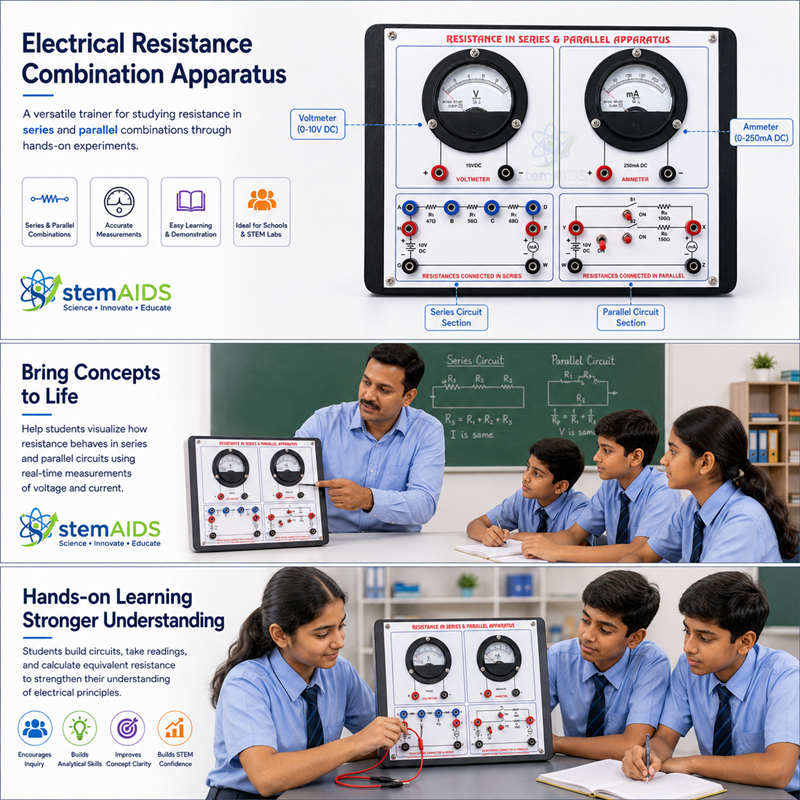
The electrical resistance combination apparatus is a physics laboratory setup used for studying resistors connected in series and parallel. Designed for students, teachers and technical trainees, it supports practical measurement of voltage, current and equivalent resistance while helping learners compare experimental results with calculated circuit values.
Product Description
The STEMAids Electrical Resistance Combination Apparatus provides a structured platform for investigating how resistance changes when individual resistors are connected in different configurations. In a series circuit, resistances add directly. In a parallel circuit, the reciprocal of the equivalent resistance equals the sum of the reciprocals of the individual resistances.
The apparatus is intended for supervised classroom demonstrations and laboratory exercises. It allows learners to assemble or select resistor combinations, measure circuit quantities and analyse differences between theoretical and observed values. Product-specific resistor values, panel material, meter ranges and terminal configuration should be confirmed from the current technical quotation before ordering.
Related teaching equipment is available in the electrical and electronics laboratory apparatus category.
Key Features
- Series and parallel investigation: supports comparative study of the two principal resistor combinations.
- Equivalent resistance analysis: helps students calculate and experimentally determine total circuit resistance.
- Hands-on circuit learning: reinforces resistor connections, current paths and potential differences.
- Measurement-based instruction: enables learners to record electrical readings and compare them with calculated values.
- Single-station capacity: accommodates one resistance-combination investigation at a time.
- Reusable laboratory format: suitable for repeated demonstrations, practical classes and student assessments.
- Curriculum relevance: complements other physics laboratory equipment used for electricity and circuit experiments.
Technical Specifications
|
Specification |
Detail |
|
Product name |
Electrical Resistance Combination Apparatus |
|
Brand |
STEMAids |
|
Product category |
Physics Lab Equipment / Electrical and Electronics Apparatus |
|
Experiment capacity |
One series or parallel resistance investigation at a time |
|
Concepts studied |
Series resistance, parallel resistance and equivalent resistance |
|
Measured quantities |
Voltage, current and resistance, subject to supplied measuring arrangement |
|
Product-specific certification |
No product-specific certification verified |
What’s Included in the Kit
- Electrical Resistance Combination Apparatus
- Integrated or detachable resistor arrangement, as specified in the current quotation
- Connection accessories, meters and experiment instructions only where listed in the confirmed packing list
Applications / Uses
- Verifying the equivalent resistance of resistors connected in series
- Verifying the equivalent resistance of resistors connected in parallel
- Comparing calculated resistance with measured resistance
- Observing current distribution in parallel branches
- Studying voltage distribution across series resistors
- Teaching basic resistor networks and DC circuit analysis
The apparatus can also support activity-based lessons alongside STEM kits for circuit learning.
How to Use the Electrical Resistance Combination Apparatus
- Place the apparatus on a clean, dry and stable laboratory bench.
- Keep the power source switched off while identifying the resistors and terminals.
- Connect the selected resistors in series according to the supplied circuit diagram.
- Measure or record the required voltage, current or total resistance.
- Calculate the theoretical series resistance by adding the individual resistance values.
- Reconnect the resistors in parallel after switching off the supply.
- Record the parallel-circuit readings and calculate the theoretical equivalent resistance.
- Compare the experimental and calculated results, allowing for component and instrument tolerances.
Safety note: Switch off the supply before changing connections. Use only the approved voltage range, avoid short circuits and do not exceed the stated power rating of any resistor.
Care & Maintenance
- Disconnect the apparatus from power before cleaning or inspection.
- Clean external surfaces with a soft, dry cloth.
- Check terminals, leads and insulation before each laboratory session.
- Store the apparatus in a dry, dust-free cabinet away from excessive heat.
Why Choose STEMAids
STEMAids is the educational equipment brand of Eduscope Smart Learning Solutions Private Limited, a New Delhi-based manufacturer. Its product range includes scientific laboratory apparatus, physics equipment, STEM kits and educational models. The company supports individual, institutional, tender and export supply requirements. Buyers can browse the broader STEMAids scientific equipment catalogue when planning a complete laboratory.
Frequently Asked Questions
What is an electrical resistance combination apparatus used for?
It is used to study resistors connected in series and parallel and to compare calculated equivalent resistance with experimental measurements.
How is resistance calculated in a series circuit?
The equivalent resistance of series-connected resistors is the sum of their individual resistances: Rtotal = R1 + R2 + R3.
How is resistance calculated in a parallel circuit?
For parallel resistors, 1/Rtotal equals 1/R1 + 1/R2 + 1/R3. The equivalent resistance is lower than the smallest individual branch resistance.
Can students measure voltage and current with this apparatus?
The experiment can involve voltage and current measurements. Buyers should confirm whether meters are integrated, supplied separately or required from the laboratory.
Is the apparatus suitable for school laboratories?
Yes. It is suitable for supervised electricity and circuit experiments at secondary, senior-secondary and introductory technical levels.
Are the resistor values fixed or interchangeable?
The public catalogue does not specify the resistor arrangement. Confirm the number, values, tolerances and replaceability of the resistors before ordering.