
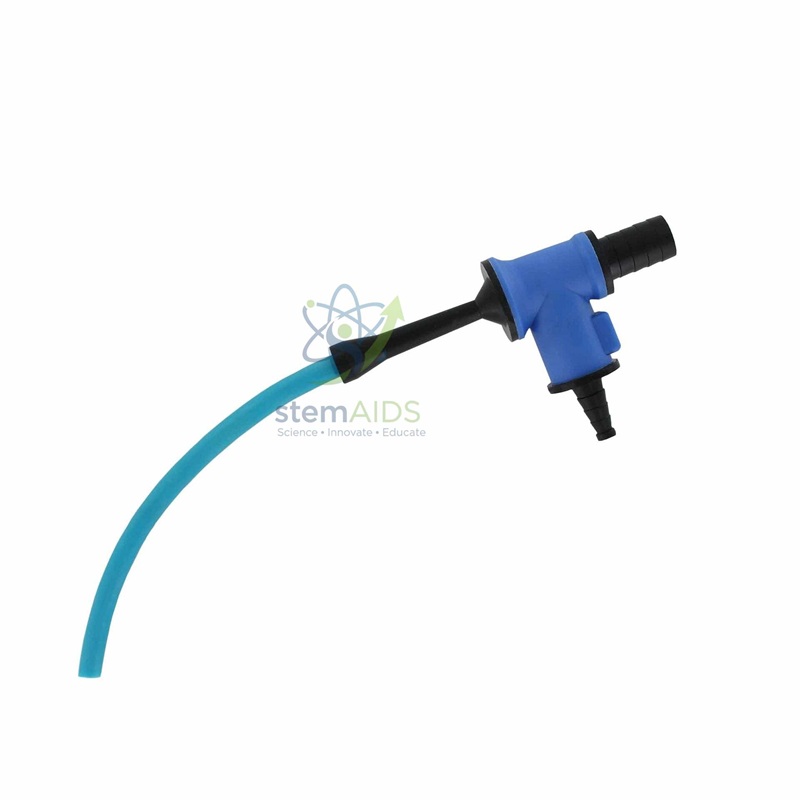
Quick Answer: This plastic water aspirator, listed simply as ‘Aspirator’, is a small water-jet vacuum pump that fits a laboratory tap. The listing photo shows a blue plastic body with a ribbed inlet for the tap connection, a stepped side barb for vacuum tubing and an outlet tail leading to the drain, used to provide suction for filtration.
Suction from Running Water
When tap water is forced through the narrow jet inside the aspirator, it speeds up and its pressure falls. Air from the side connection is dragged into the stream and carried away down the drain. Connect that side barb to a filter flask with thick-walled tubing, and the flask is evacuated for as long as the tap runs.
This version is moulded in plastic rather than made of glass or metal. In the photo the blue body carries a ribbed black inlet at the top for tubing from the tap, a stepped barb on the side that accepts vacuum hose of different bores, and a tapered outlet with tubing attached to lead the water into the sink. A plastic body will not corrode and survives knocks that would break a glass aspirator. The filter pump listed separately works on the same principle.
Suction is strongest with cold water and a fully open tap. Aspirators are noisy and use a lot of water, so they suit routine filtrations rather than hours of continuous vacuum. For rooms without a tap, the filtering kit supplies a hand pump instead.
Applications
- Buchner filtration of crystals and precipitates in chemistry practicals
- Pulling air through a filter cake so that crystals are partly dried before they are weighed
- Speeding up the filtration of fine suspensions that clog gravity filter papers
- Evacuating a vacuum desiccator slowly
Specifications
| Item | Water-jet aspirator (filter pump) |
| Material | Plastic body (photo) |
| Connections | Ribbed tap inlet, stepped side barb for vacuum tubing, outlet tail (photo) |
| Power | Water flow from a tap; no motor or electricity |
Care & Handling
- Fit a trap bottle between the plastic water aspirator and the filter flask so water cannot run back into the flask if the tap pressure drops.
- Pull the vacuum tubing off before turning the tap off, for the same reason.
- Secure the tap connection with a hose clip if the tubing tends to slip under full flow.
- Rinse the aspirator through with clean water after filtering corrosive solutions.
Why Choose LabEquip
School and college labs with bench sinks use water aspirators for everyday suction filtration because they need no electricity. This one is listed with LabEquip’s chemistry lab equipment; ask about tap fittings on the contact page.
Related Products
- Vacuum Filtration Apparatus: A vacuum filtration apparatus with funnel, side-arm flask and tubing that this aspirator can drive.
- Filter Pump: A water-jet filter pump working on the same principle, for comparing designs.
- Filtering Kit: A filtering kit with Buchner funnel, filter flask and a hand pump with gauge, an alternative suction source.
- Buchner Funnel, Plastic: A plastic Buchner funnel for the vacuum filtrations that the aspirator powers.
Frequently Asked Questions
How does a water-jet aspirator create a vacuum?
Tap water is forced through a narrow jet inside the aspirator, where it speeds up and its pressure falls. Air from the side connection is drawn into the fast stream and carried away to the drain, so a flask connected to the side barb is evacuated for as long as the tap runs.
What is a water aspirator used for in the lab?
Its main use is to provide suction for vacuum filtration with a Buchner funnel and filter flask. It can also speed up drying of solids on a filter and gently evacuate small apparatus, with no motor or electricity needed.
How do you connect a plastic aspirator to a tap and filter flask?
Push the ribbed inlet firmly onto the tap, or use a suitable adapter, and point the outlet tail into the sink. Join the stepped side barb to the side arm of the filter flask with thick-walled vacuum tubing that will not collapse under suction.
What is suck-back and how do you prevent it?
If water pressure drops, water can be drawn back from the aspirator into the filter flask and spoil the filtrate. Fit a trap bottle between aspirator and flask, and when finishing, disconnect the tubing from the flask before turning off the tap.
Why is the vacuum weaker on some days?
The suction depends on water pressure and temperature. Low mains pressure gives a weaker jet, and warmer water limits how low the pressure can go, so the same aspirator can perform differently from day to day or between taps.
Is a water aspirator better than an electric vacuum pump?
An aspirator is cheap, has no moving parts and suits school filtrations, but it uses a lot of water and gives only a moderate vacuum. An electric pump saves water and gives steadier, stronger vacuum, which matters for frequent or demanding work.
Last Updated: November 2026





Reviews
There are no reviews yet.