
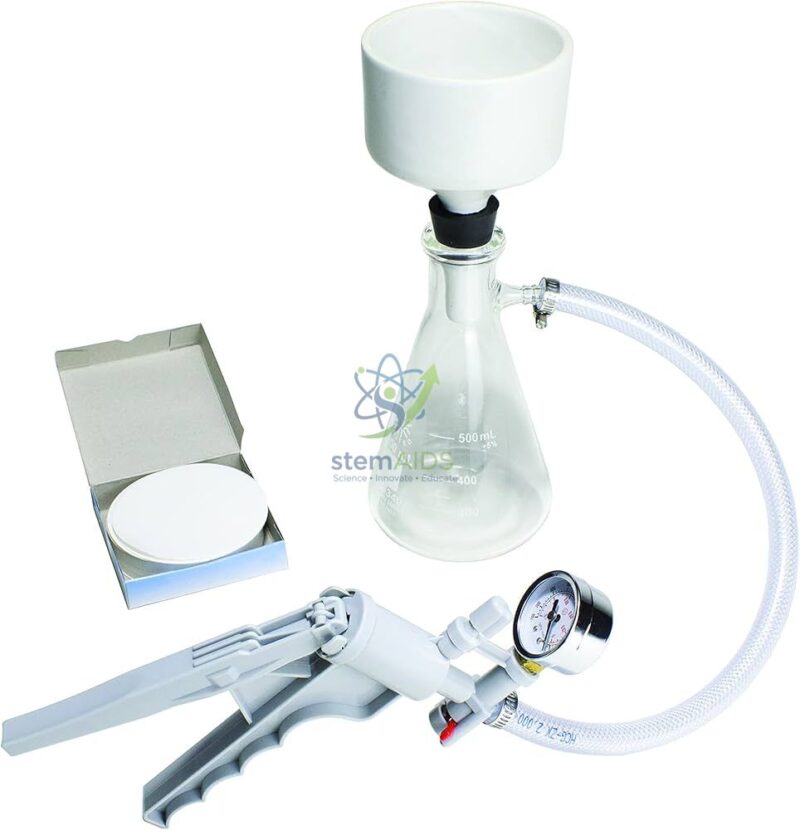
Quick Answer: The filtering kit is a vacuum filtration set that works without a tap or an electric pump. The listing photo shows a porcelain Buchner funnel on a rubber adapter in a side-arm filter flask, joined by tubing to a hand-operated vacuum pump with a pressure gauge, together with a box of filter paper circles.
Suction Filtration Powered by Hand
Filtering under suction is faster than letting liquid drain through paper by gravity, and the solid comes out drier, but a vacuum source is needed. Many labs use a water aspirator on a tap; this kit uses a hand pump instead, so the set-up can be used on any bench, in rooms without sinks, or outdoors on fieldwork. Squeezing the pump’s grip draws air out of the flask, and the gauge shows how far the pressure has dropped.
The other parts follow the standard arrangement. The Buchner funnel has a flat perforated base on which a filter paper circle lies; the rubber adapter seals it into the neck of a thick-walled filtering flask; and the tubing runs from the flask’s side arm to the pump. Wet the paper with a little of the solvent first so that it seals against the plate, then pour the mixture onto its centre.
Compared with the plastic water aspirator, the hand pump uses no water and lets the suction be built up stroke by stroke, which helps with fine precipitates that clog when suction is applied hard. For long or large filtrations, an aspirator at a sink is less tiring.
Specifications
| Funnel | Porcelain Buchner funnel with rubber adapter (photo) |
| Flask | Side-arm filter flask (photo) |
| Vacuum source | Hand-operated pump with pressure gauge and connecting tubing (photo) |
| Filter media | Box of filter paper circles (photo) |
Care & Handling
- Put only a thick-walled filter flask under vacuum with the filtering kit; an ordinary conical flask can implode.
- Release the vacuum before lifting the funnel off, so that filtrate is not drawn back into the tubing.
- Empty the flask before the filtrate rises anywhere near the side arm.
- Wash the porcelain funnel promptly so solids do not dry in the perforations, and let it dry before storage.
Applications
- Collecting crystals after recrystallisation and washing them with a little cold solvent
- Separating a precipitate such as barium sulfate or copper(II) hydroxide from its solution
- Fieldwork and outreach sessions where no tap or mains-powered pump is available
- Filtering water samples to collect suspended solids for study
Why Choose LabEquip
Teachers who want vacuum filtration in rooms without laboratory taps, and field-study groups working away from the lab, are the typical buyers of this kit. It sits in LabEquip’s chemistry lab equipment range; ask on the contact page about spare filter papers that fit the funnel.
Related Products
- Filter Pump: A water-jet filter pump for labs that prefer tap-driven suction for long or repeated filtrations.
- Flask, Filtering: A heavy-walled side-arm filtering flask, useful as a spare or second receiver for the kit.
- Buchner Funnel, Plastic: A plastic Buchner funnel, a lighter plastic alternative to the porcelain funnel in the kit.
- Buchner Funnels, Glass, With Sintered Disc: A glass Buchner funnel with a sintered disc that filters without paper.
Frequently Asked Questions
What is included in the filtering kit?
The listing photo shows a porcelain Buchner funnel on a rubber adapter, a side-arm filter flask, a hand-operated vacuum pump with a pressure gauge and connecting tubing, and a box of filter paper circles. Together they make a complete vacuum filtration set that does not need a tap or an electric pump.
How do you set up vacuum filtration with a hand pump?
Stand the filter flask securely and clamp it, seat the Buchner funnel in its neck on the rubber adapter and lay a filter paper flat on the plate. Connect the side arm to the hand pump with the tubing. Wet the paper, squeeze the pump grip a few times until the gauge shows reduced pressure, then pour in the mixture.
Why use a hand vacuum pump instead of a water aspirator?
A water aspirator needs a tap and a sink and wastes water while it runs. A hand pump works on any bench, in rooms without sinks and outdoors on fieldwork, and its gauge shows how far the pressure has dropped. It suits small batches; for long or repeated filtrations a tap aspirator or electric pump is less tiring.
What size of filter paper suits a Buchner funnel?
Choose a circle that lies flat on the perforated plate and covers every hole, but does not climb up the side walls. A paper that is too small lets solid pass round its edge, while one that is too large creases up the walls and leaks along the folds. Filter papers are sold by diameter to match standard funnel sizes.
Why should the filter paper be wetted before filtering?
Wetting the paper with a little of the solvent and applying suction pulls it flat and seals its edge against the plate. A dry paper can lift or curl when the mixture is poured on, letting solid slip underneath and through the holes into the flask, which spoils the separation.
How do you wash crystals in the Buchner funnel?
Release the vacuum first, add a small volume of cold solvent so it just covers the crystals and stir gently without tearing the paper, then reapply suction to draw the wash liquid through. Two small washes remove more impurity than one large one. Keep the solvent cold so little of the product dissolves.
Last Updated: November 2026





Reviews
There are no reviews yet.