
Quick Answer: A hand tally counter is a small mechanical counter held in the palm: each press of the button advances the number wheels by one, and a knob resets the display to zero. Biology and geography classes use it to count organisms, colonies, heartbeats and events without writing tally marks.
What Students Count with It
- Organisms in a quadrat or along a transect during ecology fieldwork
- Bacterial colonies on a Petri dish, dotting each colony with a marker as it is clicked
- Pulse beats over a timed interval before and after exercise
- Stomata or cells in one field of view under the microscope
- Vehicles, pedestrians or birds in geography and environmental surveys
How the Counter Works
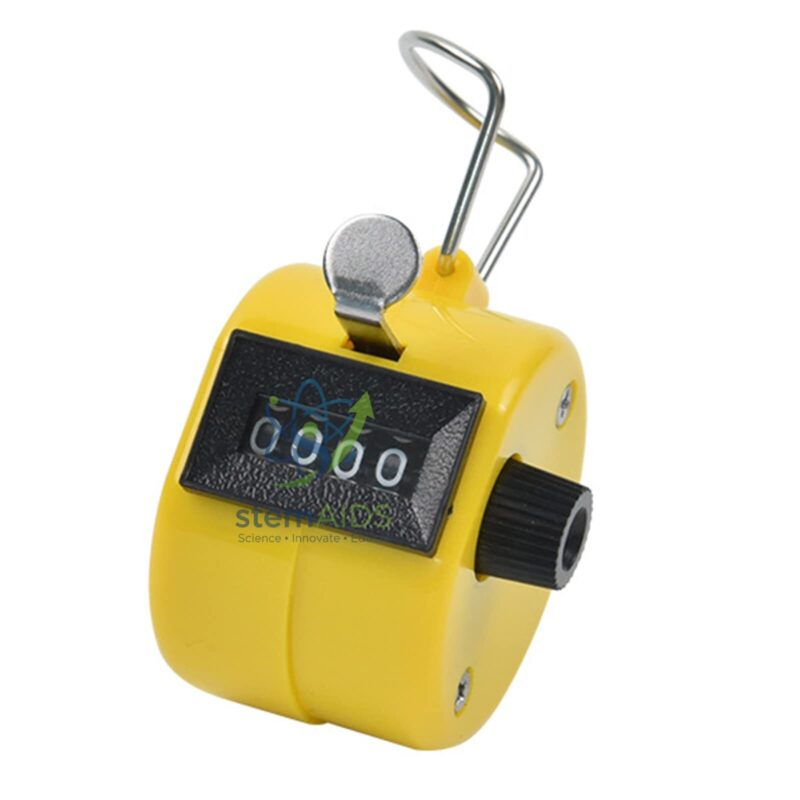
Inside the case, the press button drives a ratchet that turns the right-hand number wheel one step at a time; when that wheel passes nine it carries one to the next, like a car odometer. The counter in the listing photograph has a four-digit window, a finger ring for holding it and a reset knob on the side. Because every count is mechanical, it needs no battery and gives the same result in the field as at the bench.
The hand tally counter removes the slowest part of counting, which is looking down to write. An observer can keep eyes on the quadrat, the plate or the microscope field and click with the thumb, then read the total once at the end. The main source of error becomes the person, not the tool: a missed click or a double press. A simple check is to count the same sample twice, or to have two students count it independently and compare.
One counter records one category. For surveys that separate species or types, give each category its own counter, or pair students so that each person counts one group.
Specifications
| Item | Mechanical hand-held tally counter |
| Operation | Press button adds one; side knob resets to zero |
| Display | Four-digit number wheels in the listing photograph |
| Holding | Finger ring for one-handed use |
Care & Handling
- Keep the counter dry; wipe off rain or pond splashes after fieldwork so the mechanism does not rust or stick.
- Turn the reset knob only when the display has been read and recorded, and turn it fully so all wheels return to zero.
- Store counters in a box rather than loose in a field bag, where the button can be pressed repeatedly by other kit.
Why Choose LabEquip
Tally counters are bought in sets for ecology fieldwork, microbiology colony counts and survey work. LabEquip lists them in Biology Lab Products; for colony counting they pair with plastic Petri dishes. Tell us how many counters your groups need through the LabEquip contact page.
Related Products
- Colony Counter: A lit colony viewer with a ruled grid, used alongside a tally counter when counting colonies on agar plates.
- Petri Dish (Culture), Plastic: Plastic culture dishes whose colonies are a common thing to count with a hand tally counter.
- Automatic Seed Counter: An electric counter that feeds seeds past a sensor, an automatic alternative when counting large seed batches.
- Classification of living Organisms: A teaching resource on classifying living organisms, useful for naming the species recorded during field counts.
Frequently Asked Questions
How do you use a hand tally counter?
Slip a finger through the ring, hold the counter in the palm and press the button with the thumb once for each item; the number wheels move on by one with each press. When the count is finished, write the reading down, then turn the side knob to return the display to zero.
What happens when a four-digit tally counter goes past 9999?
It rolls over to 0000, like a car odometer, because each wheel carries one to the next as it passes nine and there is no fifth wheel. For very long counts, note the reading at intervals so that a rollover is not mistaken for a small total.
How do you count bacterial colonies on a Petri dish with a tally counter?
Turn the closed dish upside down and dot each colony on the base with a fine marker as you click, working across the dish in strips so none is counted twice. The counter keeps the running total while your eyes stay on the dish; a colony counter with a ruled grid helps on crowded plates.
How is a tally counter used for quadrat sampling in ecology?
Place the quadrat and click once for each plant or animal of the species being recorded, keeping your eyes on the ground rather than on a notebook. Record the total and reset before moving to the next quadrat; to record two species at once, use two counters, one in each hand.
Is a tally counter more accurate than making tally marks?
For fast or long counts it usually is, because you never look away to write and cannot lose your place in a column of marks. Its weakness is that a missed or doubled press leaves no trace, so for results that matter, count twice or have a partner count at the same time.
Can a tally counter be used to measure pulse or breathing rate?
Yes. Press once for each beat felt at the wrist or neck, or for each breath, over a timed interval, then scale the total up to a rate per minute. Students can then compare resting values with readings taken straight after exercise without stopping to write during the count.
Last Updated: November 2026




Reviews
There are no reviews yet.