
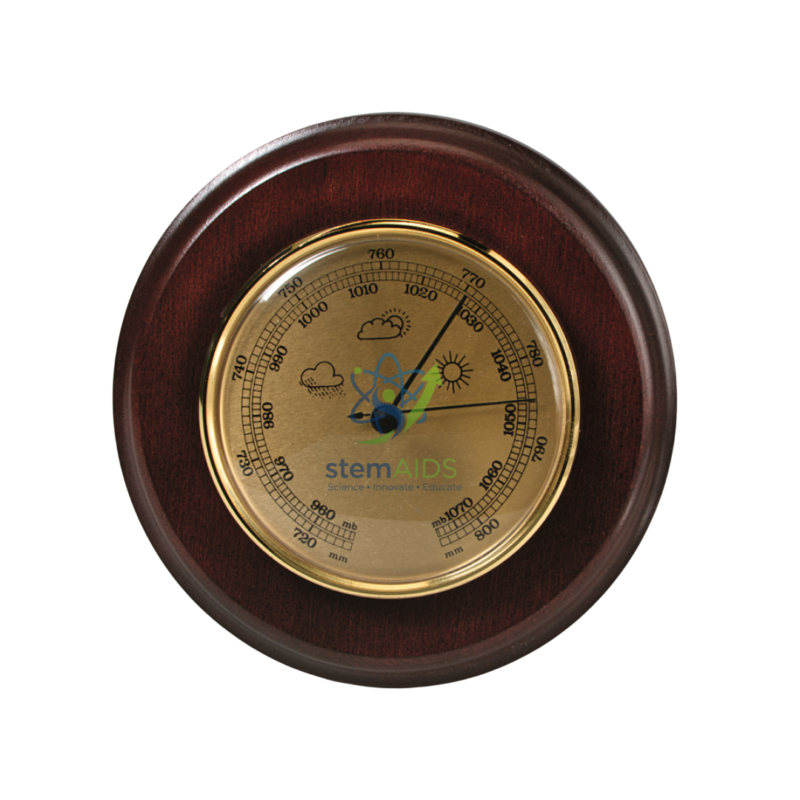
The StemAids Aneroid Barometer is an educational atmospheric pressure measuring instrument designed for schools, colleges, weather-study laboratories, geography rooms, physics labs, environmental science classrooms, and STEM learning activities. It helps students observe changes in air pressure and understand the relationship between atmospheric pressure, weather patterns, altitude, and meteorological observation.
Product Description
The StemAids Aneroid Barometer is a compact, mercury-free barometer that measures atmospheric pressure using an internal flexible metal capsule mechanism. As air pressure changes, the capsule expands or contracts slightly. This movement is transferred through a lever mechanism to the pointer on the dial, allowing users to read the current air pressure.
The instrument has a cylindrical metal body with a dial, pointer system, and front glass cover. The scale is marked in both millibars and millimeters, making it suitable for classroom comparison, weather recording, and atmospheric pressure demonstrations.
Mounted on a plastic base with a ring for easy hanging, the StemAids Aneroid Barometer is suitable for wall display in classrooms, weather stations, laboratories, and science activity rooms. It also includes an activity guide to support structured learning and practical observation.
Product Specifications
| Parameter | Details |
|---|---|
| Product Name | Aneroid Barometer |
| Brand | StemAids |
| Reference Item | ANBR01 type Aneroid Barometer |
| Reference SKU | 676 |
| Product Type | Mercury-free atmospheric pressure measuring instrument |
| Measurement Principle | Aneroid capsule mechanism with pointer movement |
| Measured Parameter | Atmospheric pressure / barometric pressure |
| Scale Marking | Marked in millibars and millimeters |
| Body Design | Cylindrical metal container, closed at back and sides |
| Front Cover | Glass cover over dial and pointers |
| Internal Mechanism | Flexible metal capsule connected to pointer through lever and pulley mechanism |
| Mounting | Mounted on plastic base with hanging ring |
| Overall Diameter | Approx. 7.5 in |
| Shipping Weight | Approx. 1.4 lb |
| Included Material | Activity guide, depending on supply configuration |
| Application | Atmospheric pressure measurement, weather observation, geography practicals, physics demonstrations, and environmental science learning |
| Suitable For | Schools, colleges, STEM labs, weather-study rooms, geography labs, physics labs, and science activity centers |
Key Features
- Mercury-free aneroid design for classroom-safe pressure observation
- Measures atmospheric pressure through flexible metal capsule movement
- Dial marked in millibars and millimeters for educational comparison
- Glass-covered front dial protects pointer and scale markings
- Plastic base with hanging ring supports easy wall mounting
- Useful for weather observation and barometric pressure study
- Suitable for geography, physics, environmental science, and STEM classrooms
- Includes activity guide to support structured practical learning
- Compact 7.5 in diameter design for classroom display and demonstration
How to Use
- Mount the StemAids Aneroid Barometer on a stable wall or place it upright on a secure surface.
- Keep the instrument away from direct sunlight, heating vents, strong vibration, moisture, and chemical fumes.
- Allow the barometer to adjust to room conditions before taking a reading.
- Gently tap the glass cover once to reduce pointer friction before reading.
- Read the atmospheric pressure value from the dial in millibars or millimeters.
- Use the movable reference pointer, if provided, to mark the current reading.
- Check the reading again after a few hours to observe whether pressure is rising, falling, or stable.
- Record pressure readings with date, time, weather condition, and location.
- Compare pressure trends with weather changes such as clear sky, cloud formation, rain, or storm conditions.
- Use the activity guide to conduct classroom discussions on air pressure, weather forecasting, and atmospheric science.
Applications
- Atmospheric pressure measurement
- Weather observation and recording
- Geography and environmental science practicals
- Physics demonstrations on pressure
- STEM weather station activities
- Classroom meteorology lessons
- Altitude and pressure relationship discussion
- Daily weather log projects
- Science fair and observation-based learning activities
- Teacher demonstrations on pressure change and weather prediction
Safety and Handling Guidelines
- Handle the barometer carefully to avoid damaging the glass cover or pointer mechanism.
- Do not drop, shake, or expose the instrument to strong vibration.
- Do not press or force the pointer manually.
- Do not open the back cover or internal mechanism unless handled by qualified service personnel.
- Keep away from water, moisture, corrosive vapours, and direct heat sources.
- Mount securely if used as a wall-hanging classroom instrument.
- Clean the glass cover gently with a soft dry cloth.
- Do not use abrasive cleaners or solvents on the dial or cover.
- Store in a clean, dry location when not in use.
- Use under teacher supervision for classroom demonstrations.
Quality and E-E-A-T Notes
The StemAids Aneroid Barometer supports evidence-based weather and atmospheric science learning by allowing students to observe real pressure changes over time. Regular readings, time-based recording, comparison with local weather conditions, and guided teacher discussion help learners connect pressure data with practical meteorology concepts.
FAQ
1. What is the StemAids Aneroid Barometer used for?
It is used to measure atmospheric pressure and observe changes in barometric pressure for weather-study, physics, geography, and environmental science activities.
2. What does an aneroid barometer measure?
It measures atmospheric pressure, also called air pressure or barometric pressure.
3. Does this barometer contain mercury?
No, an aneroid barometer is mercury-free. It uses a flexible metal capsule mechanism instead of liquid mercury.
4. What units are shown on the dial?
The dial is marked in millibars and millimeters.
5. What is the overall diameter?
The overall diameter is approximately 7.5 inches.
6. Is it suitable for school laboratories?
Yes, it is suitable for school laboratories, geography rooms, physics labs, STEM classrooms, and weather-observation activities.
7. How does the internal mechanism work?
Changes in air pressure cause a flexible metal capsule inside the barometer to expand or contract. This movement is transferred to the dial pointer through a mechanical linkage.
8. Can it be used for weather prediction?
Yes, pressure trends can support basic weather prediction. Rising pressure often indicates improving weather, while falling pressure may indicate unsettled or rainy conditions.
9. How should readings be recorded?
Readings should be recorded with date, time, pressure value, location, and observed weather condition for meaningful comparison.
10. Can it be hung on a wall?
Yes, it is mounted on a plastic base with a ring for easy hanging.
11. Does it include an activity guide?
Yes, the reference configuration includes an activity guide for classroom learning.
12. How should the barometer be maintained?
Keep it clean, dry, and protected from vibration, heat, moisture, and rough handling. Clean the glass gently with a soft cloth.
Why Choose StemAids?
StemAids educational science instruments are selected for practical learning, classroom usability, and curriculum-supportive laboratory work. The StemAids Aneroid Barometer supports weather observation, pressure measurement, STEM activity learning, geography practicals, physics demonstrations, and environmental science projects for schools, colleges, science clubs, and teacher-training institutes.
SEO Keywords
StemAids Aneroid Barometer, Aneroid Barometer for Schools, Atmospheric Pressure Meter, Barometric Pressure Instrument, Weather Study Barometer, School Weather Station Instrument, Geography Lab Barometer, Physics Pressure Demonstration, Educational Barometer, Mercury Free Barometer, Weather Observation Instrument, STEM Weather Kit




Reviews
There are no reviews yet.