

The StemAids Forces, Motion and Dynamics Kit is an educational physics experiment kit designed to help students understand force, motion, acceleration, friction, mass, momentum, energy, work, pulley systems, springs, and Newton’s laws through hands-on practical activities. It is suitable for schools, colleges, STEM labs, physics departments, science clubs, teacher demonstrations, and practical classroom learning.
Product Description
The StemAids Forces, Motion and Dynamics Kit helps learners investigate how objects move and how forces change their motion. Students can perform experiments on uniform motion, accelerated motion, force and acceleration, friction, spring force, inclined planes, pulley systems, action-reaction pairs, and work-energy relationships.
This kit is ideal for activity-based physics learning because it allows students to observe motion directly, measure distance and time, calculate speed and acceleration, compare mass effects, and relate experimental results to classroom theory. It supports practical understanding of Newton’s first, second, and third laws of motion.
The kit can be used for individual experiments, group activities, teacher-led demonstrations, practical examination preparation, and STEM-based inquiry learning.
Product Specifications
| Parameter | Details |
|---|---|
| Product Name | Forces, Motion and Dynamics Kit |
| Brand | StemAids |
| Product Type | Educational physics mechanics experiment kit |
| Subject Area | Physics, mechanics, forces, motion, dynamics, energy, and STEM education |
| Learning Level | Middle school, secondary school, senior secondary, college foundation, STEM labs, and teacher-training programs |
| Core Concepts | Force, mass, motion, speed, velocity, acceleration, friction, inertia, momentum, Newton’s laws, Hooke’s law, work, energy, and pulley systems |
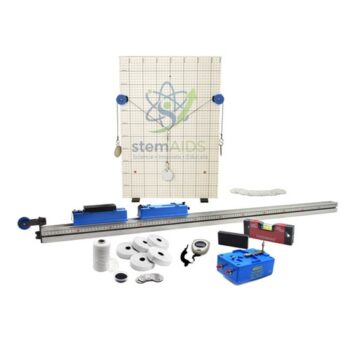
| Typical Components | Dynamics cart, ramp or track, pulley, string, slotted masses, mass hanger, spring balance, spring, meter scale, stopwatch, friction surface, connectors, activity sheet, and experiment guide depending on kit configuration |
| Measurement Support | Distance, time, force, mass, extension, speed, acceleration, and work calculation depending on experiment setup |
| Experiment Format | Hands-on mechanics experiments using classroom-safe apparatus |
| Reusable Components | Yes, most parts are reusable after proper handling and storage |
| Manual / Guide | Experiment manual, student worksheet, or teacher guide depending on supply configuration |
| Storage | Supplied in kit box, tray, or compartment case depending on configuration |
| Safety Requirement | Teacher supervision, stable setup, controlled motion, and safe handling of masses, springs, and moving carts |
| Application | Mechanics experiments, motion analysis, force measurement, dynamics demonstrations, and STEM practical learning |
| Suitable For | Schools, colleges, physics labs, STEM labs, science clubs, teacher-training institutes, and educational laboratories |
Key Features
- Designed for hands-on learning of forces, motion, and dynamics
- Supports experiments on Newton’s laws of motion
- Useful for studying acceleration, friction, mass, force, and energy
- Includes practical apparatus for carts, pulleys, springs, and mass-based experiments depending on configuration
- Helps students connect formulas with real observations
- Suitable for individual, pair, and group practical work
- Reusable parts support repeated classroom experiments
- Useful for STEM education, physics demonstrations, and practical exam preparation
- Supports inquiry-based learning through measurement, comparison, and calculation
How to Use
- Read the experiment guide before starting the activity.
- Place the StemAids Forces, Motion and Dynamics Kit on a clean, stable, and level table or laboratory bench.
- Select the required apparatus such as cart, pulley, string, spring balance, masses, ramp, meter scale, or stopwatch.
- Set up the apparatus according to the selected experiment.
- Check that the ramp, track, pulley, and moving parts are stable and aligned.
- Measure the initial values such as mass, distance, spring extension, or applied force.
- Release or move the object as instructed and observe its motion carefully.
- Measure time, distance, force, or extension using the appropriate tool.
- Repeat the experiment for different masses, forces, surfaces, or ramp angles.
- Record observations in a table and calculate speed, acceleration, force, work, or energy where required.
- Compare results with the expected physics principle or equation.
- After use, remove weights, disconnect strings, clean the apparatus, and store all parts safely in the kit box.
Applications
- Newton’s first law demonstration
- Newton’s second law experiment
- Newton’s third law demonstration
- Uniform and accelerated motion experiments
- Speed and acceleration measurement
- Static and kinetic friction experiments
- Hooke’s law and spring force study
- Inclined plane experiments
- Pulley and tension force demonstrations
- Work, energy, and conservation of energy activities
- Momentum and collision demonstrations depending on kit configuration
- STEM physics classroom projects
Safety and Handling Guidelines
- Use the kit only under teacher, instructor, or trained adult supervision.
- Ensure the ramp, track, pulley, and cart are stable before starting experiments.
- Do not place fingers in the path of moving carts, springs, or falling masses.
- Handle slotted weights and mass hangers carefully to avoid injury from falling objects.
- Do not stretch springs beyond their safe elastic limit.
- Keep the experiment area clear of unnecessary objects.
- Use only recommended masses and loads for the apparatus.
- Do not pull spring balances or strings with excessive force.
- Keep carts and ramps away from table edges unless secured properly.
- Wear safety goggles if springs, projectiles, or fast-moving objects are used.
- Store small parts, pulleys, clips, strings, and masses safely after use.
- Replace damaged, cracked, bent, or loose components before classroom use.
Quality and E-E-A-T Notes
The StemAids Forces, Motion and Dynamics Kit supports evidence-based physics education by helping students measure real motion, observe cause-and-effect relationships, compare variables, calculate results, and connect experimental data with scientific laws. For reliable learning outcomes, experiments should be repeated, measurements should be recorded carefully, and conclusions should be supported by observed data.
FAQ
1. What is the StemAids Forces, Motion and Dynamics Kit used for?
It is used for teaching physics concepts such as force, motion, acceleration, friction, Newton’s laws, springs, pulleys, work, and energy through hands-on experiments.
2. Is this kit suitable for school students?
Yes, it is suitable for middle school, secondary school, senior secondary, STEM labs, and introductory college physics practicals under teacher supervision.
3. What experiments can be performed with this kit?
Students can perform experiments on Newton’s laws, acceleration, friction, inclined planes, Hooke’s law, pulley systems, work, energy, and motion measurement depending on kit configuration.
4. What components are included?
Typical components may include dynamics cart, ramp or track, pulley, string, slotted masses, mass hanger, spring balance, spring, meter scale, stopwatch, friction surface, and experiment guide depending on the supplied version.
5. Can this kit demonstrate Newton’s second law?
Yes, students can vary mass or applied force and observe the resulting change in acceleration to understand the relationship between force, mass, and acceleration.
6. Can this kit be used for friction experiments?
Yes, the kit can support static and kinetic friction experiments when used with suitable surfaces, spring balance, cart, or block arrangement.
7. Can pulley experiments be performed?
Yes, pulley, string, and mass hanger setups can be used to study tension, direction of force, and motion in connected systems.
8. Can the kit be used for Hooke’s law?
Yes, if a spring and masses are included, students can measure extension for different loads and study the relationship between force and extension.
9. Are the components reusable?
Yes, most parts are reusable when handled carefully, cleaned when required, and stored properly after each practical session.
10. Does the kit require electricity?
Most basic force and motion experiments do not require electricity. Some advanced versions may use sensors or timing devices depending on configuration.
11. How should students record results?
Students should record variables, measurements, repeated readings, averages, calculations, graphs, observations, and conclusions in a practical notebook or worksheet.
12. Why is this kit useful for STEM education?
It encourages measurement, experimentation, graphing, problem-solving, teamwork, data analysis, and practical understanding of mechanics.
Why Choose StemAids?
StemAids educational science kits are selected for practical learning, classroom usability, and curriculum-supportive laboratory work. The StemAids Forces, Motion and Dynamics Kit supports hands-on physics learning, STEM skill development, student participation, practical mechanics demonstrations, and economical laboratory operation for schools, colleges, science clubs, teacher-training institutes, and institutional laboratories.
SEO Keywords
StemAids Forces Motion and Dynamics Kit, Forces and Motion Kit, Dynamics Kit for Physics, Newton’s Laws Experiment Kit, School Physics Mechanics Kit, Force and Motion Experiment Kit, STEM Physics Kit, Pulley and Friction Kit, Motion and Acceleration Kit, Mechanics Laboratory Kit, Educational Physics Kit, Science Lab Dynamics Kit


Reviews
There are no reviews yet.