
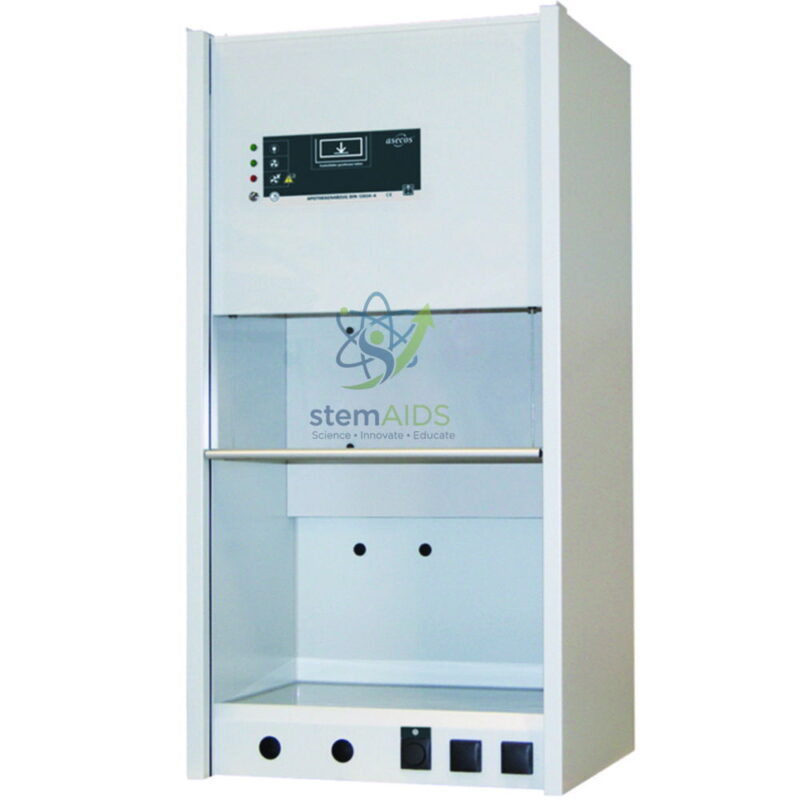
Quick Answer: The laboratory fume cupboard with extraction fan is a ducted enclosure with a sliding front sash: its fan draws air in across the work surface and exhausts fumes outside through a duct. It is the main protective enclosure for chemistry practicals and reactions that release harmful gases or vapours.
How a Ducted Fume Cupboard Removes Fumes
The extraction fan pulls air from the laboratory in through the sash opening at a steady speed, called the face velocity. Fumes released inside are carried up and out through the duct before they can reach the user’s breathing zone. Because contaminated air leaves the building rather than passing through a filter, this type of laboratory fume hood handles a broader range of chemicals than a ductless unit, including unexpected gases from a reaction.
The photograph shows a cupboard with a control panel above the sash, a vertical sliding sash and service sockets along the front of the base. The sash is a key safety device: lowering it shrinks the opening, raises the inflow speed through the remaining gap and puts a screen between the user’s face and the reaction. The title includes the extraction fan, but the duct run to the outside, the room’s make-up air and the discharge point still have to be planned for each building.
Accessories such as a duct damper for fume hoods and an oval or cup sink for fume hoods complete an installation.
Practicals and Tasks
- Chemistry practicals producing chlorine, sulfur dioxide, nitrogen dioxide or ammonia in small amounts
- Diluting concentrated acids and handling volatile solvents
- Digestion and evaporation steps in analytical sample preparation
- Teacher demonstrations of reactions that release toxic or irritant gases
Safe Use & Care
- Work with the sash as low as practical and at least 15 cm inside the opening
- Never use the cupboard for chemical storage; bottles block airflow at the rear baffle
- Check the airflow indicator before each use and have the face velocity measured at regular intervals
- Keep the sash glass clean and report any sash that will not stay in position
Specifications
| Product | Ducted laboratory fume cupboard |
| Extraction | Extraction fan included, per the title |
| As pictured | Vertical sliding sash, control panel, service sockets |
| Exhaust | Through ductwork to outside |
| Dimensions, duct size and electrical supply | Confirm at enquiry |
Why Choose LabEquip
Schools refurbishing chemistry labs, colleges and analytical labs choose a ducted cupboard when work involves varied chemicals or gas-producing reactions. LabEquip supplies it among its general lab products and can discuss ducting accessories through the contact page.
Frequently Asked Questions
What is face velocity and why is it measured?
Face velocity is the speed of air entering through the sash opening. It shows whether the fan draws enough air to contain fumes. It is measured with an anemometer at several points across the opening and compared with the value your local guidance sets.
Why should the sash be kept low?
A lower sash reduces the open area, which increases the inflow speed through the gap and improves containment. The glass also shields the face and upper body from splashes and flying fragments.
Can the fume cupboard be used for storing chemicals?
No. Bottles inside disrupt the airflow and may release vapour into the working space. Store chemicals in ventilated storage cabinets and bring only what is needed into the fume cupboard.
What is the difference between a fume cupboard and a ductless hood?
A fume cupboard exhausts contaminated air outside through a duct, so it handles a wide range of chemicals. A ductless hood filters air and returns it to the room, so it is limited to chemicals its filter can retain.
What does installing a laboratory fume cupboard involve?
A duct route from the cupboard to a safe discharge point outside, the fan, an electrical supply and enough make-up air entering the room to replace what is extracted. Plan these with a ventilation contractor before the cupboard arrives.
How can students tell if the fume cupboard is working?
Check the airflow indicator or alarm on the panel before starting. A simple classroom check is to hold a strip of tissue at the sash opening; it should be drawn steadily inwards.
Last Updated: October 2026




Reviews
There are no reviews yet.