
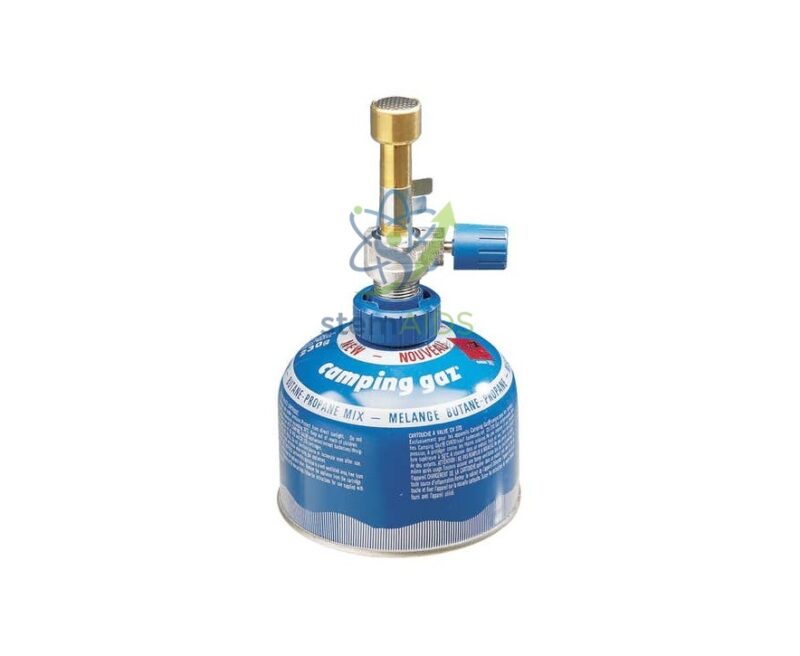
Quick Answer: This Laboratory Burner is a portable gas burner that sits on top of a disposable gas cartridge, pictured as a brass burner tube with a blue control knob on a butane-mix cartridge, giving a Bunsen-style flame in rooms that have no piped gas.
A Flame Without a Gas Line
Many classrooms, exam halls, field stations and temporary labs have no gas tap on the bench. A cartridge-mounted laboratory burner carries its own fuel: the burner head and its valve sit directly on the cartridge, so the whole unit can be taken to any stable, non-combustible surface and lit there. No hose, regulator or bench valve is involved, which also means nothing to trip over.
Inside, the principle is the same as on a bench Bunsen. Gas leaves a small jet at the base of the burner tube, draws in air through openings near the bottom, and the mixture burns at the mouth. More air gives the hotter, blue flame used for heating; less air gives a softer, yellow flame that is easier to see. The knob pictured on the side sets how much gas reaches the jet.
Because the cartridge holds liquefied gas under pressure, this burner behaves differently from a mains burner in two ways. It must stay upright, since tilting can send liquid fuel to the jet and cause a sudden flare. It also weakens in the cold, because butane vaporises poorly at low temperatures, so a chilly room or an almost empty cartridge gives a smaller flame. For fixed benches with a piped supply, a hose-fed Bunsen burner for natural gas is the usual choice.
Specifications
| Type | Portable burner mounted on a disposable gas cartridge |
| Fuel | Cartridge gas; the pictured cartridge is a butane mix |
| Control | Side knob that sets the gas flow, as pictured |
| Gas supply needed | None; the cartridge is the supply |
| Typical flame uses | General heating, flaming loops, flame tests |
| Compatible cartridge type | Confirm at enquiry |
Where a Cartridge Burner Is Useful
- Science rooms and exam venues with no piped gas where a practical still needs a flame
- Field courses, outreach visits and science fairs where apparatus has to travel
- Flaming inoculating loops and the necks of culture tubes in a portable microbiology set-up
- Heating test tubes and small volumes on a tripod and gauze during routine practicals
Care & Handling
- Change cartridges outdoors or in a well-ventilated room, well away from any flame, and check the joint by smell and sound before lighting.
- Keep the burner upright on a flat, heat-resistant surface, and never lay it down while it is lit or attached to a cartridge.
- Close the valve fully after use, and let the burner tube cool before packing it away.
- Store spare cartridges somewhere cool and out of direct sun, away from ignition sources, and dispose of empty ones as local rules require.
Why Choose LabEquip
LabEquip supplies this burner to schools, colleges and outreach teams that need a flame where no gas pipe runs. It sits in the General Lab Products range beside hose-fed burners; ask through the contact page about matching cartridges and quantities for a class set.
Frequently Asked Questions
How is a cartridge burner different from a Bunsen burner on a gas tap?
Both mix gas with air and burn it at the top of a tube. The cartridge burner carries its own fuel and needs no hose or bench supply, so it is portable; a tap-fed Bunsen can run all day on mains or cylinder gas without any cartridge changes.
Why must the burner be kept upright?
The cartridge holds liquefied gas. Upright, only vapour reaches the jet; tilted or on its side, liquid fuel can reach the burner and cause a large, uncontrolled flare. Always stand it on a flat, stable surface.
Why does the flame get smaller in a cold room?
Butane evaporates slowly when it is cold, so pressure in the cartridge falls and less gas reaches the jet. The flame also shrinks as the cartridge empties. Warmer surroundings or a cartridge with a propane blend help.
How do I check for a leak after fitting a new cartridge?
Before lighting, listen for hissing and smell for gas around the joint. If either is present, take the unit outdoors, remove the burner and refit it. Never test with a flame; soapy water brushed on the joint bubbles at a leak.
Can the burner be used for aseptic work?
Yes, it flames inoculating loops and the necks of tubes and bottles like any gas burner. Keep it at the back of the working area so sleeves, paper and hair never pass over the flame.
Which cartridges does it take?
Cartridge burners are made for one fitting, such as a pierceable cartridge or a threaded valve cartridge, and the two are not interchangeable. Tell us which cartridges you can buy locally and we will confirm the matching type when you enquire.
Last Updated: October 2026




Reviews
There are no reviews yet.