
Quick Answer: This Bunsen burner with pilot light is a laboratory gas burner for butane or propane (LPG) that carries its own control tap and a small permanent pilot flame, so the main flame can be turned off and brought back without striking a match each time.
How the Pilot Flame and Tap Work Together
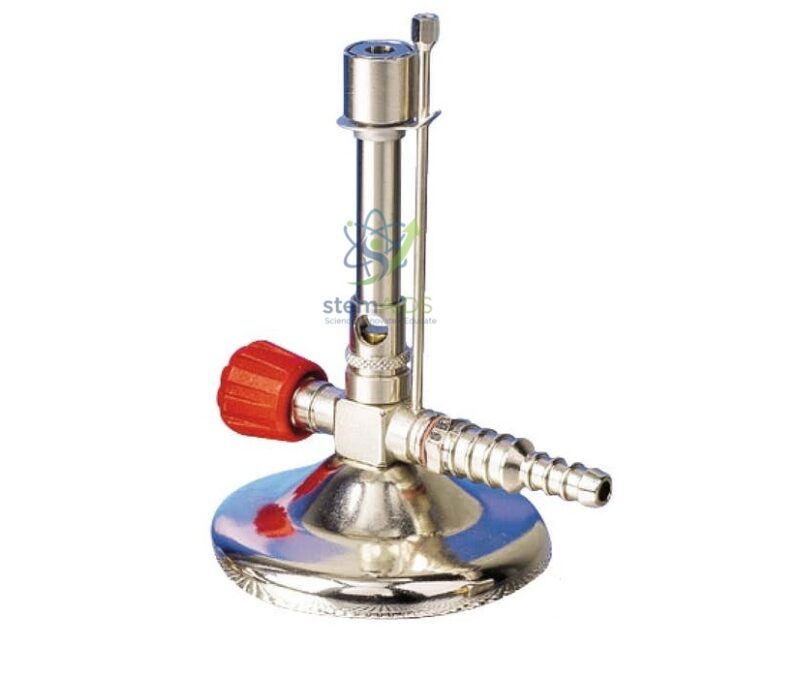
The photo shows a nickel-bright burner tube on a broad base, a red-knobbed tap at the side, a ribbed hose nozzle and a thin pilot tube running up beside the main tube. The tap sets the gas flow at the burner itself, which is finer than working the bench or cylinder valve. The pilot is a separate tiny flame that keeps burning while the main flame is shut off.
The gain shows in lessons where the flame is needed on and off. Rather than striking a new match or lighter each time, a student opens the tap and the pilot relights the main flame. Fewer ignitions mean fewer lit splints and matches around the bench. The pilot is small and easy to miss in bright light, so the rule stays the same: the burner is treated as alight until the supply valve is closed.
The burner is titled for butane or propane. These liquefied petroleum gases carry more energy per litre than natural gas and are delivered through a regulator, so their jets are made smaller. A burner jetted for LPG gives a weak flame on a natural-gas outlet, and a natural-gas burner on LPG gives an oversized one; for piped natural gas the Bunsen burner for natural gas is the matching model.
Specifications
| Burner type | Bunsen burner with control tap and pilot light |
| Gas | Butane or propane (LPG), as titled |
| Gas control | Tap with red knob on the burner body, as pictured |
| Pilot | Thin side tube carrying a small flame that stays lit when the main flame is off |
| Base | Broad round base, as pictured |
| Hose connection | Ribbed nozzle for burner tubing |
Care & Handling
- Connect with safety burner tubing pushed fully onto the nozzle, and check the hose for cracks before each session.
- The pilot keeps burning when the burner tap is closed; shut the supply valve at the end of the lesson to put the burner fully out.
- Keep the pilot jet and air openings free of dust and spilt material, and clean them only when the burner is cold.
- Use the burner only on the gas it is set up for, through a suitable regulator on the cylinder.
Where a Pilot-Light Burner Helps
- Microbiology practicals where loops and tube necks are flamed again and again in one session
- Heating in stages, such as warming a test tube, stopping to observe and heating again
- School labs supplied from LPG cylinders through a regulator
- Demonstrations of flame types, from the yellow safety flame to the blue heating flame
Why Choose LabEquip
Teachers who light and relight burners many times in a lesson, and microbiology labs working with loops, choose a pilot-light burner to cut repeated ignitions. LabEquip carries it in General Lab Products; send your gas type and class size through the contact page.
Frequently Asked Questions
What is the pilot light for?
It is a small flame that stays lit when the main flame is turned off. Opening the tap again lets the pilot relight the main flame at once, so no match or lighter is needed each time.
Does the pilot use much gas?
Very little compared with the main flame, but it burns for as long as the supply is open. Close the supply valve whenever the burner will not be needed for a while.
Can this burner be used on natural gas?
No. It is set up for butane or propane, which need a smaller jet than natural gas. On a natural-gas supply the flame would be weak and unstable, so use a burner made for natural gas instead.
Why have a tap on the burner when the bench already has a valve?
The burner tap allows fine adjustment right where the user is working, while the bench or cylinder valve acts as the main shut-off. Using both gives better control and a second point of isolation.
How can I tell whether the burner is still alight?
The pilot flame is small and can be hard to see in bright light, so look at it from the side against a dark background. Treat the burner as lit until the supply valve has been closed.
Which flame should be used for heating?
Open the air until the flame turns blue with a clear inner cone; the hottest point is just above the tip of that cone. Keep the yellow flame for idling, since it is easy to see but leaves soot on glassware.
Last Updated: October 2026




Reviews
There are no reviews yet.