
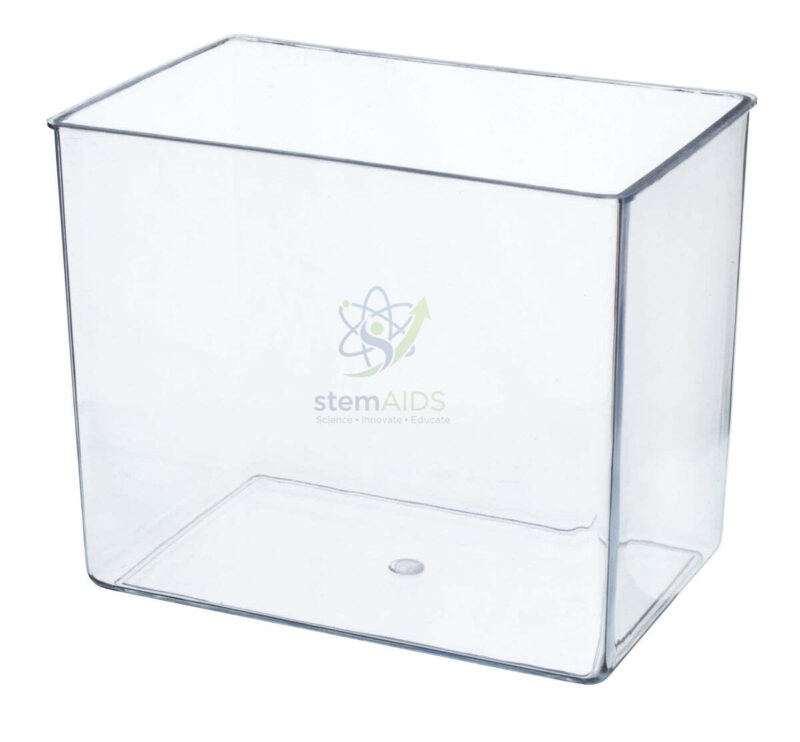
Quick Answer: The Water bath tank is an open, rectangular, transparent tank, as pictured, that holds the water of a laboratory bath; fitted with an immersion thermostat or a heating circulator, it becomes a temperature-controlled bath in which samples stay visible through the walls.
A Tank Without a Heater
This tank is only the vessel. It has no heater, controller or pump of its own. Temperature control comes from a separate unit clamped to its wall, such as the immersion thermostat TI-05 or a heating circulator head, which heats the water and keeps it moving. Splitting the bath this way lets one controller serve tanks of different sizes, or lets a clear tank stand in for a steel one when visibility matters.
The photo shows a tall, clear rectangular tank. Transparent walls let students and analysts see samples, stir bars, colour changes and liquid levels without lifting anything out of the water. The material is not given in the title; clear bath tanks are commonly moulded in polycarbonate or acrylic, which are lighter and less fragile than glass but have lower temperature limits than stainless steel.
Its role differs from the polycarbonate tank listed for multi-position stirrers, which sits over a stirring plate; this tank is a general bath vessel for a thermostat. Check the tank’s maximum water temperature before setting the controller high.
Specifications
| Type | Open vessel for a laboratory water bath |
| Form | Rectangular with transparent walls, as pictured |
| Heating | None built in; used with an immersion thermostat or circulator |
| Bath medium | Water, as titled |
| Heater mounting | Clamped to the tank wall, depending on the thermostat |
| Material and maximum temperature | Confirm at enquiry |
What the Tank Is Used For
- Building a clear demonstration bath for teaching how temperature affects enzyme activity
- Temperature-controlled incubation of tubes and flasks that need to be watched
- Holding samples at a fixed temperature for viscosity or density measurements
- Replacing a worn or scratched tank on an existing thermostat set-up
Care & Handling
- Clean with mild detergent and a soft cloth; abrasive pads scratch clear plastics and cloud the walls.
- Keep organic solvents and strong alkaline cleaners away, as they can craze transparent plastics.
- Fill with distilled water where possible to limit scale lines on the walls.
- Drain and dry the tank when it will stand unused for a long time.
Why Choose LabEquip
Teaching labs and research groups that own an immersion thermostat buy this tank to build a see-through bath. LabEquip lists it in General Lab Products; ask about tank sizes through the contact page.
Frequently Asked Questions
Does the tank heat the water?
No. It is only the vessel. A separate immersion thermostat or circulator clamped to its wall heats and controls the water.
Why choose a clear tank rather than stainless steel?
A clear tank lets you see samples, stir bars and colour changes without lifting them out. Stainless steel tolerates higher temperatures and rough handling better.
What temperature can the tank take?
That depends on the plastic. Clear bath tanks are usually made for moderate temperatures, so set the thermostat within the tank’s rating and avoid near-boiling water unless the tank is rated for it.
How do I keep the walls clear?
Wash with mild detergent and a soft cloth, rinse with distilled water and dry. Scouring pads, solvents and strong alkalis scratch or craze clear plastics.
Should a lid be used with it?
A lid reduces evaporation and heat loss and helps the thermostat hold its setting. Choose one that fits the tank opening and leaves room for the thermostat head.
Why is evaporation a problem in an open tank?
Evaporation lowers the water level and cools the surface. If the level falls below the thermostat’s minimum mark, the heater may cut out or be damaged, so top up regularly.
Last Updated: October 2026




Reviews
There are no reviews yet.