
Quick Answer: The Genetic Set Student is a student genetics set: model chromosomes that learners handle themselves to act out how genes pass from parents to offspring. It is used to connect meiosis and fertilisation with the inheritance patterns students predict with Punnett squares.
From Chromosomes to Punnett Squares
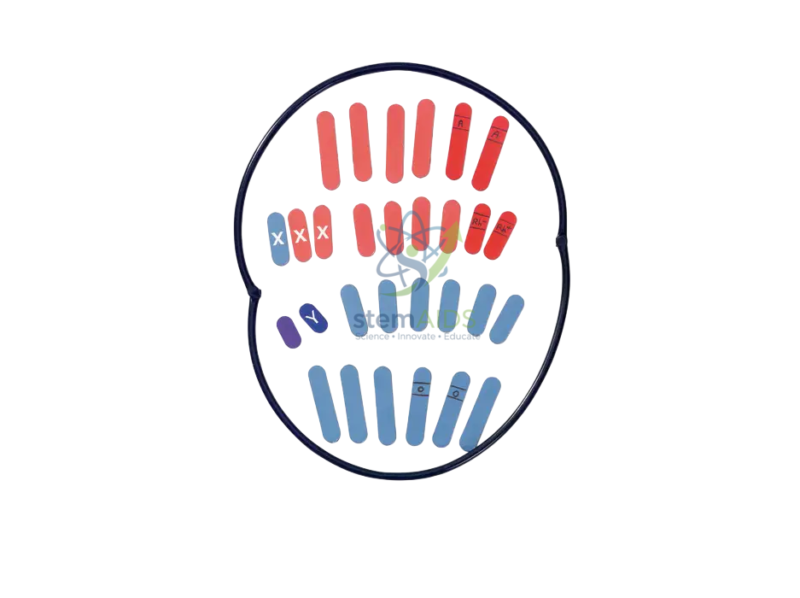
Inheritance is usually taught on paper, with letters in a Punnett square, and many students never connect the letters to anything physical. This set works the other way round. The product photo shows a cell outline containing red and blue bar-shaped chromosomes of different lengths, some of them marked, which is how student genetics sets usually represent the chromosomes from each parent. Students hold the chromosomes, pass one from each pair into a gamete and combine gametes to make offspring.
Done this way, Mendel’s laws become visible. Segregation is simply the two members of a pair going to different gametes; independent assortment is the fact that it does not matter which way each pair lines up. When students mark alleles on the chromosomes, say a dominant and a recessive allele for one trait, a monohybrid cross gives roughly a 3:1 ratio of phenotypes over many repeats, and the Punnett square becomes a record of what they have just done.
Student in the title suggests a version for learners to use at their desks rather than a large demonstration set, although the listing gives no piece count, size or number of students served. For the stages of cell division in more detail, see the chromatid chromosomes set; a genetics and evolution chart gives a wall reference.
Activities
- Making gametes from a diploid cell and counting the chromosome number
- Monohybrid and dihybrid crosses, checked against Punnett square predictions
- Sex determination and X-linked inheritance, such as red-green colour blindness
- Showing why siblings with the same parents are genetically different
Care & Handling
- Keep each student set in its own labelled bag or box so pieces from different sets do not mix.
- Wipe the pieces with a damp cloth and let them dry before storing.
- Check the piece count at the end of each lesson, because a missing chromosome spoils the next group’s activity.
Specifications
| Type | Student model set for inheritance and meiosis |
| Shown in the product photo | Cell outline with red and blue bar-shaped chromosomes of different lengths |
| Concepts | Gametes, segregation, independent assortment, fertilisation, alleles |
| Use | Hands-on work by individual students or small groups |
Why Choose LabEquip
Teachers buy student sets so every group can run its own crosses and compare results, which makes probability real in a way a single demonstration cannot. The set is part of LabEquip’s biology lab products; ask about class quantities through the contact page.
Related Products
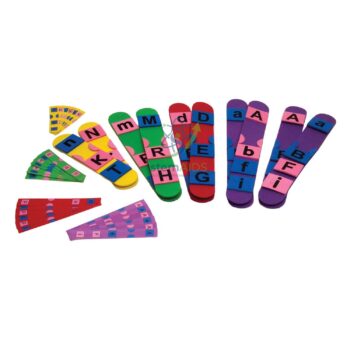
- Meiosis Manipulatives Kit: Chromosome pieces printed with allele letters for modelling crossing over and reduction to haploid in meiosis.
- Karyotype with Magnetized Chromosomes: Magnetic chromosome pieces sorted into a karyotype by length, centromere position and banding.
- Chromatid Chromosomes Set: Model chromosomes with sister chromatids and an X and Y pair, for mitosis, meiosis and crossing over.
- Plant Genetics Meiosis Chart: A wall chart of meiosis stage by stage, from homologous pairing to four haploid cells.
Frequently Asked Questions
How does a student genetics set model inheritance?
Students hold model chromosomes for each parent, pass one from each pair into a gamete and combine two gametes to make an offspring. The product photo shows a cell outline with red and blue bar-shaped chromosomes of different lengths, standing for the chromosomes from each parent.
What does segregation mean in genetics?
Segregation is Mendel’s first law: the two alleles of a gene separate when gametes form, so each gamete carries only one. With the set, it is the moment a student splits a chromosome pair and sends one member into each gamete.
Why does a monohybrid cross give a 3:1 ratio?
Crossing two heterozygous parents (Aa x Aa) gives offspring AA, Aa, Aa and aa, a 1:2:1 ratio of genotypes. If A is dominant, three of the four show the dominant trait and one the recessive, which is the 3:1 ratio of phenotypes.
What is independent assortment and how can a genetics set show it?
Genes on different chromosomes are sorted into gametes independently of each other. Using two chromosome pairs, students see that which member of the first pair enters a gamete does not decide which member of the second pair joins it, giving four types of gamete.
How is sex determined in humans?
Females have two X chromosomes and males an X and a Y. Every egg carries an X, while half of the sperm carry an X and half a Y, so the sperm decides the sex of the child and the expected ratio of boys to girls is 1:1.
Why do real results differ from predicted genetic ratios?
Genetic ratios are probabilities. With small numbers of offspring, chance alone produces deviations, just as ten coin tosses rarely give exactly five heads. Pooling the results of the whole class brings the totals closer to the expected ratio.
Last Updated: November 2026







Reviews
There are no reviews yet.