
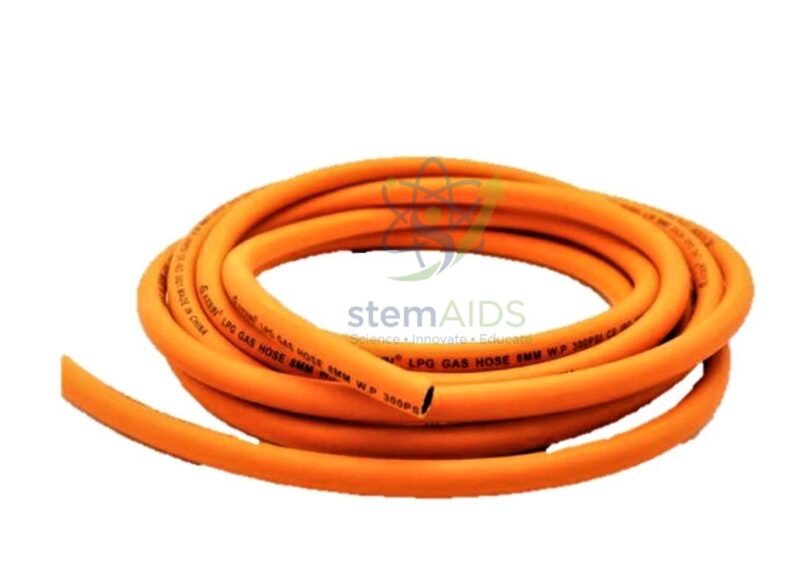
Quick Answer: The Gas Pipe Ø 3.5 mm is a flexible gas pipe for carrying gas from a valve, regulator or tap to laboratory apparatus; the product photograph shows a coil of orange gas hose. The 3.5 mm in its name is the listed diameter, and the gas pipe is pushed onto hose tails and held with clips.
Why Bore Size Controls Gas Flow
For smooth, slow flow through a narrow tube, Poiseuille’s law says the flow rate depends on the fourth power of the radius. Halving the bore of a gas pipe cuts the flow to one sixteenth for the same pressure difference, while doubling its length only halves the flow. A narrow pipe is therefore a gentle, easily controlled supply line, well suited to small valves and low-pressure demonstrations.
The same law explains why a kinked or squashed pipe starves apparatus of gas: a pinch that narrows the bore at one point has a very large effect on flow. Lay the flexible gas pipe in smooth curves and keep it clear of anything that could crush it.
Fitting and Inspecting the Pipe
Cut the gas pipe square with a sharp blade so the end seals evenly on the hose tail. Push it fully over the serrations, fit a clip, and route it away from flames, hot plates and sharp edges. After connecting, open the gas at working pressure and brush soapy water over each end to look for bubbles.
Tubing ages: it can harden, crack at the ends or turn sticky, and a pipe showing any of these signs is replaced rather than trimmed back again and again. A quick look along its length before each use catches most problems.
Uses on the Bench
- Connecting a 10 bar gas can valve to a trough, gas jar or reaction vessel
- Linking a hose tail fitting on a small gas bottle to apparatus on the bench
- Showing how tube bore and length change the rate of gas flow
- Replacing aged or cracked tubing on an existing gas set-up
Specifications
| Product | Flexible gas pipe |
| Diameter, from title | Ø 3.5 mm |
| Appearance in photograph | Orange flexible hose in a coil |
| Connection | Push-on over hose tails, secured with hose clips |
| Length supplied | Confirm at enquiry |
Care & Handling
- Keep the pipe away from naked flames and hot surfaces
- Store it loosely coiled and out of direct sunlight to slow ageing
- Replace it if it is cracked, hard or sticky
- Use a clip at every hose-tail joint
Why Choose LabEquip
Prep rooms keep a length of gas pipe on hand because every valve, fitting and burner set-up needs one. LabEquip supplies it with the compressed gas valve and the hose tail fitting for Minitop, part of our physics lab equipment; contact LabEquip for the length you need.
Frequently Asked Questions
Is Ø 3.5 mm the inside or the outside diameter?
The listing gives Ø 3.5 mm without saying which. It matters, because the bore has to fit the hose tail, so confirm it when you enquire and compare it with the hose tails you use.
Why does a narrow pipe reduce flow so much?
In steady, smooth flow the rate through a tube rises with the fourth power of its radius. A small reduction in bore therefore gives a large drop in flow, which is why a kink or pinch matters so much.
Can this pipe be used for a Bunsen burner?
Only if the tubing suits the burner gas and fits both the gas tap and the burner inlet. Burner tubing must be kept away from the flame and inspected for cracks before every lesson.
How do I stop the pipe slipping off a hose tail?
Push the pipe fully over the serrations and fit a hose clip over them. Warming the pipe end in hot water makes a tight fit easier without stretching it.
How often should gas pipe be replaced?
Whenever it shows cracks, hardening, stickiness or cuts. Inspect it before each use; the ends, where it flexes most, usually age first.
Why is gas pipe often brightly coloured?
A bright colour makes gas lines easy to see and to tell apart from water or vacuum tubing on a crowded bench. Colour is only a visual aid; suitability still depends on the tubing material and the gas in use.
Last Updated: October 2026




Reviews
There are no reviews yet.