
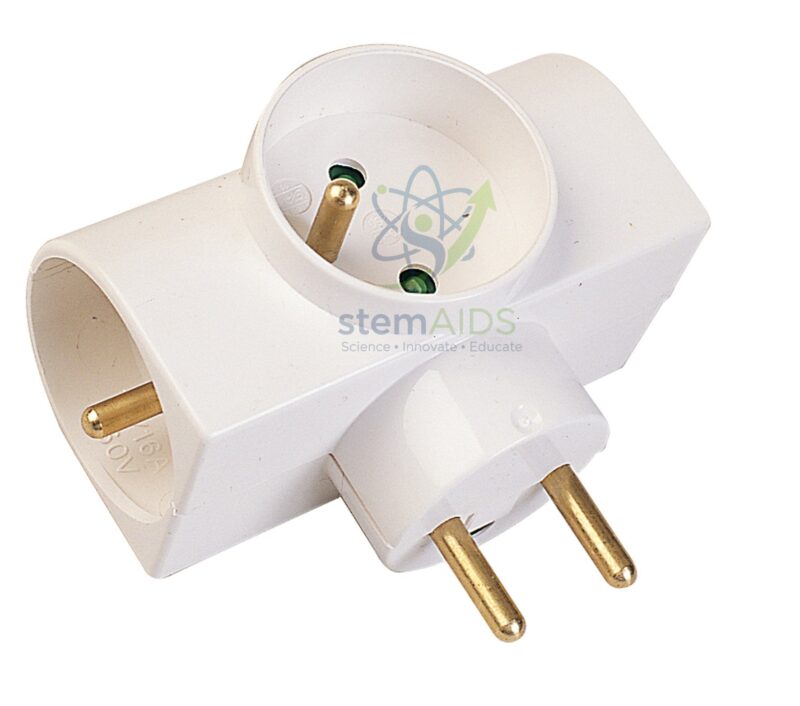
Quick Answer: This three-way socket adapter plugs into one mains outlet and provides three outlets, as pictured: a white body with round pins and an earth contact in the continental European style. A three-way socket adapter lets a bench run a few low-power instruments, such as a charger, a lamp and a meter, from a single wall socket.
Adding Up the Load
Every appliance plugged into the three-way socket adapter draws its current through the single wall outlet behind it, so the currents add. Using P = VI on a 230 V supply, devices of 60 W, 100 W and 500 W draw about 0.26 A, 0.43 A and 2.2 A, a total near 2.9 A. Students can work out totals for real bench equipment from the power ratings on their labels and compare them with the rating of the adapter and the socket.
Low-power items such as chargers, lamps and meters add little. Heaters, kettles, hot plates and ovens draw large currents and should each have a wall socket of their own, never a share of an adapter.
Plug Type and Safe Use
The adapter in the photograph has round pins and an earth contact of the continental European pattern. Plug and socket systems differ between countries, so make sure the adapter matches the sockets in your building and the plugs on your equipment before ordering.
Use only one adapter per socket and never plug one adapter into another. Keep it dry, away from sinks and water baths, and unplug it by its body rather than by any cable. An adapter that feels warm in use is overloaded or faulty and should be taken out of service.
Specifications
| Product | Three-way socket adapter |
| Shown in photograph | White adapter with round pins, an earth contact and three outlets |
| Use | Running several low-power devices from one mains outlet |
| Plug pattern | Continental European style, as pictured |
| Current and power rating | Confirm at enquiry |
Typical Uses
- Powering a charger, a lamp and a meter at one bench position
- Teaching how currents add in parallel circuits using real appliances
- Calculating total load from appliance power ratings
- Temporary power at a demonstration table
Care & Handling
- Never exceed the adapter’s rated current, and keep high-power appliances on their own sockets
- Do not chain adapters together
- Keep it away from water and wet hands
- Replace it if cracks, scorching or loose pins appear
Why Choose LabEquip
Labs with fewer wall sockets than instruments use an adapter for low-power bench equipment such as a battery charger or an LED floodlight. Contact LabEquip to confirm the plug pattern that matches your sockets, or browse our physics lab equipment.
Frequently Asked Questions
How do I work out whether the adapter is overloaded?
Add the power ratings of everything plugged in and divide by the supply voltage to get the total current. Compare that total with the current rating marked on the adapter.
Why are the outlets in parallel?
Each device needs the full supply voltage, so each is connected directly across the supply. In parallel every device gets the same voltage and the currents add.
Can a hot plate share the adapter with other equipment?
It is better not to. Heating appliances draw large currents and should have a wall socket each; the adapter is for low-power devices.
Does the plug type matter?
Yes. The photographed adapter has continental European round pins with an earth contact and fits sockets of that pattern. Check your wall sockets and equipment plugs before relying on it.
Why should adapters not be plugged into each other?
Chaining adapters piles more load onto one wall socket, strains the pins and makes overloading easy to miss. Use one adapter per socket at most.
What are the warning signs of a faulty adapter?
Warmth, a burning smell, discolouration, crackling or loose plugs. Switch off at the wall and remove it from use if any of these appear.
Last Updated: October 2026




Reviews
There are no reviews yet.