
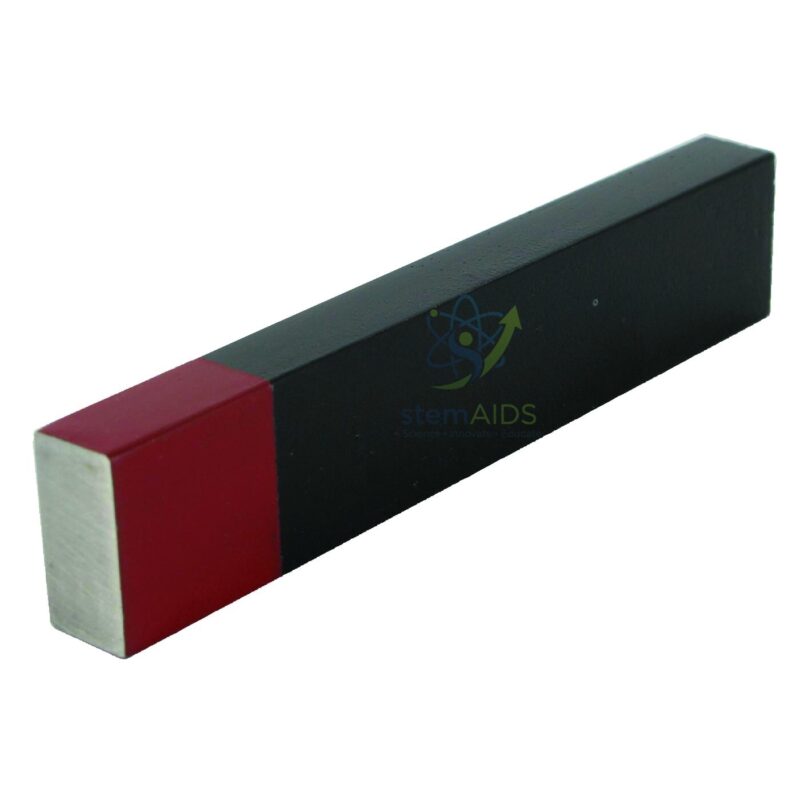
Quick Answer: The Ticonal straight magnet is a permanent bar magnet made of Ticonal, a trade name for magnet alloys of the alnico family based on iron with aluminium, nickel and cobalt. One end is red in the product photograph, the usual marking for the north pole, and the Ticonal bar magnet is used for field patterns, compass work and induction experiments.
Ticonal as a Magnet Material
Alnico-type alloys such as Ticonal hold a strong remanent magnetism and keep it well through ordinary temperature changes, which is why they were long the standard material for laboratory bar magnets and meter magnets. Their weak point is a relatively low coercivity: a strong opposing field, a hard knock or storage with like poles together can partly demagnetise them.
Ferrite and neodymium magnets resist demagnetisation better, but a Ticonal bar can be remagnetised in a strong coil, and it gives a field pattern with clear, well-separated poles at its ends, which suits school field-line work.
Uses
- Plotting field lines with iron filings or compasses
- Pushing into a coil to induce a current shown on a galvanometer
- Showing attraction and repulsion between unlike and like poles
- Magnetising a steel needle by stroking
Straight Versus Horseshoe
A straight magnet has its poles at opposite ends, so its field spreads out all around it; that makes it the right shape for drawing field lines and for pushing into a coil in induction experiments. A horseshoe magnet brings both poles side by side, giving a concentrated field across a gap that suits motor-effect demonstrations. Many laboratories keep both shapes.
Care & Handling
- Store magnets in pairs with unlike poles side by side and soft iron keepers across the ends
- Do not drop the magnet; impacts can weaken an alnico-type magnet
- Keep it away from strong opposing fields and from other magnets placed like pole to like pole
- Check the pole marking with a compass if the magnet has been stored carelessly
- Keep it away from watches, phones and bank cards
Specifications
| Type | Permanent straight bar magnet |
| Material | Ticonal, an alnico-family alloy, as titled |
| Pole marking | Red end in the product photograph, normally north |
| Uses | Field patterns, compass work and induction |
| Dimensions | Confirm at enquiry |
Why Choose LabEquip
Straight Ticonal magnets are bought by school and college laboratories that need dependable bar magnets for field-line and induction practicals. LabEquip can supply them with keepers, compasses and the bar magnet re-magnetization device from its physics lab equipment range.
Frequently Asked Questions
What is Ticonal?
Ticonal is a trade name for magnet alloys of the alnico family, made mainly of iron with aluminium, nickel and cobalt. These alloys give strong, stable permanent magnets that were widely used in laboratories and instruments.
Which end is the north pole?
In the product photograph one end is red, which normally marks the north pole. Confirm with a compass: the north-seeking end of the compass needle is repelled by the north pole of the magnet.
Why are keepers used when storing it?
A soft iron keeper across the poles gives the field a closed path through iron. This reduces the self-demagnetising effect at the poles and helps an alnico-type magnet keep its strength.
Can a weakened magnet be restored?
Yes. Placing it inside a coil carrying a large pulse of direct current, or using a magnetising device, realigns the domains. Put the red end at the end of the coil that becomes north.
How does it compare with a neodymium magnet?
A neodymium magnet of the same size is much stronger and harder to demagnetise, but it is brittle and can snap together hard enough to injure fingers. Ticonal bars are easier for students to handle and give clear field patterns.
Is it suitable for induction experiments?
Yes. Pushing either end into a coil connected to a sensitive meter induces a current, and reversing the direction of motion or the pole reverses the current.
Last Updated: October 2026




Reviews
There are no reviews yet.