
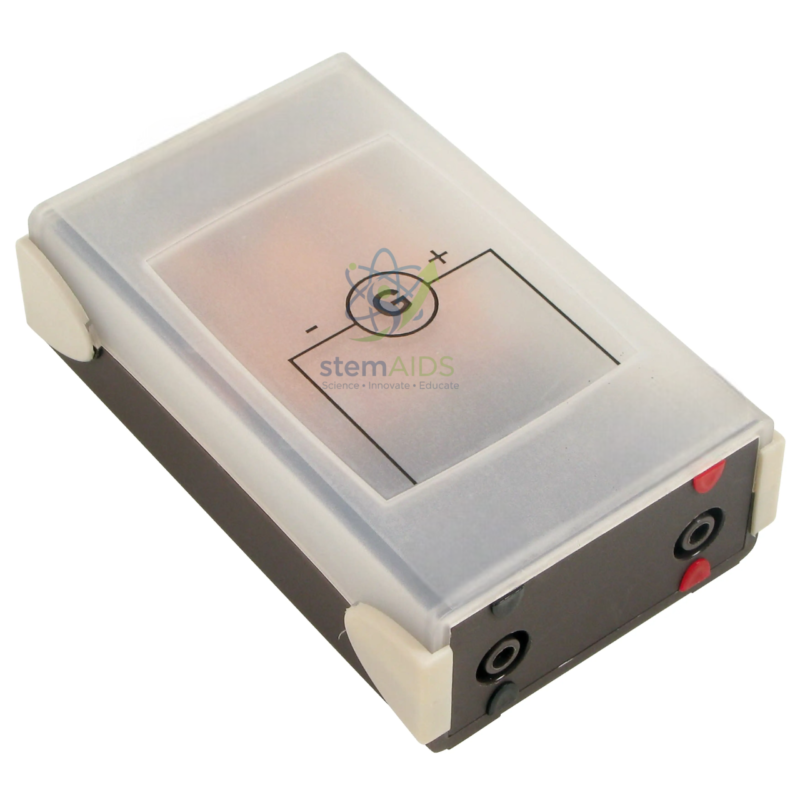
Quick Answer: The Elio 4.5 V source is a low-voltage direct-current supply rated at the 4.5 V given in its name, made for powering student circuits on the bench. This 4.5 V DC supply runs small lamps, LEDs, buzzers and motors and gives a known, fixed voltage for lessons on current, voltage and resistance.
A Safe Voltage for Hands-On Circuits
In a circuit diagram the source is the part that gives energy to the charges; every other component in the loop transfers that energy into light, sound, heat or motion. The Elio unit fills that role at 4.5 V, low enough for students to make and break connections freely yet high enough to light a torch bulb, sound a buzzer or turn a small motor. It is a source of steady direct current, not a rotating dynamo.
A fixed source suits the early stages of electricity teaching, when students are learning to build complete circuits, to read meters and to see what happens as components are added in series or in parallel. Because the voltage is known, measured values can be compared with predictions, and the differences lead naturally to the idea that a real source loses some voltage inside itself. How the unit is powered and the style of its terminals should be confirmed when ordering.
Circuits It Can Power
- Series and parallel circuits with torch bulbs, LEDs and 6 V buzzers
- Small motors and electromagnets in introductory electromagnetism
- Measuring emf and internal resistance from terminal voltage and current readings
- Sensor circuits built with thermistors and light dependent resistors
EMF, Terminal Voltage and Internal Resistance
Connect a voltmeter across the terminals with nothing else attached and it reads close to the electromotive force. Add a lamp, then a second lamp in parallel, and the reading drops a little as more current is drawn: the missing voltage is lost across the source’s internal resistance. Plotting terminal voltage against current for several loads gives a straight line whose intercept is the emf and whose gradient gives the internal resistance, a standard practical for older students. If the unit is electronically regulated the line will be much flatter, which is itself a useful comparison with a plain battery.
Specifications
| Type | Low-voltage DC source |
| Rated voltage | 4.5 V (as titled) |
| Brand | Elio (as titled) |
| Use | Student circuits with lamps, buzzers, LEDs and small motors |
| Energy source and terminal type | Confirm at enquiry |
Care & Handling
- Never join the terminals of the Elio source directly together; a short circuit drains a battery quickly and can overheat the wires.
- Switch off or disconnect the source while circuits are being rebuilt.
- If the unit holds batteries, remove exhausted ones promptly so they cannot leak, and send them for recycling.
- Keep the unit dry and away from liquids being used elsewhere on the bench.
Why Choose LabEquip
Schools equipping a whole class with matching sources usually order them with the switches, lamp holders and buzzers that go with them. LabEquip supplies the Elio 4.5 V source and companion components from our physics lab equipment range; ask through the contact page about quantities and how the unit is powered.
Frequently Asked Questions
Is 4.5 V safe for students to handle?
A 4.5 V direct-current source is an extra-low voltage and cannot drive a dangerous current through dry skin. The real risks are heating from short circuits and, where batteries are used, leaks from old cells, so students should still learn never to join the terminals directly.
Why does the voltage drop when I connect more lamps?
Every real source has some internal resistance. The more current the circuit draws, the more voltage is lost inside the source and the less appears at its terminals. With one lamp the drop is small; with several lamps in parallel the extra current makes it visible on a voltmeter.
Can it run a motor rated at a higher voltage?
Usually the motor will turn, but more slowly and with less torque than at its rated voltage, because a DC motor’s speed rises with supply voltage. That can be a useful observation in itself. A motor rated well below 4.5 V should not be connected, as it may overheat.
Is the Elio source a battery or a mains supply?
It is a 4.5 V direct-current source for student circuits. Units of this kind are made both as battery holders and as mains-fed supplies, so how this model is powered should be confirmed at enquiry.
What is the difference between emf and terminal voltage?
The emf is the energy the source gives each unit of charge, measured as the voltage when no current is drawn. The terminal voltage is what remains for the external circuit once current flows and some voltage is lost across the internal resistance. They are equal only when the current is zero.
Which components can be powered from a 4.5 V source?
Torch bulbs, protected LEDs, small buzzers, low-voltage motors, electromagnets and sensor circuits with thermistors or light dependent resistors are typical. Check each component’s rating; a bare LED, for example, still needs a series resistor.
Last Updated: October 2026






Reviews
There are no reviews yet.