
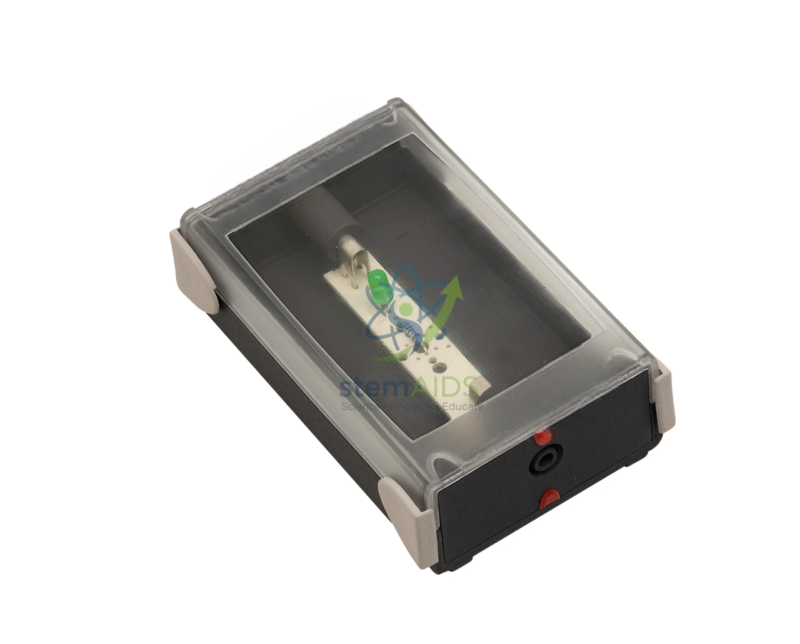
Quick Answer: This is a protected green LED on a support: a green light-emitting diode fixed to a base with connection terminals and fitted with built-in protection, normally a current-limiting resistor. It lets students connect an LED into low-voltage circuits without adding their own resistor, to show one-way conduction and to act as a visible indicator.
What the Protection Does
An LED cannot be connected straight across a battery the way a filament bulb can. Once its forward voltage is reached the current climbs very steeply, and with nothing to limit it the junction overheats almost at once. On a bare LED the circuit designer adds a series resistor chosen for the supply. On a protected module that resistor, and on some designs a diode against reverse voltage, is already built in, which suits student benches where leads are swapped and supplies are changed all lesson.
Protection widens the range of supplies the LED will tolerate; it does not make it unlimited. The supply voltages the module is designed for should be checked before use, and students should still learn why a bare LED needs its resistor, perhaps by comparing the module with an unprotected LED on a breadboard.
Specifications
| Component | Green light-emitting diode (LED) |
| Mounting | On a support with connection terminals |
| Protection | Built in, normally a current-limiting resistor |
| Operation | Lights when forward-biased only |
| Permitted supply range and terminal type | Confirm at enquiry |
Why It Lights Only One Way Round
Inside is a p-n junction made from a semiconductor in which electrons give up energy as light when they cross the junction and recombine with holes. Connected with the anode to the positive side (forward bias), current flows and the green light appears. Reversed, almost no current flows and the LED stays dark. Swapping the leads on the support is the quickest classroom proof that a diode is a one-way device. The colour is a talking point too: it is fixed by the energy gap of the semiconductor, which is larger for green than for red.
Uses in Circuit Work
- Demonstrating forward and reverse bias with a simple cell and switch circuit
- Showing the direction of conventional current, since the LED lights only one way round
- Acting as an on-off indicator in circuits built with a student switch
- Indicating the output state of logic gate or sensor circuits in electronics practicals
Care & Handling
- Check the polarity marks on the support before connecting the protected green LED; reversing it does no harm but it will not light.
- Stay within the supply range intended for the module, because the built-in protection limits current only over that range.
- Avoid staring into the LED at very close range for long periods.
- Keep the terminals clean and store the modules dry so the contacts do not corrode.
Why Choose LabEquip
Schools buying LED modules usually want one for every pair of students, often in more than one colour. LabEquip supplies the green module alongside switches, buzzers and low-voltage sources from our physics lab equipment range; tell us your supply voltage and the quantity through the contact page.
Frequently Asked Questions
What does protected mean on this green LED?
It means the LED has its own current-limiting component, normally a series resistor, so it can be connected to a suitable low-voltage supply without the user adding one. Some designs also include a diode against reverse voltage. The supply range the module accepts should be checked before use.
Can I use the protected LED to measure the forward voltage of a green LED?
Not accurately. A voltmeter across the terminals reads the LED voltage plus the drop across the built-in resistor, which changes with current. For forward-voltage work or the LED method for the Planck constant, use a bare LED with your own resistor so the meter sits directly across the diode.
Why does the LED not light when I connect it?
The most likely reason is that it is the wrong way round, so the diode is reverse-biased. Swap the leads. If it still stays dark, check that the supply is on and within the range for the module and that the circuit is complete.
Why use a green LED instead of a small bulb as an indicator?
An LED gives a clearly visible glow from far less current than a filament bulb, stays cool and shows the direction of current because it lights one way only. A bulb lights either way round and is the better choice when the lesson is about heating or brightness changing with current.
What sets the colour of an LED?
The semiconductor material and its energy gap. When an electron recombines with a hole it releases a photon whose energy is close to that gap, so a larger gap gives light towards the blue end of the spectrum. Green LEDs have a larger gap than red ones.
Can the protected LED be used on an alternating supply?
It glows only on the half-cycles that forward-bias it, so on a low-voltage AC supply it flickers at the supply frequency, which can be seen by moving the LED quickly sideways. Check that the module’s protection can withstand the reverse voltage of the other half-cycles first.
Last Updated: October 2026




Reviews
There are no reviews yet.