
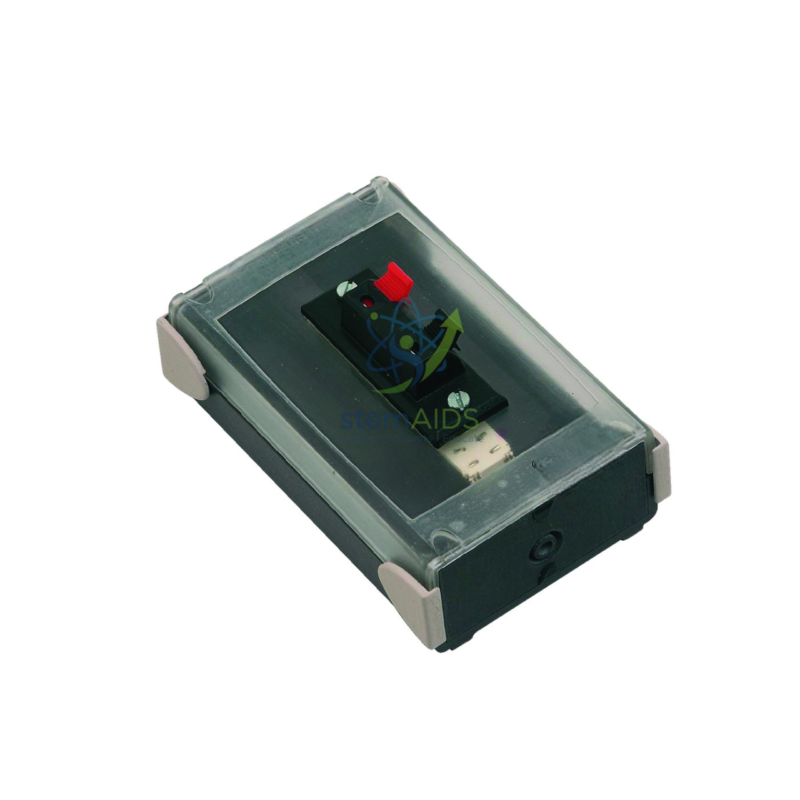
Quick Answer: The universal component holder is a module with a clear cover, clip contacts on a small board and connection sockets, as pictured, into which a two-lead electronic component can be fitted. It turns a loose resistor, capacitor, diode or similar part into a robust plug-in circuit element that connects with ordinary leads.
One Holder, Many Components
Two-terminal components make up most of the circuits studied in school and college: resistors, capacitors, diodes, LEDs, thermistors, light-dependent resistors and small inductors. Each is awkward on its own, with thin leads that bend, break or short. The holder grips the component’s two leads in its clips and brings them out to the module’s sockets, so the part can be wired like any other module and swapped in seconds.
A single holder therefore does the work of many dedicated modules. A teacher can keep a box of loose components and a few holders instead of a separate mounted module for every value, and students can test a component, change it for another value and repeat the measurement without rewiring the rest of the circuit.
Comparing Components Side by Side
The holder is especially useful for comparing different components under the same conditions. Mount a resistor, then a diode, then a thermistor, each in the same position in a circuit with an ammeter and a voltmeter, and plot their current-voltage graphs. Ohmic, one-way and temperature-dependent behaviour appear side by side. The same approach works for comparing capacitors of different values in charging and discharging circuits, or LEDs of different colours.
Applications
- Mounting resistors, capacitors, diodes and sensors for current-voltage studies
- Swapping component values quickly in series, parallel and RC timing circuits
- Testing unknown or salvaged components in a safe, enclosed holder
- Reducing the number of dedicated component modules a laboratory needs to stock
Specifications
| Type | Universal holder for two-lead components |
| Contacts | Clip contacts on an internal board, as pictured |
| Housing | Module with clear cover and side sockets, as pictured |
| Suitable parts | Resistors, capacitors, diodes, LEDs, thermistors and similar two-lead components |
| Maximum lead size and current rating | Confirm at enquiry |
Care & Handling
- Insert component leads straight into the clips and avoid forcing thick leads that could spread them.
- Switch off before changing the component; after capacitor experiments, discharge the capacitor first.
- Respect the polarity of electrolytic capacitors and diodes when fitting them.
- Keep the clips clean and dry, and store the module in a tray with other circuit modules.
Why Choose LabEquip
Universal holders are bought by laboratories that want flexibility, since one module serves for many components across a whole course. LabEquip lists it with dedicated modules such as the protected red LED and the unknown resistor set in its Physics Equipments category.
Frequently Asked Questions
Which components can be mounted in the holder?
Any component with two wire leads that fit the clips, such as resistors, capacitors, diodes, LEDs, thermistors, light-dependent resistors and small coils. Components with three or more leads, such as transistors, need a different holder.
Why use a holder instead of plugging components into a breadboard?
A breadboard suits small electronic circuits, but school physics circuits are usually built with leads and modules. The holder lets a loose component join that kind of circuit with proper sockets and protection from damage.
Do I need to worry about polarity?
For polarity-sensitive parts such as diodes, LEDs and electrolytic capacitors, yes. Note which socket connects to which lead and fit the component the right way round for the circuit.
Can the holder be used for capacitor charging experiments?
Yes. Mount the capacitor, connect it in series with a resistor and supply, and record the voltage or current over time. Always discharge the capacitor before removing it from the holder.
Will the clips wear out?
Clips can lose their grip if thick leads are forced in or bent wires are twisted in them. Straighten leads before inserting them and the clips keep a firm contact for longer.
Is the holder safe for students?
It is intended for low-voltage teaching circuits. The cover keeps fingers away from the component, and students should switch off before changing parts.
Last Updated: October 2026




Reviews
There are no reviews yet.