
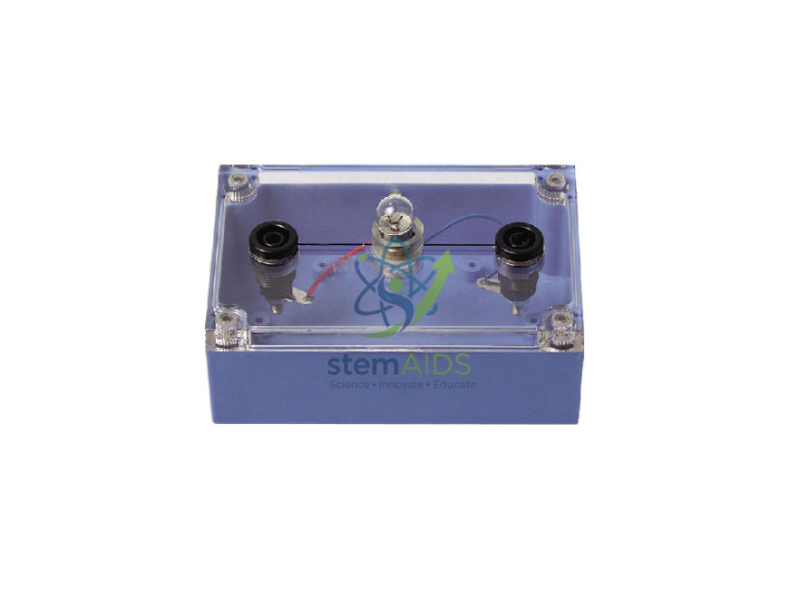
Quick Answer: The Socket E10 is an E10 lamp socket mounted in a protective module with a clear cover and two connection sockets, as pictured, for holding a miniature screw bulb in circuit experiments. E10 denotes an Edison screw thread 10 mm in diameter, the common fitting for small torch-type bulbs.
Why a Lamp Module Helps
A bare miniature bulb is awkward in student circuits: it rolls, its contacts are tiny and it is easy to short. Mounting the E10 holder in a module with proper sockets turns it into a component that connects with ordinary leads and sits flat on the bench, so attention goes to the circuit rather than the wiring. The clear cover lets students see the filament glow while protecting the bulb from knocks.
Because the bulb screws in, it can be swapped for one of a different voltage or wattage rating, or replaced when it fails, without changing the module. The bulb’s rating should match the supply: a bulb run above its rated voltage burns out quickly, and one run far below it barely glows.
Lamp Experiments
With two or three lamp modules students compare series and parallel circuits directly. In series the lamps share the supply voltage and glow dimly, and removing one breaks the circuit for all; in parallel each receives the full supply voltage, glows brightly and works independently. With an ammeter and a voltmeter, a single lamp shows a classic non-ohmic characteristic: as the current rises the filament heats, its resistance increases, and the current-voltage graph curves away from a straight line.
Applications
- Comparing lamp brightness in series and parallel circuits
- Plotting the current-voltage characteristic of a filament lamp
- Using a lamp as a simple current indicator in continuity and switch circuits
- Building model house-wiring and traffic-light circuits in project work
Care & Handling
- Switch off before changing a bulb, and let a hot bulb cool first.
- Screw bulbs in gently until they make contact; overtightening strains the holder.
- Match the bulb to the supply voltage to avoid early burnout.
- Keep the module dry and avoid stacking heavy items on the clear cover.
Specifications
| Type | E10 lamp holder module |
| Lamp fitting | E10 miniature Edison screw |
| Housing | Module with clear cover and two connection sockets, as pictured |
| Lamp | Miniature E10 bulb, as pictured; ratings vary by bulb |
| Bulb supplied and connection socket size | Confirm at enquiry |
Why Choose LabEquip
Lamp modules are among the most used items in school electricity, bought in class sets so every group can build series and parallel circuits. LabEquip lists the E10 holder with matching modules such as the single pole knife switch and the protected red LED in its Physics Equipments category.
Frequently Asked Questions
What does E10 mean?
E stands for Edison screw, the threaded base used on many bulbs, and 10 is the nominal diameter of the thread in millimetres. E10 is the standard fitting for miniature torch-type bulbs.
Which bulbs fit the socket?
Any miniature bulb with an E10 screw base fits. Choose the bulb’s voltage rating to suit the supply used in the experiment, such as the number of cells in the circuit.
Why do lamps in series glow more dimly than lamps in parallel?
In series the lamps share the supply voltage, so each receives only part of it and less current flows. In parallel each lamp is connected directly across the supply and receives the full voltage.
Why is the lamp’s current-voltage graph curved?
As more current flows, the filament gets hotter and its resistance rises. Equal increases in voltage then produce smaller increases in current, so the graph bends toward the voltage axis.
Can an LED bulb be used in the socket?
Some E10 LED bulbs exist, but they are polarity-sensitive or contain their own circuitry and may behave differently in experiments. For filament-lamp practicals, use ordinary filament bulbs.
What should I do if the bulb does not light?
Check that the bulb is screwed in fully, that the filament is unbroken, and that the supply and leads work. Testing the module with a known good bulb quickly shows whether the fault is in the bulb or the circuit.
Last Updated: October 2026




Reviews
There are no reviews yet.