
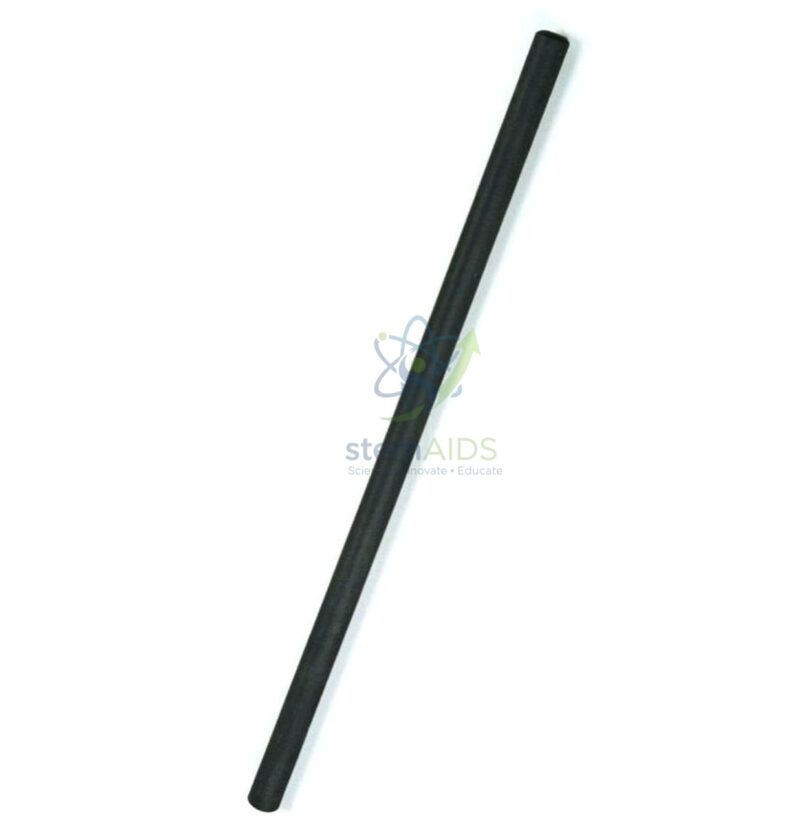
Quick Answer: The Ebonite stick is a black rod of ebonite, a hard vulcanised rubber, used in electrostatics as a charging rod. Rubbed with wool or fur, an ebonite rod becomes negatively charged, providing the classic negative reference charge in school experiments.
What Ebonite Is
Ebonite is natural rubber vulcanised with a large proportion of sulfur until it becomes hard, dark and rigid. It was developed in the nineteenth century and used for combs, pipe stems and electrical insulators, and it became a standard material for electrostatics because it is an excellent insulator and charges strongly by friction.
When ebonite is rubbed with wool or fur, electrons transfer from the cloth to the rod. The rod gains a negative charge and the cloth an equal positive charge. This is the resinous electricity of early experimenters, opposite in sign to the charge on glass rubbed with silk.
Charging an Electroscope by Induction
Charging by induction is where the ebonite rod comes into its own. Bring the negatively charged rod near the cap of an electroscope: electrons are repelled down to the leaf or needle, which deflects. Touch the cap briefly with a finger and those electrons escape to earth through the body. Remove the finger first, then the rod, and the electroscope is left with a positive charge, opposite to the rod, shown by a steady deflection.
Uses in Electrostatics
- Providing a negative reference charge for testing the sign of other charges
- Charging electroscopes positively by induction and negatively by contact
- Showing attraction between rubbed ebonite and glass on an electrostatic pivot
- Attracting small paper pieces and bending a thin stream of water from a tap
Specifications
| Material | Ebonite (hard vulcanised rubber) |
| Form | Black round rod, as pictured |
| Charge when rubbed with wool or fur | Negative |
| Paired with | Wool cloth or fur; tested with electroscopes and pendulums |
| Length and diameter | Confirm at enquiry |
Care & Handling
- Store ebonite away from sunlight; light slowly oxidises its surface, which then leaks charge.
- Clean with a soft, dry cloth; if the surface has dulled, gentle rubbing with a fine polishing cloth restores it.
- Keep solvents and oils away from it, as they soften or contaminate the surface.
- Handle with care: ebonite is hard but can chip or snap if dropped onto a hard floor.
Why Choose LabEquip
Every electrostatics kit needs a negative reference, and schools buy these rods in sets for group practicals. Pair it with friction textiles for rubbing and the glass rod for the opposite charge, both in the LabEquip Physics Equipments category.
Frequently Asked Questions
Why does ebonite become negatively charged?
Ebonite holds electrons more strongly than wool or fur. When the two are rubbed and separated, electrons move onto the ebonite, giving it a negative charge and leaving the cloth positive.
Is an ebonite stick the same as an ebonite rod?
Yes. Stick and rod are two names for the same item, a straight bar of ebonite held at one end and rubbed at the other.
Can a plastic rod replace ebonite?
Polythene and similar plastics also charge negatively with wool and are often used today. Ebonite remains popular because it charges strongly, is rigid and gives results that match textbook descriptions.
Why has my rod stopped charging well?
Exposure to light slowly oxidises the surface of ebonite, and grease from hands builds up over time; both let charge leak away. Keep the rod in a closed box and clean the surface with a soft, dry cloth.
How do I bend a stream of water with the rod?
Rub the rod with wool, then bring it close to a thin, smooth stream of water from a tap. The water bends toward the rod because the charge induces an opposite charge in the nearby water.
Which rubbing cloth works with ebonite?
Wool and fur are the traditional choices. Rub briskly over a short section with a dry cloth, and test the charge immediately on an electroscope or pith ball.
Last Updated: October 2026




Reviews
There are no reviews yet.