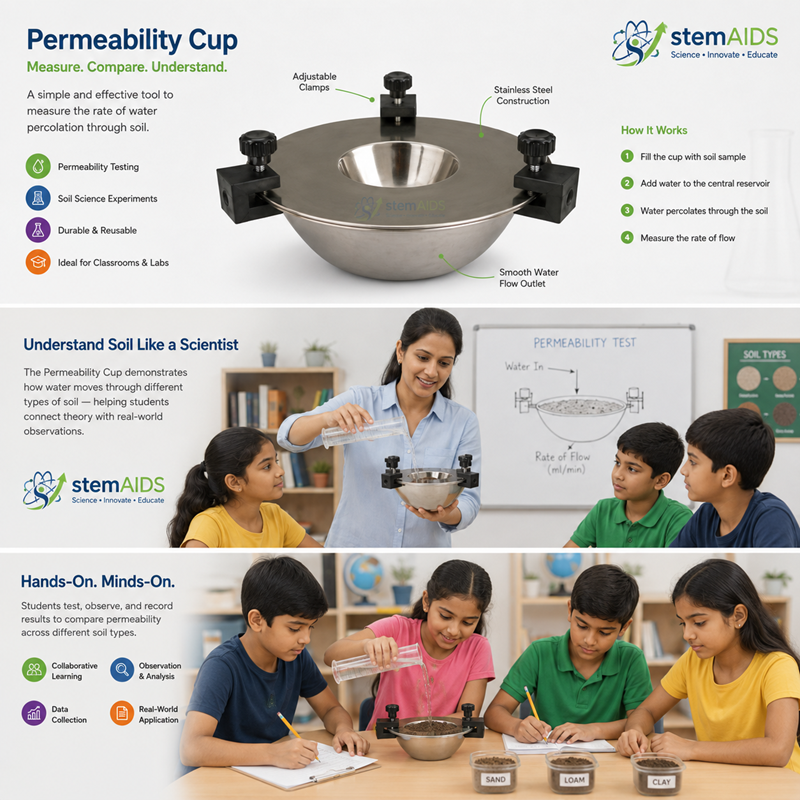
The Permeability Cup is a laboratory test apparatus used for evaluating the transmission of water vapour through compatible films, coatings and sheet materials under controlled test conditions. It is intended for materials laboratories, coatings laboratories, academic institutions and quality-control environments where comparative barrier-property measurements are required.
Product Description
The STEMAids Permeability Cup is intended for gravimetric permeability testing of suitable thin specimens. In a typical cup method, a test specimen is sealed across the opening of a cup containing either a moisture source or desiccant. Water vapour passes through the exposed specimen according to the established test conditions.
Changes in mass over a defined period can then be used to evaluate water-vapour transmission or related permeability characteristics. Exact cup material, exposed area, dimensions, gasket arrangement and test-standard conformity of this STEMAids model should be confirmed before procurement. Browse related General Lab Products and the wider STEMAids laboratory product catalogue.
Key Features
- Barrier-property testing: Supports evaluation of water-vapour transmission through compatible films and coatings.
- Gravimetric test principle: Enables permeability assessment from measured mass change over a specified test period.
- Controlled specimen exposure: The specimen is positioned across the cup opening so vapour transmission occurs through a defined test region.
- Comparative material evaluation: Useful for comparing the moisture-barrier behaviour of compatible specimen types.
- Laboratory application: Suitable for supervised materials, polymer, coatings and educational testing workflows.
- Supports wet or dry cup methodology: Applicable in principle to suitable test procedures using a moisture source or desiccant, subject to the chosen method.
- Procurement-ready test concept: Allows laboratories to specify exposed area, materials and standards separately according to their required test method.
Technical Specifications
|
Specification |
Detail |
|
Product Name |
Permeability Cup |
|
Brand |
STEMAids |
|
Product Type |
Laboratory permeability / water-vapour transmission test cup |
|
Test Principle |
Gravimetric vapour-transmission measurement |
|
Typical Specimens |
Compatible films, coatings and thin sheet materials |
What’s Included in the Kit
- 1 × Permeability Cup assembly
Gaskets, retaining rings, sealing accessories, desiccant, test specimens and operating instructions should be confirmed for the exact supplied configuration.
Applications / Uses
- Water-vapour transmission testing of compatible films.
- Comparative permeability testing of coatings and coating systems.
- Evaluating moisture-barrier behaviour of thin sheet materials.
- Materials-science and polymer laboratory practicals.
- Quality-control comparison of compatible barrier materials.
- Academic demonstrations of diffusion and vapour transmission.
How to Use the Permeability Cup
- Confirm the required test method, specimen type and environmental conditions.
- Prepare the specimen according to the applicable laboratory procedure.
- Add the required desiccant or test liquid to the cup if specified by the selected method.
- Place the specimen across the cup opening without damaging or unnecessarily stretching it.
- Seal the specimen securely using the supplied retaining and sealing arrangement.
- Record the initial mass using a suitable calibrated balance.
- Expose the assembled cup to the controlled temperature and humidity specified by the test method.
- Measure mass change at the prescribed intervals and calculate the required transmission result according to the selected procedure.
Safety note: Follow the safety requirements for any liquid, desiccant, coating or test material used. Wear suitable laboratory PPE and handle specimens and chemicals according to their safety documentation.
Care & Maintenance
- Clean the cup thoroughly after each test and remove residual coating, liquid or desiccant.
- Keep sealing surfaces free from scratches, contamination and dried residues.
- Inspect gaskets and retaining components for damage before each test.
- Store the apparatus clean and dry to preserve repeatable sealing performance.
Why Choose STEMAids
STEMAids supplies laboratory equipment, scientific instruments and educational apparatus for academic and professional laboratory environments. Its General Lab Products range covers cross-disciplinary tools used in science, research and institutional laboratories. STEMAids is associated with Eduscope Smart Learning Solutions Private Limited, an ISO 9001:2015-certified manufacturer based in New Delhi. Procurement teams can review STEMAids tender and institutional supply information and company credentials before ordering.
Frequently Asked Questions
What is a Permeability Cup used for?
A Permeability Cup is used to evaluate how readily water vapour passes through compatible films, coatings or thin materials under controlled test conditions.
How does a permeability cup test work?
A specimen is sealed across the cup opening while a controlled humidity difference is maintained across it. The change in cup mass over time is used to assess vapour transmission according to the selected test method.
Can a permeability cup test paint and coating films?
Yes. Permeability cup methods are commonly used with suitable paint films, varnishes, coatings and other thin barrier materials.
What is the difference between wet-cup and dry-cup testing?
Wet-cup testing normally uses a moisture source to create high humidity on one side of the specimen, while dry-cup testing uses a desiccant to establish low humidity. The selected method depends on the applicable test procedure.
Does this STEMAids Permeability Cup comply with ASTM D1653 or ISO 7783?
Model-specific compliance with ASTM D1653, ISO 7783 or another standard has not been verified. Confirm the required exposed area, dimensions and conformity with STEMAids before ordering for standardized testing.
What material is the Permeability Cup made from?
The construction material of this exact STEMAids model has not been verified and should be confirmed before procurement.