Wave Motion Pendulum Model

The Wave Motion Pendulum Model is a physics demonstration model used for visualizing wave motion, oscillation, and phase relationships between multiple pendulums. Designed for students and educators, it helps explain periodic motion, wave patterns, and the behaviour of coupled oscillating systems.

Product Description

The STEMAids Wave Motion Pendulum Model is an educational physics model designed to demonstrate how individual oscillations combine to create visible wave patterns. Multiple pendulums with different oscillation phases create a dynamic representation of wave movement that helps students understand complex wave concepts.

This model supports lessons on periodic motion, frequency, wavelength concepts, phase difference, and oscillations. It provides a practical visual demonstration that connects mathematical descriptions of waves with observable motion. The exact number of pendulums, materials, dimensions, and included components should be confirmed from the latest STEMAids product documentation.

Key Features

  • Wave motion visualization: Creates visible wave patterns through coordinated pendulum oscillations.
  • Oscillation concept demonstration: Helps explain periodic motion and repetitive movement.
  • Phase relationship learning: Shows how differences in timing create changing wave patterns.
  • Physics classroom application: Supports demonstrations of waves and oscillatory systems.
  • STEM learning support: Encourages observation, analysis, and scientific discussion.
  • Interactive teaching model: Makes abstract wave concepts easier to understand.
  • Reusable demonstration apparatus: Suitable for repeated classroom use with proper handling.

Technical Specifications

Specification

Detail

Product Name

Wave Motion Pendulum Model

Brand

STEMAids

Product Category

Physics Waves and Oscillation Demonstration Model

Main Function

Demonstration of wave motion through pendulum oscillations

Operating Principle

Periodic motion, oscillation, and phase difference

Standards or Certifications

No product-specific certification verified

What’s Included in the Kit

  • Wave Motion Pendulum Model assembly
  • Pendulum arrangement system
  • Supporting frame/base
  • Accessories required for demonstration
  • Experiment guide

Applications / Uses

  • Demonstrating wave patterns and oscillatory motion.
  • Explaining frequency, phase difference, and periodic behaviour.
  • Teaching simple harmonic motion concepts.
  • Supporting physics lessons on waves and vibrations.
  • Conducting STEM activities involving motion analysis.
  • Helping students visualize wave propagation concepts.

Explore related educational solutions from STEMAids, including physics laboratory products, science models, STEM kits, and other scientific educational equipment.

How to Use the Wave Motion Pendulum Model

  1. Place the model on a stable and level surface.
  2. Check that all pendulums are correctly positioned.
  3. Move or release the pendulums according to the supplied instructions.
  4. Observe the changing wave patterns produced by different oscillation phases.
  5. Discuss how individual pendulum motion combines to create wave-like behaviour.
  6. Relate observations to concepts of frequency, phase, and periodic motion.

Safety note: Operate carefully and avoid pulling or forcing pendulums beyond their normal movement range.

Care & Maintenance

  • Keep the model clean and dry after use.
  • Store pendulums and frame components safely.
  • Check suspension points before demonstrations.
  • Avoid impacts that may affect pendulum alignment.

Why Choose STEMAids

STEMAids manufactures and supplies scientific laboratory instruments, educational models, science kits, and STEM learning products for schools and institutions. The company develops practical teaching solutions that support science education through visual demonstrations and hands-on experiments. STEMAids serves educational buyers through its product portfolio and export capabilities. Customers should confirm the latest technical specifications and supplied configuration before purchase.

Frequently Asked Questions

What is a Wave Motion Pendulum Model used for?

A Wave Motion Pendulum Model is used to demonstrate wave patterns, oscillations, and phase relationships between multiple pendulums.

What physics concepts can students learn from this model?

Students can learn about periodic motion, oscillation, wave behaviour, frequency, and phase difference.

Can the Wave Motion Pendulum Model be used in schools?

Yes. It is suitable for physics classrooms, science laboratories, and STEM learning activities.

How does a pendulum model demonstrate wave motion?

The model uses multiple pendulums with different timing relationships to create visible wave-like patterns from individual oscillations.

Does the Wave Motion Pendulum Model require electricity?

No external electrical power is normally required for a mechanical pendulum wave demonstration model.

Why are pendulum wave models useful for teaching physics?

They provide a visual way to understand complex wave and oscillation concepts that are difficult to observe using only diagrams or equations.

Contact STEMAids for confirmed specifications, availability, and institutional requirements, or explore the complete range of science demonstration models.

Recommended Image ALT Text: STEMAids Wave Motion Pendulum Model demonstrating oscillation patterns and wave motion concepts for physics education
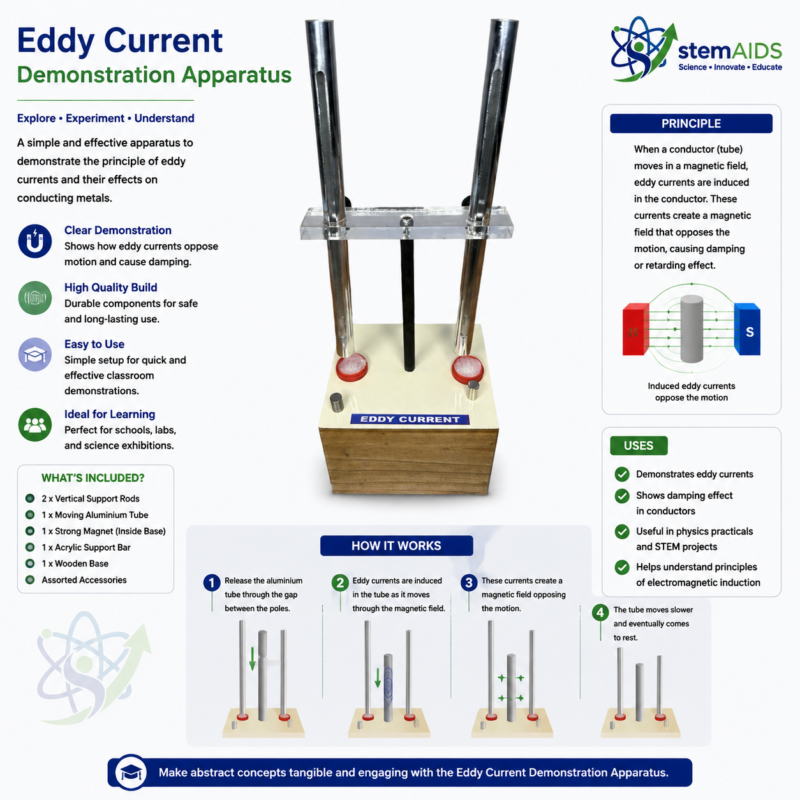
Eddy Current Demonstration Apparatus

The Eddy Current Demonstration Apparatus is a physics laboratory apparatus used for demonstrating eddy currents, electromagnetic induction, and magnetic damping effects. Designed for students and educators, it helps explain how changing magnetic fields generate induced currents and produce opposing magnetic forces.

Product Description

The STEMAids Eddy Current Demonstration Apparatus is an educational electromagnetism model designed to demonstrate the practical effects of induced currents in conductive materials. It helps students observe how magnetic fields interact with moving conductors and how this interaction can create resistance to motion.

Eddy currents are circulating currents produced inside a conductor when the magnetic flux through it changes. These induced currents generate magnetic fields that oppose the change causing them, providing a practical demonstration of Lenz’s law and electromagnetic damping. The exact disc material, magnet specifications, dimensions, and included accessories should be confirmed from the latest STEMAids product documentation.

Key Features

  • Eddy current demonstration: Shows the generation and effects of induced currents in conductive materials.
  • Lenz’s law visualization: Helps students understand opposing magnetic effects during induction.
  • Magnetic damping experiment: Demonstrates resistance to motion caused by electromagnetic interaction.
  • Electromagnetic induction learning: Connects theoretical concepts with practical observation.
  • Physics laboratory application: Suitable for classroom demonstrations and practical experiments.
  • STEM education support: Encourages investigation of electricity and magnetism principles.
  • Reusable apparatus: Designed for repeated educational demonstrations with proper handling.

Technical Specifications

Specification

Detail

Product Name

Eddy Current Demonstration Apparatus

Brand

STEMAids

Product Category

Physics Laboratory Electromagnetism Demonstration Apparatus

Main Function

Demonstration of eddy currents and electromagnetic damping

Operating Principle

Electromagnetic induction and Lenz’s law

Standards or Certifications

No product-specific certification verified

What’s Included in the Kit

  • Eddy Current Demonstration Apparatus assembly
  • Conductive disc component
  • Magnetic components
  • Supporting frame/base
  • Experiment instruction guide

Applications / Uses

  • Demonstrating electromagnetic induction principles.
  • Explaining Lenz’s law and induced current effects.
  • Showing electromagnetic braking and damping concepts.
  • Supporting electricity and magnetism lessons.
  • Conducting practical physics laboratory demonstrations.
  • Introducing real-world applications of eddy currents.

Explore related educational solutions from STEMAids, including physics laboratory products, science models, STEM kits, and other scientific educational equipment.

How to Use the Eddy Current Demonstration Apparatus

  1. Place the apparatus on a stable laboratory surface.
  2. Check that the disc and magnetic components are correctly positioned.
  3. Move the conductor or magnetic component according to the experiment setup.
  4. Observe changes in motion caused by electromagnetic effects.
  5. Discuss the results using concepts of induced currents and magnetic fields.
  6. Repeat the experiment under different conditions if required.

Safety note: Use under laboratory supervision. Keep magnets away from sensitive electronic devices and handle moving parts carefully.

Care & Maintenance

  • Keep metallic components clean and free from dust.
  • Store magnets and apparatus parts in a dry location.
  • Inspect mechanical components before use.
  • Handle the conductive disc and support structure carefully.

Why Choose STEMAids

STEMAids manufactures and supplies scientific laboratory instruments, educational models, science kits, and STEM learning products for schools and institutions. The company develops practical teaching solutions that support science education through laboratory demonstrations and hands-on experiments. STEMAids serves educational buyers through its product portfolio and export capabilities. Customers should confirm the latest technical specifications and supplied configuration before purchase.

Frequently Asked Questions

What is an Eddy Current Demonstration Apparatus used for?

An Eddy Current Demonstration Apparatus is used to demonstrate eddy currents, electromagnetic induction, and magnetic damping effects in physics education.

Which physics principle does this apparatus demonstrate?

It demonstrates electromagnetic induction and Lenz’s law, where induced currents oppose changes in magnetic flux.

Can the Eddy Current Demonstration Apparatus be used in schools?

Yes. It is suitable for supervised physics demonstrations in schools, colleges, universities, and STEM laboratories.

What are eddy currents?

Eddy currents are circulating electrical currents induced inside conductive materials when they experience changing magnetic fields.

Where are eddy currents used in real life?

Eddy currents are used in magnetic braking systems, induction heating equipment, sensors, and some measuring instruments.

Does the Eddy Current Demonstration Apparatus require electricity?

The basic demonstration model generally uses magnetic interaction and does not require an external electrical power source.

Contact STEMAids for confirmed specifications, availability, and institutional requirements, or explore the complete range of physics laboratory apparatus.

Recommended Image ALT Text: STEMAids Eddy Current Demonstration Apparatus showing electromagnetic induction and magnetic damping experiment for physics education

Atomic Structure Model Set

The Atomic Structure Model Set is a chemistry teaching model used for demonstrating the structure of atoms, including the arrangement of subatomic particles such as protons, neutrons, and electrons. Designed for students and educators, it helps visualize atomic concepts that are difficult to observe directly.

Product Description

The STEMAids Atomic Structure Model Set is an educational chemistry model designed to support the teaching of atomic structure and basic concepts of matter. It provides a three-dimensional representation that helps students understand how atoms are organized and how scientific models are used to explain microscopic structures.

The model set supports lessons on atomic composition, electron arrangement, elements, and fundamental chemistry concepts. It helps teachers present abstract ideas through visual demonstration and hands-on learning activities. The exact model types, included atoms, materials, dimensions, and components should be confirmed from the latest STEMAids product documentation.

Key Features

  • Atomic structure visualization: Helps students understand the basic arrangement of subatomic particles.
  • Three-dimensional learning model: Makes microscopic atomic concepts easier to visualize.
  • Chemistry classroom support: Suitable for explaining fundamental concepts of matter and elements.
  • Hands-on STEM education: Encourages interactive learning and scientific exploration.
  • Subatomic particle demonstration: Supports explanation of protons, neutrons, and electrons.
  • Reusable teaching model: Designed for repeated classroom demonstrations.
  • Visual science learning aid: Helps connect textbook concepts with physical representation.

Technical Specifications

Specification

Detail

Product Name

Atomic Structure Model Set

Brand

STEMAids

Product Category

Chemistry & Science Atomic Structure Teaching Model

Main Function

Demonstration of atomic structure and subatomic particles

Model Type

Three-dimensional atomic structure model set

Standards or Certifications

No product-specific certification verified

What’s Included in the Kit

  • Atomic Structure Model Set assembly
  • Atom representation components
  • Subatomic particle models
  • Connecting/support accessories
  • Instruction or educational guide

Applications / Uses

  • Demonstrating the structure of atoms in chemistry classes.
  • Explaining the relationship between protons, neutrons, and electrons.
  • Introducing atomic models and scientific representation methods.
  • Supporting lessons on elements and matter.
  • Conducting STEM chemistry learning activities.
  • Helping students visualize concepts at the atomic scale.

Explore related educational solutions from STEMAids, including science models, STEM kits, educational models, and other scientific educational equipment.

How to Use the Atomic Structure Model Set

  1. Select the required atom or structure model for the lesson or demonstration.
  2. Identify the represented subatomic particles and their positions.
  3. Explain the nucleus structure and electron arrangement using the model.
  4. Compare different atomic structures if multiple models are included.
  5. Discuss how atomic structure relates to elements and chemical properties.
  6. Store the components properly after completing the activity.

Safety note: Use the model under supervision with younger students. Handle small components carefully and store them safely after use.

Care & Maintenance

  • Clean model surfaces using a soft dry cloth.
  • Keep small components organized to prevent loss.
  • Store the set in a dry and protected location.
  • Avoid dropping or applying excessive force to model parts.

Why Choose STEMAids

STEMAids manufactures and supplies scientific laboratory instruments, educational models, science kits, and STEM learning products for schools and institutions. The company develops practical teaching solutions that support science education through visual models and hands-on learning resources. STEMAids serves educational buyers through its product portfolio and export capabilities. Customers should confirm the latest technical specifications and supplied configuration before purchase.

Frequently Asked Questions

What is an Atomic Structure Model Set used for?

An Atomic Structure Model Set is used to demonstrate the arrangement of subatomic particles and explain basic atomic structure concepts in chemistry education.

Which particles are represented in an atomic structure model?

Atomic structure models commonly represent protons, neutrons, and electrons to explain the composition of atoms.

Can the Atomic Structure Model Set be used in schools?

Yes. It is suitable for chemistry classrooms, science laboratories, and STEM learning activities.

Why are atomic models useful for students?

Atomic models help students visualize microscopic structures that cannot be directly seen and make abstract chemistry concepts easier to understand.

Is this model set used for teaching the Bohr model?

The model may support Bohr-style atomic structure demonstrations depending on the configuration supplied by STEMAids.

What material is the Atomic Structure Model Set made from?

The exact material depends on the STEMAids product configuration and should be confirmed from the manufacturer’s technical specifications.

Contact STEMAids for confirmed specifications, availability, and institutional requirements, or explore the complete range of science demonstration models.

Recommended Image ALT Text: STEMAids Atomic Structure Model Set showing atom components and subatomic particle arrangement for chemistry education

Parrot and Cage Inertia Apparatus

The Parrot and Cage Inertia Apparatus is a physics demonstration model used for explaining inertia and Newton’s first law of motion through an engaging mechanical experiment. Designed for students and educators, it visually demonstrates how objects resist changes in their state of motion or rest.

Product Description

The STEMAids Parrot and Cage Inertia Apparatus is an educational mechanics model designed to demonstrate the concept of inertia in a simple and memorable way. The model uses the movement relationship between a parrot figure and cage mechanism to help learners observe the effect of sudden motion changes.

This apparatus supports classroom explanations of Newton’s first law, which states that an object remains at rest or continues in uniform motion unless acted upon by an external force. It provides a practical demonstration method for introducing concepts of inertia, motion, and force. The exact construction materials, mechanism details, dimensions, and included components should be confirmed from the latest STEMAids product documentation.

Key Features

  • Inertia demonstration: Helps students understand resistance to changes in motion.
  • Newton’s first law support: Provides a visual explanation of the law of inertia.
  • Interactive mechanics model: Makes abstract physics concepts easier to observe.
  • Classroom-friendly design: Suitable for physics demonstrations and science activities.
  • Concept-based learning: Connects theoretical mechanics with practical observation.
  • STEM education support: Encourages curiosity and scientific thinking.
  • Reusable teaching apparatus: Designed for repeated demonstrations with proper handling.

Technical Specifications

Specification

Detail

Product Name

Parrot and Cage Inertia Apparatus

Brand

STEMAids

Product Category

Physics Laboratory Mechanics & Inertia Demonstration Apparatus

Main Function

Demonstration of inertia and Newton’s first law of motion

Operating Principle

Inertia of rest and resistance to change in motion

What’s Included in the Kit

  • Parrot and Cage Inertia Apparatus assembly
  • Parrot model component
  • Cage mechanism
  • Supporting structure/base
  • Experiment instructions

Applications / Uses

  • Demonstrating Newton’s first law of motion.
  • Explaining inertia of rest and inertia of motion.
  • Introducing force and motion relationships.
  • Supporting mechanics lessons in physics classrooms.
  • Conducting interactive science demonstrations.
  • Helping students visualize everyday examples of inertia.

Explore related educational solutions from STEMAids, including physics laboratory products, science models, STEM kits, and other scientific educational equipment.

How to Use the Parrot and Cage Inertia Apparatus

  1. Place the apparatus on a stable laboratory surface.
  2. Position the parrot and cage mechanism as instructed.
  3. Apply the required motion or movement to the apparatus.
  4. Observe how the parrot and cage respond to the change in motion.
  5. Discuss the observation using the concept of inertia.
  6. Relate the demonstration to Newton’s first law of motion.

Safety note: Use the apparatus carefully under supervision. Avoid excessive force that may damage the mechanical parts.

Care & Maintenance

  • Keep the apparatus clean and dry after use.
  • Store in a protected location when not in operation.
  • Handle moving components carefully.
  • Inspect the mechanism before repeated demonstrations.

Why Choose STEMAids

STEMAids manufactures and supplies scientific laboratory instruments, educational models, science kits, and STEM learning products for schools and institutions. The company develops practical teaching solutions that support science education through laboratory demonstrations and hands-on learning. STEMAids serves educational buyers through its product portfolio and export capabilities. Customers should confirm the latest technical specifications and supplied configuration before purchase.

Frequently Asked Questions

What is a Parrot and Cage Inertia Apparatus used for?

It is used to demonstrate inertia and Newton’s first law of motion through a visual mechanics experiment.

Which law of physics does this apparatus demonstrate?

The apparatus demonstrates Newton’s first law of motion, also known as the law of inertia.

Can the Parrot and Cage Inertia Apparatus be used in schools?

Yes. It is suitable for physics classrooms, science laboratories, and STEM demonstrations.

What concept of inertia does this model explain?

It explains that objects resist sudden changes in their state of rest or motion unless an external force acts on them.

Does the Parrot and Cage Inertia Apparatus require electricity?

No. A basic mechanical inertia demonstration apparatus does not require external electrical power.

Why are inertia models useful for students?

Inertia models provide a visual and practical way for students to understand motion concepts that are difficult to observe directly.

Contact STEMAids for confirmed specifications, availability, and institutional requirements, or explore the complete range of physics laboratory apparatus.

Recommended Image ALT Text: STEMAids Parrot and Cage Inertia Apparatus demonstrating Newton’s first law and inertia concepts in a physics classroom

Gyroscope Experiment Apparatus

The Gyroscope Experiment Apparatus is a physics laboratory instrument used for demonstrating rotational motion, angular momentum, torque, and gyroscopic effects. Designed for students and educators, it helps explain how rotating bodies maintain stability and respond to external forces through practical experiments.

Product Description

The STEMAids Gyroscope Experiment Apparatus is an educational mechanics apparatus designed to support experiments involving rotational dynamics. It enables students to observe gyroscopic motion, precession, and the relationship between applied torque and angular momentum.

The apparatus provides a hands-on method for understanding important concepts in classical mechanics. By observing the behavior of a rotating disc or wheel, learners can connect theoretical principles of rotation with visible physical effects. The exact wheel specifications, frame material, dimensions, accessories, and measurement components should be confirmed from the latest STEMAids product documentation.

Key Features

  • Angular momentum demonstration: Helps students understand the conservation and effects of rotational momentum.
  • Gyroscopic effect visualization: Demonstrates stability and directional behavior of rotating bodies.
  • Precession study: Supports observation of gyroscope response under applied torque.
  • Rotational motion learning: Converts mechanics theory into practical laboratory activity.
  • Physics classroom application: Suitable for demonstrations and advanced mechanics experiments.
  • STEM education support: Encourages scientific observation and analysis of motion.
  • Reusable laboratory apparatus: Designed for repeated educational use with proper handling.

Technical Specifications

Specification

Detail

Product Name

Gyroscope Experiment Apparatus

Brand

STEMAids

Product Category

Physics Laboratory Mechanics & Rotational Motion Apparatus

Main Function

Demonstration of gyroscopic effects and rotational dynamics

Operating Principle

Angular momentum, torque, and rotational motion

Standards or Certifications

No product-specific certification verified

What’s Included in the Kit

  • Gyroscope Experiment Apparatus assembly
  • Rotating wheel/disc mechanism
  • Supporting frame or stand
  • Accessories for demonstrations
  • Experiment guide or instructions

Applications / Uses

  • Demonstrating angular momentum and rotational inertia.
  • Explaining gyroscopic stability and precession.
  • Studying the effect of torque on rotating bodies.
  • Supporting mechanics laboratory experiments.
  • Teaching applications of gyroscopes in engineering and technology.
  • Conducting STEM activities related to rotational physics.

Explore related educational solutions from STEMAids, including physics laboratory products, science models, STEM kits, and other scientific educational equipment.

How to Use the Gyroscope Experiment Apparatus

  1. Place the apparatus on a stable laboratory surface.
  2. Check that the rotating components are properly assembled.
  3. Spin the gyroscope wheel according to the operating instructions.
  4. Observe the stability and directional behavior of the rotating system.
  5. Apply controlled external forces to demonstrate gyroscopic effects.
  6. Record observations related to rotation, torque, and precession.
  7. Allow the apparatus to stop naturally after completing the experiment.

Safety note: Operate under laboratory supervision. Keep fingers and loose objects away from rotating parts during operation.

Care & Maintenance

  • Clean the apparatus with a soft cloth after use.
  • Check rotating parts and bearings before experiments.
  • Store the equipment in a dry and protected environment.
  • Avoid impacts or excessive force on the rotating assembly.

Why Choose STEMAids

STEMAids manufactures and supplies scientific laboratory instruments, educational models, science kits, and STEM learning products for schools and institutions. The company develops practical teaching solutions that support science education through laboratory demonstrations and hands-on experiments. STEMAids serves educational buyers through its product portfolio and export capabilities. Customers should confirm the latest technical specifications and supplied configuration before purchase.

Frequently Asked Questions

What is a Gyroscope Experiment Apparatus used for?

A Gyroscope Experiment Apparatus is used to demonstrate rotational motion, angular momentum, torque, and gyroscopic effects in physics education.

What physics concepts can students learn using a gyroscope?

Students can learn about angular momentum, rotational inertia, precession, torque, and rotational stability.

Can the Gyroscope Experiment Apparatus be used in schools and colleges?

Yes. It is suitable for supervised mechanics demonstrations in schools, colleges, universities, and engineering laboratories.

What is gyroscopic precession?

Gyroscopic precession is the change in the orientation of a rotating body’s axis caused by an applied external torque.

Does the Gyroscope Experiment Apparatus require electricity?

The basic mechanical gyroscope demonstration does not normally require external electrical power.

Where are gyroscopes used in real life?

Gyroscopes are used in navigation systems, aerospace equipment, robotics, stabilization systems, and electronic devices.

Contact STEMAids for confirmed specifications, availability, and institutional requirements, or explore the complete range of physics laboratory apparatus.

Recommended Image ALT Text: STEMAids Gyroscope Experiment Apparatus demonstrating angular momentum and rotational motion concepts in a physics laboratory

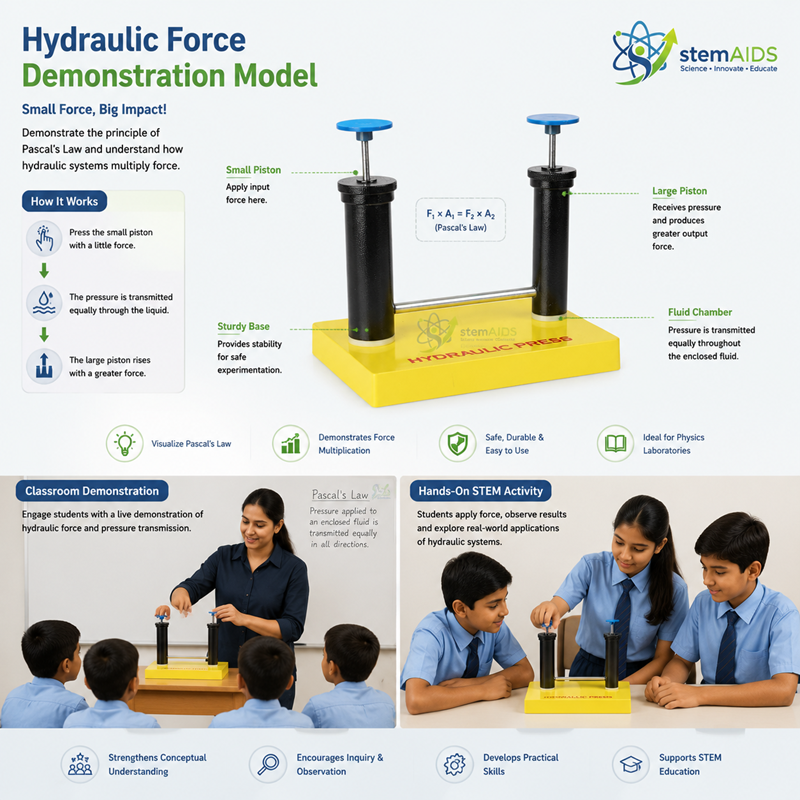
Hydraulic Force Demonstration Model

The Hydraulic Force Demonstration Model is a physics teaching model used for demonstrating hydraulic force transmission and fluid pressure principles. Designed for students and educators, it helps explain Pascal’s law, hydraulic systems, and the mechanical advantage of fluids through practical classroom demonstrations.

Product Description

The STEMAids Hydraulic Force Demonstration Model is an educational fluid mechanics model designed to show how pressure applied to a confined fluid can be transmitted through the system. It helps students understand the operating principle behind hydraulic machines such as lifts, presses, and braking systems.

This model provides a practical method for teaching concepts related to pressure, force multiplication, and fluid mechanics. By observing the movement of hydraulic components, learners can connect theoretical physics principles with real-world engineering applications. The exact fluid type, cylinder specifications, materials, dimensions, and included accessories should be confirmed from the latest STEMAids product documentation.

Key Features

  • Pascal’s law demonstration: Helps students understand pressure transmission through confined fluids.
  • Hydraulic force visualization: Shows how a small applied force can create a larger output force through hydraulic principles.
  • Fluid mechanics learning: Supports practical understanding of pressure and force relationships.
  • Engineering concept support: Introduces the working principles behind hydraulic machines.
  • Classroom demonstration model: Suitable for physics and STEM education activities.
  • Hands-on learning: Enables students to observe mechanical effects of fluid pressure.
  • Reusable educational apparatus: Designed for repeated demonstrations with proper handling.

Technical Specifications

Specification

Detail

Product Name

Hydraulic Force Demonstration Model

Brand

STEMAids

Product Category

Physics Laboratory Fluid Mechanics Demonstration Model

Main Function

Demonstration of hydraulic force transmission and fluid pressure

Operating Principle

Pascal’s law and hydraulic pressure transmission

Standards or Certifications

No product-specific certification verified

What’s Included in the Kit

  • Hydraulic Force Demonstration Model assembly
  • Hydraulic cylinders and piston mechanism
  • Connecting tubes or fluid channels
  • Supporting frame/base
  • Experiment instructions

Applications / Uses

  • Demonstrating Pascal’s law in physics classrooms.
  • Explaining how hydraulic systems transmit force.
  • Teaching fluid pressure and mechanical advantage concepts.
  • Introducing students to hydraulic engineering applications.
  • Supporting practical fluid mechanics experiments.
  • Conducting STEM activities related to force and machines.

Explore related educational solutions from STEMAids, including physics laboratory products, science models, STEM kits, and other scientific educational equipment.

How to Use the Hydraulic Force Demonstration Model

  1. Place the model on a stable and level laboratory surface.
  2. Check that hydraulic components are properly connected.
  3. Operate the input piston or control mechanism according to the instructions.
  4. Observe how pressure applied at one point affects movement at another point.
  5. Compare the input force and resulting output movement.
  6. Discuss the observation using Pascal’s law and hydraulic principles.
  7. Clean and store the model after completing the demonstration.

Safety note: Use the model under supervision. Avoid excessive force on pistons and handle hydraulic components carefully to prevent leakage or damage.

Care & Maintenance

  • Keep the hydraulic system clean and free from contamination.
  • Check tubes, seals, and moving components before use.
  • Store the model in a dry and protected location.
  • Handle transparent or moving parts carefully to prevent damage.

Why Choose STEMAids

STEMAids manufactures and supplies scientific laboratory instruments, educational models, science kits, and STEM learning products for schools and institutions. The company develops practical teaching solutions that support science education through demonstrations and hands-on experiments. STEMAids serves educational buyers through its product portfolio and export capabilities. Customers should confirm the latest technical specifications and supplied configuration before purchase.

Frequently Asked Questions

What is a Hydraulic Force Demonstration Model used for?

A Hydraulic Force Demonstration Model is used to demonstrate how hydraulic systems transmit force using fluid pressure principles.

Which law does the hydraulic model demonstrate?

The model demonstrates Pascal’s law, which explains that pressure applied to a confined fluid is transmitted throughout the fluid.

Can this hydraulic model be used in schools?

Yes. It is suitable for physics classrooms, science laboratories, and STEM learning activities.

What concepts can students learn from this model?

Students can learn about pressure, force transmission, mechanical advantage, fluid mechanics, and hydraulic machine operation.

Where are hydraulic principles used in real life?

Hydraulic principles are used in equipment such as vehicle braking systems, hydraulic lifts, construction machinery, and industrial presses.

Does the Hydraulic Force Demonstration Model require electricity?

No external electricity is normally required for a basic hydraulic demonstration model.

Contact STEMAids for confirmed specifications, availability, and institutional requirements, or explore the complete range of physics laboratory apparatus.

Recommended Image ALT Text: STEMAids Hydraulic Force Demonstration Model showing Pascal’s law and hydraulic pressure transmission in a physics classroom

Pinhole Imaging Camera

The Pinhole Imaging Camera is an optics demonstration apparatus used for showing how light travels in straight lines and forms an inverted image through a small aperture. Designed for students and educators, it helps explain image formation, ray optics, and basic principles of photography through practical observation.

Product Description

The STEMAids Pinhole Imaging Camera is an educational optics model designed to demonstrate the formation of images without using conventional lenses. It allows students to observe how light rays passing through a small opening create an image on a viewing surface.

This apparatus supports physics lessons on rectilinear propagation of light, image inversion, aperture size, and optical principles. It provides a simple and effective way to connect theoretical concepts with a visible experiment. The exact construction material, viewing screen details, dimensions, and included components should be confirmed from the latest STEMAids product documentation.

Key Features

  • Image formation demonstration: Helps students understand how images are formed using a small aperture.
  • Light propagation learning: Demonstrates that light travels in straight lines.
  • Optics experiment support: Useful for teaching basic ray optics concepts.
  • Lens-free imaging concept: Shows the fundamental principle behind early cameras.
  • Classroom-friendly design: Suitable for physics demonstrations and science activities.
  • Hands-on learning: Allows students to observe optical phenomena directly.
  • STEM education support: Encourages experimentation and scientific understanding.

Technical Specifications

Specification

Detail

Product Name

Pinhole Imaging Camera

Brand

STEMAids

Product Category

Physics Laboratory Optics Demonstration Apparatus

Main Function

Demonstration of image formation through a pinhole

Operating Principle

Rectilinear propagation of light and pinhole imaging

What’s Included in the Kit

  • Pinhole Imaging Camera assembly
  • Pinhole aperture section
  • Supporting accessories
  • Experiment instructions

Applications / Uses

  • Demonstrating image formation using a pinhole.
  • Explaining the straight-line travel of light.
  • Teaching basic optics and ray diagrams.
  • Introducing the working principle of early cameras.
  • Supporting physics laboratory experiments on light.
  • Helping students understand inverted image formation.

Explore related educational solutions from STEMAids, including physics laboratory products, science models, STEM kits, and other scientific educational equipment.

How to Use the Pinhole Imaging Camera

  1. Place the pinhole camera facing a well-lit object or scene.
  2. Ensure the pinhole and viewing screen are correctly positioned.
  3. Allow light from the object to pass through the small aperture.
  4. Observe the image formed on the viewing surface.
  5. Discuss the image characteristics, including size and inversion.
  6. Relate observations to the principles of light propagation and optics.

Safety note: Do not use the pinhole camera to view the Sun directly unless it is specifically designed and approved for solar observation.

Care & Maintenance

  • Keep the pinhole opening clean and free from dust.
  • Protect the viewing screen from scratches or damage.
  • Store the apparatus in a dry location.
  • Handle the structure carefully to maintain alignment.

Why Choose STEMAids

STEMAids manufactures and supplies scientific laboratory instruments, educational models, science kits, and STEM learning products for schools and institutions. The company develops practical teaching solutions that support science education through demonstrations and hands-on learning resources. STEMAids serves educational buyers through its product portfolio and export capabilities. Customers should confirm the latest technical specifications and supplied configuration before purchase.

Frequently Asked Questions

What is a Pinhole Imaging Camera used for?

A Pinhole Imaging Camera is used to demonstrate how light passing through a small aperture forms an inverted image.

What principle does a pinhole camera demonstrate?

It demonstrates rectilinear propagation of light and basic image formation principles in optics.

Can the Pinhole Imaging Camera be used in schools?

Yes. It is suitable for physics classrooms, optics demonstrations, and STEM learning activities.

Why is the image formed by a pinhole camera inverted?

The image is inverted because light rays travel in straight lines and cross as they pass through the small aperture.

Does the Pinhole Imaging Camera require electricity?

No. A basic pinhole camera demonstration does not require an external power source.

Is a pinhole camera related to modern photography?

Yes. The pinhole camera demonstrates the fundamental image formation principle used in the development of early photographic cameras.

Contact STEMAids for confirmed specifications, availability, and institutional requirements, or explore the complete range of physics laboratory apparatus.

Recommended Image ALT Text: STEMAids Pinhole Imaging Camera demonstrating light propagation and inverted image formation in an optics experiment

Human Powered Battery Model

The Human Powered Battery Model is a science education model used for demonstrating the conversion of human effort into electrical energy. Designed for students and educators, it helps explain energy transformation, electricity generation, and renewable energy concepts through interactive learning.

Product Description

The STEMAids Human Powered Battery Model is an educational energy demonstration model designed to introduce the relationship between mechanical energy and electrical energy. It helps learners understand how human activity can be used as an input source for demonstrating electricity generation principles.

This model supports STEM lessons related to renewable energy, sustainability, energy conversion, and basic electrical concepts. By observing the working process, students can connect everyday physical effort with scientific principles of energy transformation. The exact mechanism, electrical output details, materials, dimensions, and included components should be confirmed from the latest STEMAids product documentation.

Key Features

  • Energy conversion demonstration: Helps students understand transformation between human mechanical energy and electrical energy.
  • Renewable energy learning: Introduces sustainable energy concepts through practical observation.
  • Interactive STEM activity: Encourages participation and experimental learning.
  • Electricity generation concept: Demonstrates basic principles behind producing electrical energy from motion.
  • Classroom-friendly design: Suitable for science demonstrations and educational activities.
  • Visual learning support: Makes energy concepts easier to understand through a physical model.
  • Reusable teaching model: Designed for repeated demonstrations with proper handling.

Technical Specifications

Specification

Detail

Product Name

Human Powered Battery Model

Brand

STEMAids

Product Category

Renewable Energy & Physics Demonstration Model

Main Function

Demonstration of human energy conversion into electrical energy

Energy Input

Human mechanical effort

What’s Included in the Kit

  • Human Powered Battery Model assembly
  • Energy conversion mechanism
  • Electrical demonstration components
  • Battery/storage components
  • User instructions or experiment guide

Applications / Uses

  • Demonstrating energy conversion principles.
  • Introducing renewable and sustainable energy concepts.
  • Explaining how mechanical movement can generate electricity.
  • Supporting STEM activities on energy and engineering.
  • Teaching basic electricity generation concepts.
  • Encouraging discussions about alternative energy solutions.

Explore related educational solutions from STEMAids, including science models, STEM kits, physics laboratory products, and other scientific educational equipment.

How to Use the Human Powered Battery Model

  1. Place the model on a stable surface before starting the demonstration.
  2. Check that all mechanical and electrical components are correctly positioned.
  3. Operate the human-powered mechanism according to the supplied instructions.
  4. Observe the conversion of mechanical input into electrical output.
  5. Discuss how energy changes form during the demonstration.
  6. Record observations and relate them to energy transformation principles.

Safety note: Operate the model under supervision. Avoid excessive force on moving parts and handle electrical components according to manufacturer instructions.

Care & Maintenance

  • Keep the model clean and dry after use.
  • Store the apparatus in a protected location.
  • Inspect mechanical and electrical connections regularly.
  • Avoid applying excessive force to moving components.

Why Choose STEMAids

STEMAids manufactures and supplies scientific laboratory instruments, educational models, science kits, and STEM learning products for schools and institutions. The company develops practical teaching solutions that support science education through demonstrations and hands-on activities. STEMAids serves educational buyers through its product portfolio and export capabilities. Customers should confirm the latest technical specifications and supplied configuration before purchase.

Frequently Asked Questions

What is a Human Powered Battery Model used for?

A Human Powered Battery Model is used to demonstrate how human mechanical effort can be converted into electrical energy for educational purposes.

What energy concept does this model demonstrate?

It demonstrates energy transformation, showing how one form of energy can be converted into another form.

Can the Human Powered Battery Model be used in schools?

Yes. It is suitable for science classrooms, STEM activities, and educational demonstrations.

Is this a real power-generating device?

The model is designed as an educational demonstration tool. The exact electrical output capability should be confirmed from STEMAids specifications.

What subjects can use this model?

The model supports physics, renewable energy, engineering, environmental science, and STEM education lessons.

Does the Human Powered Battery Model require external electricity?

The model is designed around human-powered operation. Specific electrical requirements depend on the product configuration.

Contact STEMAids for confirmed specifications, availability, and institutional requirements, or explore the complete range of science demonstration models.

Recommended Image ALT Text: STEMAids Human Powered Battery Model demonstrating human energy conversion and electricity generation concepts for STEM education

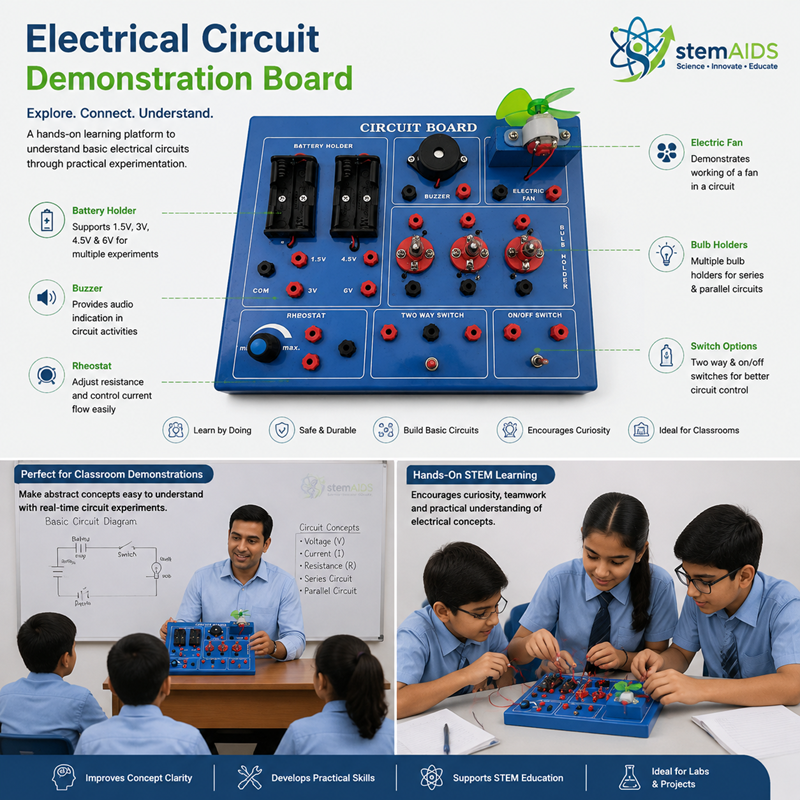
Electrical Circuit Demonstration Board

The Electrical Circuit Demonstration Board is a physics laboratory apparatus used for demonstrating electrical circuits, component connections, and basic electricity principles. Designed for students and educators, it helps learners understand current flow, circuit arrangements, and electrical components through practical experiments.

Product Description

The STEMAids Electrical Circuit Demonstration Board is an educational electricity apparatus designed to support hands-on learning of basic electrical circuits. It allows students to observe how electrical components are connected and how different circuit arrangements function.

The board supports demonstrations of fundamental concepts such as open and closed circuits, series and parallel connections, electrical symbols, and circuit troubleshooting. It provides a practical learning platform for connecting theory with laboratory observation. The exact board layout, components, dimensions, electrical ratings, and included accessories should be confirmed from the latest STEMAids product documentation.

Key Features

  • Basic circuit demonstration: Helps students understand electrical connections and current flow.
  • Hands-on electricity learning: Converts circuit theory into practical classroom activities.
  • Component identification: Helps learners recognize common electrical components and their functions.
  • Series and parallel circuit support: Enables demonstrations of different circuit configurations.
  • Classroom-friendly design: Suitable for physics and electrical science demonstrations.
  • STEM education support: Encourages experimentation, observation, and problem-solving.
  • Reusable laboratory apparatus: Designed for repeated educational demonstrations with proper handling.

Technical Specifications

Specification

Detail

Product Name

Electrical Circuit Demonstration Board

Brand

STEMAids

Product Category

Physics Laboratory Electricity & Circuit Demonstration Apparatus

Main Function

Demonstration of electrical circuit principles

Standards or Certifications

No product-specific certification verified

What’s Included in the Kit

  • Electrical Circuit Demonstration Board
  • Electrical components
  • Connecting wires/leads
  • Power supply or battery holder
  • Experiment instructions

Applications / Uses

  • Demonstrating basic electrical circuit operation.
  • Teaching series and parallel circuit concepts.
  • Explaining electrical symbols and component functions.
  • Introducing students to current flow and circuit behaviour.
  • Supporting physics and electrical science practical lessons.
  • Conducting STEM activities related to electronics and electricity.

Explore related educational solutions from STEMAids, including physics laboratory products, science models, STEM kits, and other scientific educational equipment.

How to Use the Electrical Circuit Demonstration Board

  1. Place the circuit board on a stable laboratory surface.
  2. Identify the available electrical components and connection points.
  3. Connect components according to the required circuit arrangement.
  4. Check all connections before applying power.
  5. Observe circuit operation and measure results if required.
  6. Compare different circuit configurations such as series and parallel arrangements.
  7. Disconnect the circuit safely after completing the experiment.

Safety note: Use the apparatus under teacher or laboratory supervision. Do not exceed the recommended electrical ratings and avoid making connections with the power supply switched on.

Care & Maintenance

  • Keep the board and electrical components clean and dry.
  • Inspect connecting wires and terminals before use.
  • Store the apparatus in a protected location after experiments.
  • Avoid excessive force when connecting or removing components.

Why Choose STEMAids

STEMAids manufactures and supplies scientific laboratory instruments, educational models, science kits, and STEM learning products for schools and institutions. The company develops practical teaching solutions that support science education through laboratory demonstrations and hands-on activities. STEMAids serves educational buyers through its product portfolio and export capabilities. Customers should confirm the latest technical specifications and supplied configuration before purchase.

Frequently Asked Questions

What is an Electrical Circuit Demonstration Board used for?

An Electrical Circuit Demonstration Board is used to demonstrate electrical circuits, component connections, and basic electricity concepts in educational laboratories.

Can this circuit board be used in schools?

Yes. It is suitable for supervised physics, science, and STEM classroom demonstrations.

What concepts can students learn using this apparatus?

Students can learn about current flow, circuit connections, electrical components, series circuits, parallel circuits, and basic electronics principles.

Does the Electrical Circuit Demonstration Board require electricity?

The apparatus may require a suitable low-voltage electrical supply depending on the configuration. The exact requirement should be confirmed from STEMAids specifications.

What components are included with the circuit board?

The supplied components depend on the STEMAids model configuration and should be confirmed before purchase.

Is this suitable for beginner electronics education?

Yes. Circuit demonstration boards are commonly used to introduce students to fundamental electrical concepts and safe circuit-building practices.

Contact STEMAids for confirmed specifications, availability, and institutional requirements, or explore the complete range of physics laboratory apparatus.

Recommended Image ALT Text: STEMAids Electrical Circuit Demonstration Board showing electrical components and circuit connections for physics education

Pendulum Time Period Apparatus

The Pendulum Time Period Apparatus is a physics laboratory apparatus used for measuring and studying the time period of a pendulum oscillation. Designed for students and educators, it helps demonstrate simple harmonic motion, periodic motion, and the relationship between pendulum length and oscillation time.

Product Description

The STEMAids Pendulum Time Period Apparatus is an educational mechanics apparatus designed to support practical experiments on pendulum motion and oscillation. It enables students to observe repeated motion cycles and calculate the time period of a pendulum using experimental measurements.

The apparatus helps learners understand the factors affecting pendulum motion, including pendulum length and gravitational acceleration. It provides a hands-on approach to studying periodic motion and simple harmonic motion concepts in physics laboratories. The exact materials, dimensions, pendulum length range, timing accessories, and included components should be confirmed from the latest STEMAids product documentation.

Key Features

  • Time period measurement: Helps students determine the oscillation period of a pendulum through practical experiments.
  • Simple harmonic motion learning: Supports understanding of periodic motion principles.
  • Gravity experiment support: Helps demonstrate the relationship between pendulum motion and gravitational acceleration.
  • Hands-on physics learning: Converts theoretical oscillation concepts into measurable activities.
  • Laboratory-friendly design: Suitable for classroom demonstrations and practical sessions.
  • Reusable experiment apparatus: Designed for repeated educational use with proper handling.
  • STEM education support: Encourages measurement, observation, and scientific analysis.

Technical Specifications

Specification

Detail

Product Name

Pendulum Time Period Apparatus

Brand

STEMAids

Product Category

Physics Laboratory Oscillation & Mechanics Apparatus

Main Function

Measurement and demonstration of pendulum oscillation time period

Operating Principle

Periodic motion of a simple pendulum

Standards or Certifications

No product-specific certification verified

What’s Included in the Kit

  • Pendulum Time Period Apparatus assembly
  • Pendulum bob and suspension system
  • Support stand/frame
  • Measurement accessories
  • Experiment instructions

Applications / Uses

  • Measuring the time period of a simple pendulum.
  • Studying periodic motion and oscillation behaviour.
  • Demonstrating simple harmonic motion principles.
  • Understanding the effect of pendulum length on time period.
  • Supporting physics laboratory practical experiments.
  • Introducing experimental methods for calculating gravitational acceleration.

Explore related educational solutions from STEMAids, including physics laboratory products, science models, STEM kits, and other scientific educational equipment.

How to Use the Pendulum Time Period Apparatus

  1. Place the apparatus on a stable laboratory surface.
  2. Set up the pendulum according to the supplied instructions.
  3. Measure or note the pendulum length before starting the experiment.
  4. Displace the pendulum slightly from its equilibrium position.
  5. Release the pendulum and allow it to oscillate freely.
  6. Measure the time taken for a selected number of oscillations.
  7. Calculate the time period and compare results with theoretical values.

Safety note: Operate under laboratory supervision. Avoid large release angles and handle the pendulum assembly carefully to prevent damage.

Care & Maintenance

  • Keep the apparatus clean and dry after use.
  • Store the pendulum and accessories safely when not in operation.
  • Check the suspension point and moving parts regularly.
  • Avoid bending or damaging delicate components.

Why Choose STEMAids

STEMAids manufactures and supplies scientific laboratory instruments, educational models, science kits, and STEM learning products for schools and institutions. The company develops practical teaching solutions that support science education through laboratory experiments and demonstrations. STEMAids serves educational buyers through its product portfolio and export capabilities. Customers should confirm the latest technical specifications and supplied configuration before purchase.

Frequently Asked Questions

What is a Pendulum Time Period Apparatus used for?

A Pendulum Time Period Apparatus is used to measure and study the oscillation time period of a pendulum during physics experiments.

What physics concepts can students learn using this apparatus?

Students can learn about periodic motion, simple harmonic motion, oscillation frequency, time period, and gravitational effects.

Can the Pendulum Time Period Apparatus be used in schools?

Yes. It is suitable for supervised physics demonstrations and practical laboratory experiments in schools and colleges.

What factors affect the time period of a pendulum?

The time period mainly depends on pendulum length and gravitational acceleration. For small oscillations, the mass of the bob does not significantly affect the period.

Does the Pendulum Time Period Apparatus require electricity?

The basic pendulum experiment does not normally require electrical power unless electronic timing accessories are included.

Can this apparatus be used to study simple harmonic motion?

Yes. It supports demonstrations of oscillatory motion and the principles associated with simple harmonic motion.

Contact STEMAids for confirmed specifications, availability, and institutional requirements, or explore the complete range of physics laboratory apparatus.

Recommended Image ALT Text: STEMAids Pendulum Time Period Apparatus demonstrating simple pendulum oscillation and time measurement in a physics laboratory.

Select your currency
USD United States (US) dollar
×

No WhatsApp Number Found!

WhatsApp us
Exit mobile version