Aspirator Bottle

Quick answer: STEMAids’ Aspirator Bottle is a borosilicate glass vessel for secure storage and precision dispensing of distilled water and chemical reagents. This listing does not currently show a published price on stemaids.com — contact STEMAids directly for an indicative quotation.

The Aspirator Bottle is a laboratory vessel engineered for secure storage and precision dispensing of distilled water and chemical reagents. Constructed from chemically inert borosilicate 3.3 glass, it facilitates gravity-fed liquid transfer in pharmaceutical and industrial research settings.

Technical Specifications

Parameter Detail
Material Borosilicate 3.3 glass
Function Gravity-fed liquid transfer, precision dispensing
Typical use Pharmaceutical and industrial research settings
Price Not currently published — contact STEMAids for a quotation
Exact dimensions/technical detail Not independently verified for this listing — confirm with STEMAids before specifying in a tender

Applications

  • Precision dispensing of distilled water and reagents
  • Gravity-fed liquid transfer in industrial research
  • Contamination-free storage in institutional laboratories
  • Institutional procurement for high-throughput fluid management

Care & Maintenance

  • Clean and rinse thoroughly between different reagents
  • Handle carefully to avoid chipping or breakage
  • Store in a stable, upright position

Why Choose STEMAids

STEMAids supplies a wide range of Biology Lab Products including Immune System Education Kit for related laboratory and classroom needs. Eduscope Smart Learning Solutions Private Limited is a Udyam-registered micro manufacturing enterprise (UDYAM-DL-06-0069460) and ISO 9001:2015 certified, supplying schools, colleges and vocational institutes across India and for export.

Frequently Asked Questions

What is an Aspirator Bottle used for?

It is used for secure storage and precision dispensing of distilled water and chemical reagents.

Why doesn’t this listing show a price?

This listing does not currently have a published price on stemaids.com. Contact STEMAids directly for an indicative quotation.

How does this differ from the Deluxe version?

STEMAids also supplies a separate Aspirator Bottle Deluxe with an integrated stopcock mechanism.

Is this suitable for high-throughput labs?

Yes, it is designed for streamlined fluid management in high-throughput institutional laboratories.

Is bulk institutional procurement available?

Yes, bulk procurement is supported for pharmaceutical and industrial research settings — contact STEMAids for a quotation.

Is STEMAids a registered manufacturer of this product?

Yes. Eduscope Smart Learning Solutions Private Limited is a Udyam-registered micro manufacturing enterprise (UDYAM-DL-06-0069460) and is ISO 9001:2015 certified. See the About page for full registration and certification details — manufacturer-stated, verify before citing in procurement documents.

Last updated: 29 August 2026.

Beaker, Tall Form, Borosilicate Glass

Quick Answer: This Tall Form Beaker is made from borosilicate 3.3 glass and has a slender, Berzelius-style profile that helps reduce evaporative loss and splashing during titration, electrolysis, and heating work in chemistry laboratories.

The tall, narrow shape of this beaker reduces the liquid’s exposed surface area compared with a standard low-form beaker, which helps limit evaporation during prolonged heating and reduces splash during stirring or electrolysis. It is manufactured from borosilicate 3.3 glass, giving it strong resistance to thermal shock and chemical attack from acids, alkalis, and solvents. The beaker is fitted with a moulded spout for controlled pouring and printed graduations for approximate volume reference during general laboratory work.

Specifications

Material Borosilicate 3.3 glass
Form Tall form (slender profile)
Features Moulded pour-out spout, printed graduation scale
Capacity Supplied in a range of standard laboratory capacities – confirm the exact volume required at enquiry
Typical use Titration, electrolysis, heating

Applications

  • Titration where a stable, splash-resistant vessel is preferred
  • Electrolysis experiments where electrodes are suspended in the vessel
  • Heating and concentrating liquids where reduced evaporative surface area is useful
  • General glassware for school, college, and industrial laboratories

Care & Handling

Allow the beaker to cool gradually before rinsing with cold water to avoid thermal shock. Clean with a mild laboratory detergent and a soft brush, then rinse thoroughly with distilled water before precision work. Because tall-form beakers are narrower and less stable than low-form beakers, use a clamp stand or support when heating. Inspect the rim and base for chips or cracks before each use, and store upright on a stable shelf away from bench edges.

Why Choose LabEquip

LabEquip supplies borosilicate laboratory glassware, including tall-form and low-form beakers, to schools, colleges, and industrial laboratories across India. We’re happy to advise on the right form and capacity for your application. Browse our full range of lab glassware and other chemistry lab equipment, or contact us for bulk pricing and institutional quotations.

What is a tall form beaker used for?

A tall form beaker is commonly used for titration, electrolysis, and heating tasks where a slender profile helps reduce evaporative loss and splashing, compared with a wider low-form beaker.

Is this beaker suitable for electrolysis experiments?

Yes. The tall, narrow shape provides good depth for suspending electrodes, and the borosilicate glass is chemically resistant to the electrolyte solutions commonly used in school and college electrolysis demonstrations.

Can this beaker be heated directly over a flame?

Yes. Because it is made from borosilicate 3.3 glass, it can withstand the thermal shock of direct heating on a hotplate or over a low flame far better than ordinary soda-lime glass. As it is narrower and taller, use a clamp stand for stability when heating.

How is a tall form beaker different from a low form beaker?

A tall form beaker has a narrower diameter relative to its height, while a low form beaker has a wider base. The tall form reduces surface-area evaporation and suits stirring-heavy work, while the low form offers better bench stability.

What capacities are available?

This beaker is supplied in a range of standard laboratory capacities. Please confirm the exact volume you require when placing your enquiry so we can advise on availability.

Do you supply tall form beakers in bulk for institutions?

Yes. LabEquip supplies laboratory glassware, including tall form beakers, in bulk for schools, colleges, and industrial laboratories. Please contact us with your quantity and capacity requirements for a quotation.

Last Updated: September 2026

Beaker, Tall form as per IS 2619 or ISO 3819 or DIN 12331

Quick Answer: This Tall Form Beaker (Berzelius-style, manufactured to the geometry referenced in IS 2619, ISO 3819, and DIN 12331) is a borosilicate 3.3 glass vessel with a slender profile suited to titration and heating of liquids where reduced surface-area evaporation is useful.

A tall-form beaker, sometimes called a Berzelius beaker, has a narrower diameter relative to its height compared with a standard low-form beaker. This slender shape reduces the surface area exposed to air, which helps limit evaporative loss during prolonged heating and supports splash-free mechanical stirring. It is manufactured from borosilicate 3.3 glass, giving it good resistance to thermal shock and chemical attack, and the geometry follows the tall-form beaker dimensions described in IS 2619, ISO 3819, and DIN 12331. It is fitted with a moulded spout for controlled pouring and printed graduations for approximate volume reference.

Specifications

Material Borosilicate 3.3 glass
Form Tall form / Berzelius style (slender profile)
Reference standards IS 2619 / ISO 3819 / DIN 12331
Features Moulded pour-out spout, printed graduation scale
Capacity Supplied in a range of standard laboratory capacities – confirm the exact volume required at enquiry
Typical use Titration, heating, mechanical stirring

Applications

  • Titration where a stable, splash-resistant vessel is preferred
  • Heating and concentrating liquids where reduced evaporative surface area is useful
  • Mechanical stirring using an overhead stirrer or magnetic stirrer
  • General glassware for school, college, and industrial quality-control laboratories

Care & Handling

Allow the beaker to cool gradually before rinsing with cold water to avoid thermal shock. Clean with a mild laboratory detergent and a soft brush, then rinse thoroughly with distilled water before precision work. Because tall-form beakers are narrower and less stable than low-form beakers, use a clamp stand or support when heating on an open flame. Inspect the rim and base for chips or cracks before each use, and store upright on a stable shelf away from bench edges.

Why Choose LabEquip

LabEquip supplies borosilicate laboratory glassware, including tall-form and low-form beakers, to schools, colleges, and industrial laboratories across India. We’re happy to advise on the right form and capacity for your application. Browse our full range of lab glassware and other chemistry lab equipment, or contact us for bulk pricing and institutional quotations.

What is a tall form (Berzelius) beaker used for?

A tall form beaker is commonly used for titration and heating tasks where a slender profile helps reduce evaporative loss and supports splash-free mechanical stirring, compared with a wider low-form beaker.

How is a tall form beaker different from a low form beaker?

A tall form beaker has a narrower diameter relative to its height, while a low form beaker has a wider base. The tall form reduces surface-area evaporation and suits stirring-heavy work, while the low form offers better stability on the bench.

Can this beaker be heated directly over a flame?

Yes. Because it is made from borosilicate 3.3 glass, it can withstand the thermal shock of direct heating on a hotplate or over a low flame far better than ordinary soda-lime glass. As it is narrower and taller, use a clamp stand for stability when heating.

What do IS 2619, ISO 3819, and DIN 12331 refer to?

These are reference standards commonly used for laboratory beaker dimensions and shape. IS 2619 is the Indian Standard, ISO 3819 is the corresponding international standard, and DIN 12331 is the German equivalent.

What capacities are available?

This beaker is supplied in a range of standard laboratory capacities. Please confirm the exact volume you require when placing your enquiry so we can advise on availability.

Do you supply tall form beakers in bulk for institutions?

Yes. LabEquip supplies laboratory glassware, including tall form beakers, in bulk for schools, colleges, and industrial laboratories. Please contact us with your quantity and capacity requirements for a quotation.

Last Updated: September 2026

Beaker, Phillip (Conical) with Spout

Quick Answer: The Philips (Conical) Beaker with Spout is a borosilicate 3.3 glass vessel with a tapered, cone-shaped body that reduces splashing and evaporative loss during titration, boiling, and crystallisation work in chemistry laboratories.

Unlike a standard cylindrical beaker, the Philips-style conical beaker narrows towards the top, which helps contain liquid during swirling and boiling and reduces loss from splashing when reagents are added. This makes it a popular choice for titration end-point work, recrystallisation, and general evaporation tasks where controlling splash and vapour loss matters. It is manufactured from borosilicate 3.3 glass for resistance to thermal shock and chemical attack, and is fitted with a moulded spout for controlled, drip-free pouring.

Specifications

Material Borosilicate 3.3 glass
Shape Conical (Philips-style), tapered body
Features Moulded pour-out spout
Capacity Supplied in a range of standard laboratory capacities – confirm the exact volume required at enquiry
Typical use Titration, boiling, crystallisation, evaporation

Applications

  • Titration work where minimising splash near the end point is important
  • Boiling and evaporation tasks where reduced vapour loss is beneficial
  • Crystallisation and controlled cooling of solutions
  • General chemistry laboratory use in schools, colleges, and industrial labs

Care & Handling

Allow the beaker to cool gradually before rinsing with cold water to avoid thermal shock. Clean with a mild laboratory detergent and a soft brush, then rinse thoroughly with distilled water before precision work. Inspect the rim, spout, and base for chips or cracks before each use. Store upright on a stable shelf away from bench edges.

Why Choose LabEquip

LabEquip supplies a wide range of borosilicate laboratory glassware, including conical and standard beakers, flasks, and cylinders, to schools, colleges, and industrial laboratories across India. We’re happy to help you choose the right shape and capacity for your application. Browse our full range of lab glassware and other chemistry lab equipment, or contact us for bulk pricing and institutional quotations.

What is a Philips (conical) beaker used for?

A Philips conical beaker is commonly used for titration, boiling, and crystallisation work where the tapered shape helps reduce splashing and evaporative loss compared with a standard cylindrical beaker.

How is this different from a standard beaker?

A standard beaker has straight, parallel sides, while a Philips conical beaker narrows towards the top. This tapered shape helps contain liquid during swirling and reduces splash when reagents are added, which is useful for titration and similar precision tasks.

Can this beaker be heated directly over a flame?

Yes. Because it is made from borosilicate 3.3 glass, it can withstand the thermal shock of direct heating on a hotplate or over a low flame far better than ordinary soda-lime glass. Avoid sudden extreme temperature changes and never heat an empty beaker.

Does the spout affect titration accuracy?

No. The moulded spout is designed for controlled, drip-free pouring and does not affect the accuracy of titration work carried out inside the beaker. It simply makes it easier to transfer liquids without spillage.

What capacities are available?

This beaker is supplied in a range of standard laboratory capacities. Please confirm the exact volume you require when placing your enquiry so we can advise on availability.

Do you supply conical beakers in bulk for institutions?

Yes. LabEquip supplies laboratory glassware, including Philips conical beakers, in bulk for schools, colleges, and industrial laboratories. Please contact us with your quantity and capacity requirements for a quotation.

Last Updated: September 2026

Beaker, Low Form, Borosilicate Glass

Quick Answer: This Low Form Beaker is made from borosilicate 3.3 glass, giving it strong resistance to thermal shock and chemical attack for everyday mixing, heating, and titration work in chemistry and pharmaceutical laboratories.

Borosilicate glass is the standard material for laboratory glassware that needs to withstand rapid temperature changes and contact with acids, alkalis, and solvents. This low-form beaker combines that chemical resistance with a wide, stable base that makes it easier to stir, heat, and monitor liquids without the vessel tipping. The wide mouth allows convenient access for stirring rods, thermometers, and probes, while the moulded spout supports controlled, drip-free pouring. It is a general-purpose vessel suited to routine laboratory work in schools, colleges, and industrial quality-control settings.

Specifications

Material Borosilicate 3.3 glass
Form Low form (wide-base profile)
Features Moulded pour-out spout, printed graduation scale
Capacity Supplied in a range of standard laboratory capacities – confirm the exact volume required at enquiry
Typical use Heating, mixing, stirring, titration

Applications

  • Heating and boiling liquids on a hotplate or over a low flame
  • Mixing, dissolving, and stirring reagents in chemistry and pharmaceutical labs
  • Titration and general volumetric work where a stable base is preferred
  • Routine glassware for school, college, and industrial laboratories

Care & Handling

Let the beaker cool gradually before rinsing with cold water, as a sudden temperature change can crack even borosilicate glass. Wash with a mild laboratory detergent and a soft brush, then rinse thoroughly with distilled water before precision work. Check the rim and base for chips or cracks before each use, since damaged glass is more prone to failure under heat. Store upright on a stable shelf away from bench edges.

Why Choose LabEquip

LabEquip supplies borosilicate laboratory glassware, including low-form and tall-form beakers, to schools, colleges, and industrial laboratories across India. We select glassware for consistent wall thickness and dependable thermal performance, and we’re happy to help you choose the right size for your application. Browse our full range of lab glassware and other chemistry lab equipment, or contact us for bulk pricing and institutional quotations.

What makes borosilicate glass suitable for laboratory beakers?

Borosilicate 3.3 glass has a low coefficient of thermal expansion, which means it resists cracking when moved between hot and cold conditions. It is also chemically resistant to most acids, alkalis, and solvents, making it a durable choice for everyday laboratory use.

Can this beaker be heated directly over a flame?

Yes. Because it is made from borosilicate 3.3 glass, it can withstand direct heating on a hotplate or over a low flame far better than ordinary soda-lime glass. Avoid sudden extreme temperature changes and never heat an empty beaker.

What does “low form” mean for a beaker?

Low form describes a wider base relative to height compared with a standard tall-form beaker. This gives better stability during heating and stirring and makes it easier to fit a stirring rod, thermometer, or electrode inside without tipping.

Are the printed graduations accurate enough for precise measurement?

The printed scale is intended for approximate volume reference during general laboratory work, not for precision volumetric measurement. Where an exact volume is required, a graduated cylinder or volumetric flask should be used instead.

What capacities are available?

This beaker is supplied in a range of standard laboratory capacities. Please confirm the exact volume you require when placing your enquiry so we can advise on availability.

Do you supply borosilicate beakers in bulk for institutions?

Yes. LabEquip supplies laboratory glassware, including low-form beakers, in bulk for schools, colleges, and industrial laboratories. Please contact us with your quantity and capacity requirements for a quotation.

Last Updated: September 2026

Beaker, Low Form as per IS 2619 or ISO 3819 or DIN 12331

Quick Answer: This Low Form Beaker (manufactured to the geometry referenced in IS 2619, ISO 3819, and DIN 12331) is a borosilicate 3.3 glass beaker suited to general heating, mixing, and titration work in chemistry, pharmaceutical, and industrial laboratories. Its wide, squat profile gives good stability on the bench and easy stirring access.

A low-form beaker differs from a standard tall-form beaker mainly in its proportions: a wider base relative to its height, which improves stability during stirring and heating and makes it easier to insert stirring rods, thermometers, or probes. This beaker is manufactured from borosilicate 3.3 glass, giving it good resistance to thermal shock and chemical attack, so it can be moved from ambient temperature to a hotplate or Bunsen flame without the risk of cracking that applies to ordinary soda-lime glass. The shape and proportions follow the low-form beaker geometry described in IS 2619, ISO 3819, and DIN 12331, which are the reference standards commonly used for laboratory beaker dimensions. It is supplied with a moulded spout for controlled pouring and printed graduations for approximate volume reference during general laboratory work.

Specifications

Material Borosilicate 3.3 glass
Form Low form (wide-base profile)
Reference standards IS 2619 / ISO 3819 / DIN 12331
Features Moulded pour-out spout, printed graduation scale
Capacity Supplied in a range of standard laboratory capacities – confirm the exact volume required at enquiry
Typical use Heating, mixing, stirring, titration

Applications

  • General heating and boiling of liquids on a hotplate or over a low flame
  • Mixing, dissolving, and stirring reagents in chemistry and pharmaceutical labs
  • Titration and volumetric work where a stable, wide-based vessel is preferred
  • General glassware for school, college, and industrial quality-control laboratories

Care & Handling

Allow the beaker to cool gradually before rinsing with cold water to avoid thermal shock from sudden temperature change. Clean with a mild laboratory detergent and a soft brush, then rinse thoroughly with distilled water before precision work. Inspect the rim and base for chips or star-cracks before each use, as damaged glass is more likely to fail under heating. Store upright on a stable shelf, away from bench edges, and avoid stacking heavy glassware inside it.

Why Choose LabEquip

LabEquip supplies borosilicate laboratory glassware, including low-form and tall-form beakers, to schools, colleges, and industrial laboratories across India. Our glassware is selected for consistent wall thickness and dependable thermal performance, and we’re happy to advise on the right capacity and form for your application. Browse our full range of lab glassware and other chemistry lab equipment, or contact us for bulk pricing and institutional quotations.

What does “low form” mean for a beaker?

Low form describes the proportions of the beaker – a wider base relative to its height compared with a standard tall-form beaker. This gives better stability during heating and stirring and makes it easier to fit a stirring rod, thermometer, or electrode inside without the vessel tipping.

Can this beaker be heated directly over a flame?

Yes. Because it is made from borosilicate 3.3 glass, it can withstand the thermal shock of direct heating on a hotplate or over a low flame far better than ordinary soda-lime glass. As with any glassware, avoid sudden extreme temperature changes and never heat an empty beaker.

What do IS 2619, ISO 3819, and DIN 12331 refer to?

These are reference standards commonly used for laboratory beaker dimensions and shape. IS 2619 is the Indian Standard, ISO 3819 is the corresponding international standard, and DIN 12331 is the German equivalent – all describing the same general low-form beaker geometry.

Are the printed graduations on this beaker accurate for precise measurement?

The printed scale is intended for approximate volume reference during general laboratory work, not for precision volumetric measurement. Where an exact volume is required, a graduated cylinder or volumetric flask should be used instead.

What capacities are available?

This beaker is supplied in a range of standard laboratory capacities. Please confirm the exact volume you require when placing your enquiry so we can advise on availability.

Do you supply low-form beakers in bulk for institutions?

Yes. LabEquip supplies laboratory glassware, including low-form beakers, in bulk for schools, colleges, and industrial laboratories. Please contact us with your quantity and capacity requirements for a quotation.

Last Updated: September 2026

Beaker, Clear Glass/Soda Glass

Quick Answer: LabEquip’s Clear Soda-Glass Beaker is a general-purpose laboratory beaker made from soda-lime glass, ideal for routine mixing, sample storage, and classroom demonstrations where the higher thermal-shock resistance of borosilicate glass is not required. It is supplied in a range of standard laboratory capacities to suit school and college requirements.

Description

The Clear Soda-Glass Beaker from LabEquip is manufactured from clear soda-lime glass, giving it good optical clarity for observing colour changes, precipitation, and reaction progress during general laboratory work. Soda-glass beakers are widely used across school and college laboratories as an economical alternative to borosilicate beakers for tasks that do not involve direct flame heating or rapid temperature changes. Each beaker features a flat base for stable bench placement and a moulded spout for controlled pouring, making it a practical choice for everyday liquid handling, mixing, and short-term storage of aqueous solutions.

Specifications

Parameter Detail
Material Soda-lime (soda) glass
Form Low-form beaker with moulded pouring spout
Graduation Approximate volume markings on the glass body — confirm exact capacity at enquiry
Capacity range Supplied in a range of standard laboratory capacities
Heat tolerance Suitable for ambient and mild-warmth use; not recommended for direct open-flame heating
Typical use General mixing, liquid transfer, and educational demonstrations

Applications

  • General chemistry and biology laboratory mixing and liquid handling
  • School and college teaching demonstrations
  • Short-term storage of aqueous solutions and samples
  • Titration and volumetric work where non-heated glassware is required
  • General-purpose glassware for student practicals

Care & Handling

Wash with a mild laboratory detergent and rinse thoroughly with distilled water before and after use. Because soda-lime glass has lower thermal-shock resistance than borosilicate glassware, avoid placing this beaker directly over an open flame or subjecting it to sudden temperature changes, such as moving it straight from a hot plate to a cold surface. Store beakers on a stable, padded shelf away from bench edges, and inspect the rim and base for chips or cracks before each use to avoid breakage during handling.

Why Choose LabEquip

LabEquip supplies laboratory glassware for schools, colleges, and institutional laboratories, with consistent quality checks before dispatch. Browse our full Lab Glassware range for related beakers, flasks, and cylinders, or explore our Chemistry Lab Equipment category for complementary apparatus. For bulk quotations, institutional orders, or help selecting the right capacity for your lab, please contact our team.

Frequently Asked Questions

What is a soda-glass beaker used for?

A soda-glass beaker is used for general laboratory tasks such as mixing solutions, transferring liquids, and short-term storage of samples in school and college laboratories. It is not intended for applications involving direct flame heating.

Can this beaker be heated directly on a flame?

No. Soda-lime glass has lower thermal-shock resistance than borosilicate glass, so this beaker should not be heated directly over an open flame or exposed to sudden temperature changes. For heated applications, a borosilicate beaker or flask is more suitable.

What sizes or capacities are available?

This beaker is supplied in a range of standard laboratory capacities. Please confirm the exact volume you require when placing your enquiry so we can advise on availability.

Is soda glass the same as borosilicate glass?

No. Soda-lime (soda) glass and borosilicate glass are different glass compositions. Soda glass is more economical and offers good clarity for general use, while borosilicate glass offers greater resistance to thermal shock and is generally preferred for heating applications.

How should I clean and store the beaker?

Clean with a mild laboratory detergent and rinse well with distilled water. Store on a stable shelf away from bench edges and check for chips or cracks before each use to reduce the risk of breakage.

Do you supply beakers in bulk for schools and institutions?

Yes. LabEquip supplies laboratory glassware, including beakers, in bulk for schools, colleges, and institutional laboratories. Please contact us with your quantity and capacity requirements for a quotation.

Last Updated: September 2026

Beaker with Handle

Quick Answer: The Beaker with Handle is a borosilicate glass laboratory beaker fitted with an integrated carrying handle, designed to let laboratory staff transport and pour hot, corrosive, or otherwise hazardous liquids without direct hand contact with the vessel body.

Standard laboratory beakers rely on a firm two-handed grip for safe pouring, which becomes difficult once the contents are hot, caustic, or simply heavy. The Beaker with Handle adds a carrying handle to a conventional borosilicate beaker body, giving technicians a stable, single-hand grip point that keeps fingers further from the heated or chemically active glass surface during transport and pouring.

Because the handle is formed to match the thermal profile of the beaker body, the vessel retains the standard resistance to thermal shock and common laboratory reagents expected of borosilicate glassware, making it suitable for use on hotplates, in water baths, and during general chemical handling in school, college, and industrial laboratories.

Specifications

Parameter Detail
Material Borosilicate glass (low thermal expansion)
Design Beaker body with an integrated carrying handle
Handle function Single-hand grip for transport and controlled pouring
Typical use Suitable for hotplate and water-bath heating within standard borosilicate limits
Available capacities Supplied in a range of standard laboratory beaker capacities — confirm the exact volume required at enquiry

Applications

  • Transporting hot or chemically active liquids between workstations
  • Controlled pouring of reagents into narrow-necked glassware
  • General chemical mixing and heating in school and college laboratories
  • Handling corrosive or caustic solutions where reduced hand contact with the vessel is preferred

Care & Handling

  • Inspect the handle joint periodically for cracks or looseness before each use
  • Allow the beaker to cool gradually after heating; avoid sudden temperature changes that can cause thermal shock
  • Rinse and dry thoroughly after use to prevent residue buildup
  • Store away from bench edges to reduce the risk of impact chips

Why Choose LabEquip

LabEquip manufactures and exports laboratory glassware, including beakers and general lab glassware, alongside a broader range of chemistry lab equipment for schools, colleges, and research laboratories. For bulk orders, tender quotations, or capacity-specific requirements, contact our team directly.

Frequently Asked Questions

What is a beaker with a handle used for?

It serves the same general laboratory purposes as a standard beaker — mixing, heating, and pouring — but the added handle makes it easier to carry and pour hot or hazardous liquids safely, without gripping the vessel body directly.

Is the handle made of the same glass as the beaker?

Yes. The handle is formed to match the borosilicate beaker body, so it shares the same resistance to thermal shock and common laboratory chemicals as the rest of the vessel.

Can this beaker be heated directly on a hotplate?

Borosilicate beakers of this type are generally suitable for hotplate and water-bath heating within standard laboratory limits. Always allow gradual heating and cooling to avoid thermal shock, and follow your lab’s standard operating procedure for the specific liquid being heated.

What capacities is the Beaker with Handle available in?

It is supplied in a range of standard laboratory beaker capacities. Contact LabEquip with your required volume so we can confirm availability for your order.

Is this beaker suitable for corrosive chemicals?

Borosilicate glass resists most common laboratory acids and solvents, making it appropriate for many corrosive-liquid applications. Always check chemical compatibility for the specific reagent you plan to use.

How should I care for the handle over time?

Check the handle joint for cracks or looseness before each use, avoid sudden temperature swings, and store the beaker away from bench edges to reduce the risk of impact damage to the handle or body.

Last Updated: September 2026

Aspirator Bottles, Screw Cap with Tubulation

Quick answer: STEMAids’ Aspirator Bottle with Screw Cap and Tubulation supports controlled storage and gravity-fed dispensing of reagents and distilled water. This listing does not currently show a published price on stemaids.com — contact STEMAids directly for an indicative quotation.

Aspirator Bottles with Screw Cap and Tubulation are used for controlled storage and gravity-fed dispensing of reagents and distilled water. Featuring borosilicate 3.3 construction, these bottles provide chemical resistance and thermal stability, used in pharmaceutical laboratories for large-scale buffer preparation.

Technical Specifications

Parameter Detail
Material Borosilicate 3.3 glass
Feature Screw cap with tubulation
Typical use Pharmaceutical laboratories, industrial research facilities
Price Not currently published — contact STEMAids for a quotation
Exact dimensions/technical detail Not independently verified for this listing — confirm with STEMAids before specifying in a tender

Applications

  • Controlled reagent storage in pharmaceutical laboratories
  • Gravity-fed dispensing for buffer preparation
  • Large-scale liquid handling in industrial research
  • Institutional procurement for safe liquid handling infrastructure

Care & Maintenance

  • Check the tubulation and screw cap seal for leaks
  • Clean and rinse thoroughly between different reagents
  • Store in a stable, upright position

Why Choose STEMAids

STEMAids supplies a wide range of Biology Lab Products including Cardboard Slide Trays for related laboratory and classroom needs. Eduscope Smart Learning Solutions Private Limited is a Udyam-registered micro manufacturing enterprise (UDYAM-DL-06-0069460) and ISO 9001:2015 certified, supplying schools, colleges and vocational institutes across India and for export.

Frequently Asked Questions

What is this Aspirator Bottle with Tubulation used for?

It is used for controlled storage and gravity-fed dispensing of reagents and distilled water.

Why doesn’t this listing show a price?

This listing does not currently have a published price on stemaids.com. Contact STEMAids directly for an indicative quotation.

What is tubulation used for on this bottle?

The tubulation provides an outlet point for gravity-fed dispensing and connection to tubing.

Is this suitable for large-scale buffer preparation?

Yes, it is widely used for large-scale buffer preparation in pharmaceutical laboratories.

Is bulk institutional procurement available?

Yes, bulk procurement is supported for industrial research facilities — contact STEMAids for a quotation.

Is STEMAids a registered manufacturer of this product?

Yes. Eduscope Smart Learning Solutions Private Limited is a Udyam-registered micro manufacturing enterprise (UDYAM-DL-06-0069460) and is ISO 9001:2015 certified. See the About page for full registration and certification details — manufacturer-stated, verify before citing in procurement documents.

Last updated: 29 August 2026.

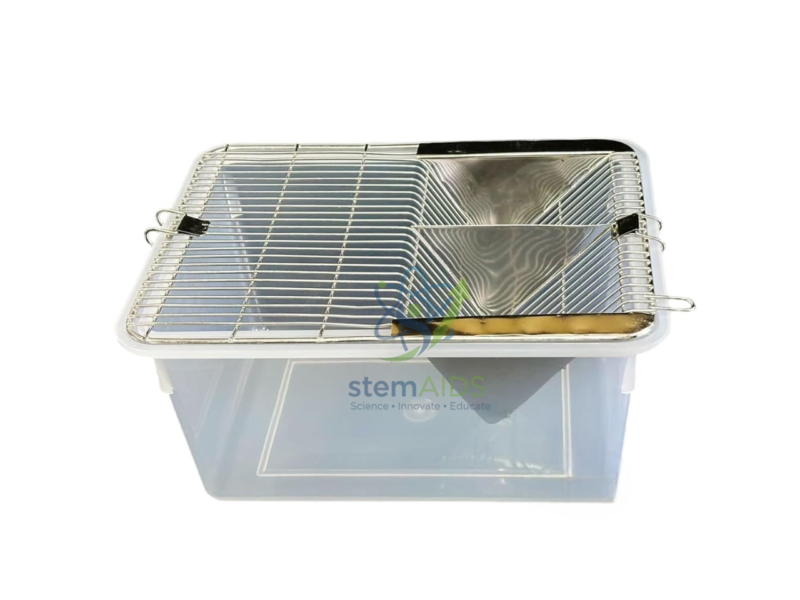
Animal cage (Twin Grill)

Quick answer: STEMAids’ Twin Grill Animal Cage provides ventilated, autoclavable housing for biomedical research and rodent husbandry. This listing does not currently show a published price on stemaids.com — contact STEMAids directly for an indicative quotation.

The Twin Grill Animal Cage provides ventilated housing for biomedical research and rodent husbandry. The dual-grill architecture optimizes airflow and access for feeding and watering, with durable, autoclavable construction supporting a sterile microenvironment for pharmaceutical and academic research.

Technical Specifications

Parameter Detail
Feature Dual-grill architecture, autoclavable
Function Ventilated rodent housing
Typical use Biomedical research, pharmaceutical and academic laboratories
Price Not currently published — contact STEMAids for a quotation
Exact dimensions/technical detail Not independently verified for this listing — confirm with STEMAids before specifying in a tender

Applications

  • Rodent housing in biomedical research vivariums
  • Pharmaceutical preclinical testing protocols
  • Academic research requiring sterile animal housing
  • Institutional procurement for high-throughput vivarium operations

Care & Maintenance

  • Autoclave as needed following standard sterilization protocols
  • Clean grills regularly to maintain ventilation and hygiene
  • Inspect for structural wear before continued use

Why Choose STEMAids

STEMAids supplies a wide range of Biology Lab Products including Cardboard Slide Mailers for related laboratory and classroom needs. Eduscope Smart Learning Solutions Private Limited is a Udyam-registered micro manufacturing enterprise (UDYAM-DL-06-0069460) and ISO 9001:2015 certified, supplying schools, colleges and vocational institutes across India and for export.

Frequently Asked Questions

What is the Twin Grill Animal Cage used for?

It is used for ventilated rodent housing in biomedical research and academic laboratories.

Why doesn’t this listing show a price?

This listing does not currently have a published price on stemaids.com. Contact STEMAids directly for an indicative quotation.

Does the dual-grill design improve airflow?

Yes, the dual-grill architecture is designed to optimize airflow and access for feeding and watering.

Is this related to the standard Animal Cage listing?

Yes, STEMAids also supplies a separate Animal Cage listing — confirm the exact configuration difference with STEMAids.

Is bulk institutional procurement available?

Yes, bulk procurement is supported for pharmaceutical and academic research — contact STEMAids for a quotation.

Is STEMAids a registered manufacturer of this product?

Yes. Eduscope Smart Learning Solutions Private Limited is a Udyam-registered micro manufacturing enterprise (UDYAM-DL-06-0069460) and is ISO 9001:2015 certified. See the About page for full registration and certification details — manufacturer-stated, verify before citing in procurement documents.

Last updated: 29 August 2026.

Select your currency
INR Indian rupee
×

No WhatsApp Number Found!

WhatsApp us
Exit mobile version