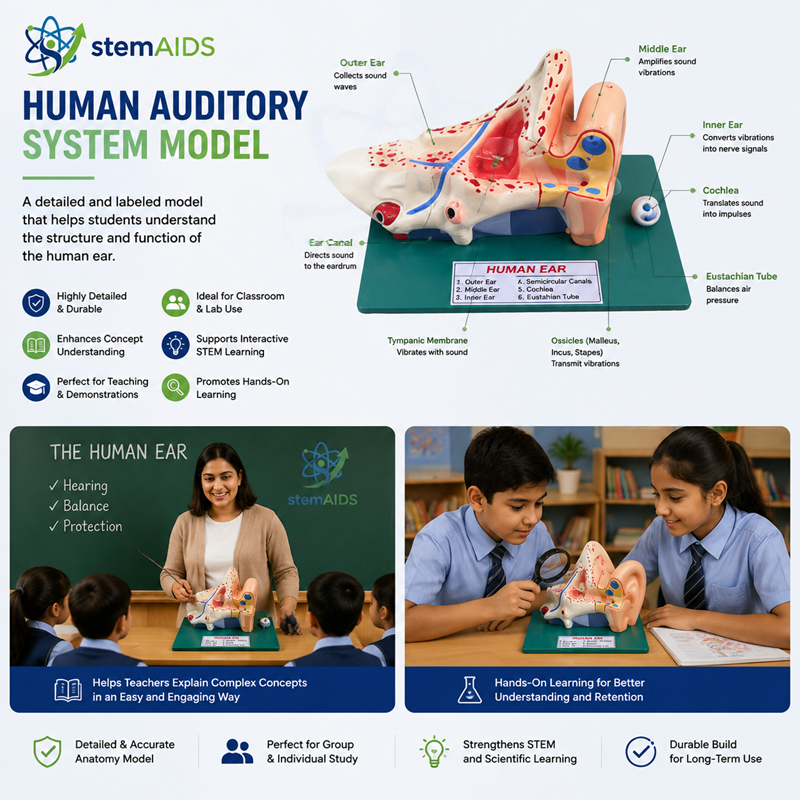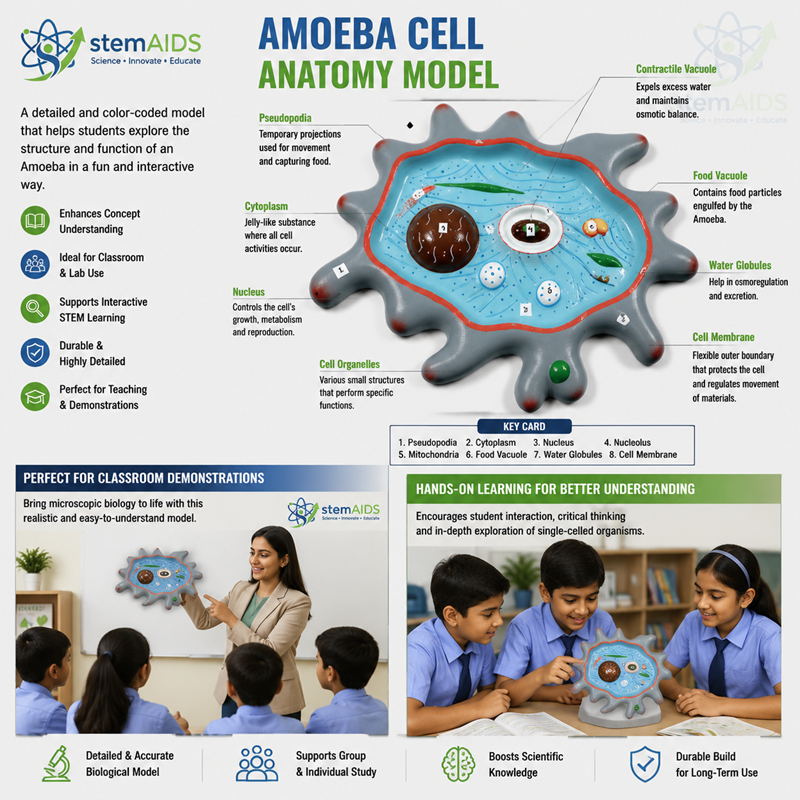
Amoeba Cell Anatomy Model

Last updated: September 2026

Quick Answer: The Amoeba Cell Anatomy Model is a biology teaching model that shows the internal structure of an Amoeba — pseudopodia, nucleus, contractile vacuole and food vacuole — so students can study a unicellular organism’s anatomy in three dimensions rather than only under a microscope. LabEquip supplies it as part of the Biology Models range, alongside the Paramecium Educational Model used for the same introductory microbiology unit.

Product Description

Amoeba is one of the standard single-celled organisms covered in introductory microbiology and cell-biology teaching, usually alongside microscope-based observation of live or prepared specimens. This Amoeba Cell Anatomy Model from LabEquip gives students an enlarged, labelled view of the organism’s internal structure that is easier to study and discuss in a classroom setting than a slide viewed under magnification alone.

Teachers typically use a model like this to point out the pseudopodia used for movement and feeding, the nucleus that controls cell activity, the contractile vacuole involved in water regulation, and food vacuoles formed during feeding — connecting each structure to the organism’s basic life functions.

The exact scale, number of labelled parts, construction material and dimensions of this specific model were not confirmed in the specification on file for this listing. Schools and institutions who need this detail before finalising a purchase order are welcome to confirm it with LabEquip.

What This Model Helps Students Learn

  • Identify the pseudopodia, nucleus, contractile vacuole and food vacuole in an Amoeba’s structure.
  • Explain how pseudopodia are used for movement and feeding (phagocytosis).
  • Describe the role of the contractile vacuole in water regulation (osmoregulation).
  • Connect single-celled organism structure to basic life functions: movement, feeding, excretion and reproduction.
  • Compare a physical, enlarged Amoeba model to microscope observation and textbook diagrams.
  • Build a foundation for comparing Amoeba to other single-celled organisms such as Paramecium.

Specifications

Attribute Detail
Product name Amoeba Cell Anatomy Model
Category Biology Models – Biology Laboratory Products
Product type Enlarged single-celled-organism (protozoology) teaching model
Typical use Teaching Amoeba anatomy and single-celled organism biology
Recommended for Schools, colleges, biology laboratories, microbiology educators
Scale, labelled parts, material, dimensions Contact us for detailed specifications
Availability In stock at time of publication – confirm current stock before ordering
Indicative price (India) ₹265 (list price ₹550) – indicative market benchmark, incl. GST, September 2026

Safety Note

This is a static, non-electrical, non-chemical teaching model intended for normal classroom handling. Handle any detachable parts carefully to avoid breakage, and keep small detachable components away from very young children because of choking-hazard risk. Recommended for use under teacher supervision during classroom demonstrations.

Care & Maintenance

  • Keep the model clean and free of dust, wiping with a dry or lightly damp cloth as suited to the material.
  • Store away from direct sunlight and excess heat to prevent warping, fading or discolouration.
  • Handle any detachable structures gently and store them together so none go missing.
  • Check labels and connecting points periodically for damage before each classroom session.

Why Choose LabEquip

LabEquip supplies biology teaching models, microbiology teaching aids and laboratory equipment to schools, colleges and technical training institutes across India. Alongside this Amoeba Cell Anatomy Model, our Biology Models range includes the Paramecium Educational Model for the same single-celled-organism unit, plus the Mitosis Process Teaching Model and Meiosis Visualization Model for cell-division teaching. Browse our full Biology Models category for the complete range.

Frequently Asked Questions

What is an Amoeba Cell Anatomy Model used for?

It is used to teach the internal structure and basic life functions of Amoeba as an introductory single-celled organism in microbiology and cell-biology lessons.

What parts of the Amoeba does the model show?

Models of this type are generally built to show pseudopodia, the nucleus, a contractile vacuole and food vacuoles, but the exact labelled parts on this specific unit were not confirmed in the listing on file. Please confirm this detail with LabEquip before ordering if it matters for your syllabus.

What is this model made of?

The construction material was not confirmed for this listing. Contact LabEquip for detailed specifications before finalising an order.

Is this suitable for school-level biology teaching?

Yes. It is designed as an educational resource for microbiology and cell-biology lessons at school and college level.

Can this be paired with the Paramecium Educational Model?

Yes — the two are commonly used together to compare the structure and movement of different single-celled organisms in an introductory microbiology unit.

Do you supply this for bulk or institutional orders?

Yes, LabEquip supplies Biology Models products for institutional and tender orders; email sales@thelabequipment.com with your requirement list and quantities.
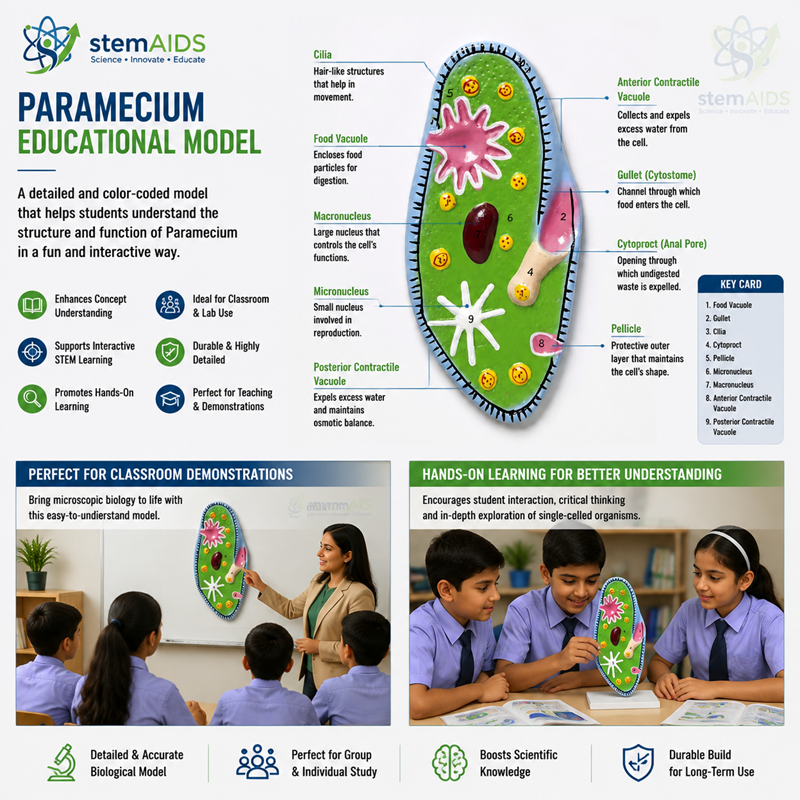
Paramecium Educational Model

Last updated: September 2026

Quick Answer: The Paramecium Educational Model is a biology teaching model that shows the internal structure of a Paramecium — cilia, oral groove, macronucleus, micronucleus and contractile vacuoles — so students can study a ciliated single-celled organism in three dimensions rather than only under a microscope. LabEquip supplies it as part of the Biology Models range, alongside the Amoeba Cell Anatomy Model used for the same introductory microbiology unit.

Product Description

Paramecium is one of the standard single-celled organisms covered in introductory microbiology and cell-biology teaching, typically studied alongside Amoeba to compare different modes of movement and feeding among protozoa. This Paramecium Educational Model from LabEquip gives students an enlarged, labelled view of the organism’s structure that is easier to study and discuss in a classroom setting than a slide viewed under magnification alone.

Teachers typically use a model like this to point out the cilia used for movement, the oral groove used for feeding, the macronucleus and micronucleus involved in cell function and reproduction, and the contractile vacuoles involved in water regulation — connecting each structure to the organism’s basic life functions.

The exact scale, number of labelled parts, construction material and dimensions of this specific model were not confirmed in the specification on file for this listing. Schools and institutions who need this detail before finalising a purchase order are welcome to confirm it with LabEquip.

What This Model Helps Students Learn

  • Identify the cilia, oral groove, macronucleus, micronucleus and contractile vacuoles in a Paramecium’s structure.
  • Explain how cilia are used for movement and how the oral groove is used for feeding.
  • Describe the role of the contractile vacuole in water regulation (osmoregulation).
  • Connect single-celled organism structure to basic life functions: movement, feeding, excretion and reproduction.
  • Compare a physical, enlarged Paramecium model to microscope observation and textbook diagrams.
  • Compare Paramecium’s ciliated movement to Amoeba’s pseudopodial movement in the same microbiology unit.

Specifications

Attribute Detail
Product name Paramecium Educational Model
Category Biology Models – Biology Laboratory Products
Product type Enlarged single-celled-organism (protozoology) teaching model
Typical use Teaching Paramecium anatomy and single-celled organism biology
Recommended for Schools, colleges, biology laboratories, microbiology educators
Scale, labelled parts, material, dimensions Contact us for detailed specifications
Availability In stock at time of publication – confirm current stock before ordering
Indicative price (India) ₹265 (list price ₹550) – indicative market benchmark, incl. GST, September 2026

Safety Note

This is a static, non-electrical, non-chemical teaching model intended for normal classroom handling. Handle any detachable parts carefully to avoid breakage, and keep small detachable components away from very young children because of choking-hazard risk. Recommended for use under teacher supervision during classroom demonstrations.

Care & Maintenance

  • Keep the model clean and free of dust, wiping with a dry or lightly damp cloth as suited to the material.
  • Store away from direct sunlight and excess heat to prevent warping, fading or discolouration.
  • Handle any detachable structures gently and store them together so none go missing.
  • Check labels and connecting points periodically for damage before each classroom session.

Why Choose LabEquip

LabEquip supplies biology teaching models, microbiology teaching aids and laboratory equipment to schools, colleges and technical training institutes across India. Alongside this Paramecium Educational Model, our Biology Models range includes the Amoeba Cell Anatomy Model for the same single-celled-organism unit, plus the Mitosis Process Teaching Model and Meiosis Visualization Model for cell-division teaching. Browse our full Biology Models category for the complete range.

Frequently Asked Questions

What is a Paramecium Educational Model used for?

It is used to teach the internal structure and basic life functions of Paramecium as an introductory ciliated single-celled organism in microbiology and cell-biology lessons.

What parts of the Paramecium does the model show?

Models of this type are generally built to show cilia, the oral groove, macronucleus, micronucleus and contractile vacuoles, but the exact labelled parts on this specific unit were not confirmed in the listing on file. Please confirm this detail with LabEquip before ordering if it matters for your syllabus.

What is this model made of?

The construction material was not confirmed for this listing. Contact LabEquip for detailed specifications before finalising an order.

Is this suitable for school-level biology teaching?

Yes. It is designed as an educational resource for microbiology and cell-biology lessons at school and college level.

Can this be paired with the Amoeba Cell Anatomy Model?

Yes — the two are commonly used together to compare the structure and movement of different single-celled organisms in an introductory microbiology unit.

Do you supply this for bulk or institutional orders?

Yes, LabEquip supplies Biology Models products for institutional and tender orders; email sales@thelabequipment.com with your requirement list and quantities.
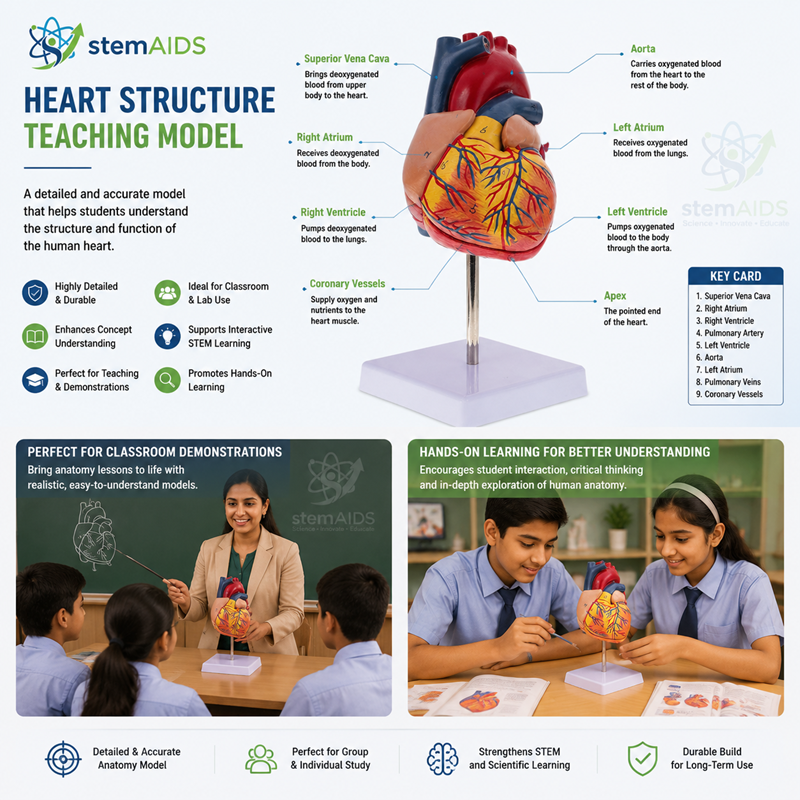
Human Eye Visualization Model

Quick Answer: The Human Eye Visualization Model is a three-dimensional teaching model of the human eye used in school and college biology labs to show learners the arrangement of the eye’s major structures in a way flat diagrams cannot. It is supplied as a classroom demonstration aid, not a certified medical device, and is intended for educational use by teachers and students.

Product Description

The LabEquip Human Eye Visualization Model gives biology and anatomy teachers a hands-on way to walk students through how the human eye is structured. Rather than relying only on textbook illustrations, instructors can point to the physical model while explaining concepts such as light entry, focusing, and the general layout of the eye’s internal structures. This makes the model useful for classroom lectures, lab stations, science exhibitions, and revision sessions ahead of practical exams.

The model is designed for repeated classroom use across academic terms. It suits schools, junior colleges, biology laboratories, and any institution that teaches human sensory anatomy as part of its science curriculum. Because it presents information in three dimensions, it is often used alongside charts and diagrams rather than as a replacement for them, giving students more than one way to understand the same anatomical concepts.

Key Features

  • Three-dimensional layout of major eye structures for classroom demonstration
  • Designed for repeated use in biology and anatomy teaching sessions
  • Compact enough for a lab bench, lecture table, or display shelf
  • Supports both guided teaching and independent student study
  • Reusable teaching resource suited to schools, colleges, and training centres

Specifications

Specification Detail
Product Name Human Eye Visualization Model
Brand LabEquip
Category Human Anatomy Teaching Model / Biology Lab Aid
Material Not specified for this listing — confirm with our sales team
Scale Demonstration scale — not stated as life-size for this listing; confirm with our sales team
Removable / Labelled Parts Not specified for this listing — confirm with our sales team
Intended Users Schools, colleges, biology teachers, anatomy educators

Care & Maintenance

  • Wipe the model gently with a soft, dry or slightly damp cloth — avoid soaking it or using harsh solvents.
  • Keep the model out of direct sunlight and away from heat sources, which can cause discolouration or warping over time.
  • Handle any detachable or hinged sections carefully to avoid stressing the connection points.
  • Store the model in a dry, dust-free location such as a lab cupboard or display case when not in use.
  • Check periodically for loose parts or labels and report any damage to your lab in-charge before the next demonstration.

Why Choose LabEquip

LabEquip (The Lab Equipment Pvt Ltd) supplies science and biology teaching aids to schools and colleges, with the Human Eye Visualization Model offered as part of a wider range of anatomy teaching models for classroom use. We focus on giving teachers straightforward, honestly described teaching resources rather than overstated claims.

Explore more from our range: our Anatomy Models category covers the human body systems commonly taught at school and college level, our STEM Kits category supports hands-on science learning beyond anatomy, and you can see our full range from the LabEquip homepage.

Frequently Asked Questions

Q1. What is the Human Eye Visualization Model used for?
It is used in biology and anatomy classes to give students a three-dimensional reference for how the human eye is structured, supporting lessons on vision and sensory systems.

Q2. Is this model suitable for school-level teaching?
Yes, it is designed as a general classroom and laboratory teaching aid suitable for school and college biology programmes.

Q3. What material is the model made from?
Material is not specified for this particular listing. Please contact our sales team if you need this confirmed before ordering.

Q4. Does the model come with a stand or display base?
Accessories included vary by listing. Please check the product images or contact our sales team to confirm what is supplied with this specific model.

Q5. How should I clean and store the model?
Wipe gently with a dry or slightly damp cloth, avoid direct sunlight and heat, and store it in a dry cupboard or display case between uses.

Q6. Can I order this model in bulk for a school or college lab?
Yes, LabEquip supplies schools, colleges, and institutions. Contact sales@thelabequipment.com for bulk or institutional orders.

Last Updated: September 2026

Heart Structure Teaching Model

Quick Answer: The Heart Structure Teaching Model is a three-dimensional classroom model of the human heart, used in biology and anatomy lessons to help students visualise how the chambers, valves, and major blood vessels are arranged. It is a general classroom teaching aid, not a certified medical device.

Product Description

The LabEquip Heart Structure Teaching Model helps biology and anatomy teachers explain the layout of the human heart without relying only on textbook diagrams. Instructors can use the model to point out the general arrangement of the heart’s chambers and connecting vessels while explaining how blood moves through the circulatory system, making abstract diagrams easier for students to follow.

This model is intended for repeated use in school and college biology classes, laboratory demonstrations, and revision sessions. It is commonly used alongside circulatory system charts and diagrams rather than as their replacement, giving students a physical reference point for classroom discussion.

Key Features

  • Three-dimensional layout to support teaching of heart structure and circulation
  • Designed for repeated use across multiple teaching sessions
  • Compact enough for a lab bench, lecture table, or display shelf
  • Supports both instructor-led teaching and independent student study
  • Reusable resource suited to schools, colleges, and biology training centres

Specifications

Specification Detail
Product Name Heart Structure Teaching Model
Brand LabEquip
Category Human Anatomy Teaching Model / Biology Lab Aid
Material Not specified for this listing — confirm with our sales team
Scale Demonstration scale — not stated as life-size for this listing; confirm with our sales team
Removable / Labelled Parts Not specified for this listing — confirm with our sales team
Intended Users Schools, colleges, biology teachers, anatomy educators

Care & Maintenance

  • Wipe gently with a soft, dry or slightly damp cloth — avoid soaking or harsh solvents.
  • Keep away from direct sunlight and heat sources, which can cause discolouration or warping.
  • Handle any detachable or hinged sections carefully to avoid stressing connection points.
  • Store in a dry, dust-free location such as a lab cupboard or display case when not in use.
  • Check periodically for loose parts or labels and report any damage before the next demonstration.

Why Choose LabEquip

LabEquip (The Lab Equipment Pvt Ltd) supplies science and biology teaching aids to schools and colleges. The Heart Structure Teaching Model is offered alongside our wider range of human anatomy models for classroom use, with straightforward, honestly described product information rather than overstated claims.

Explore related resources: see our Human Eye Visualization Model for sensory system teaching, browse the full Anatomy Models category, or visit our LabEquip homepage for our complete range.

Frequently Asked Questions

Q1. What is the Heart Structure Teaching Model used for?
It is used in biology and anatomy classes to help students visualise the arrangement of the heart’s chambers and major vessels as part of lessons on the circulatory system.

Q2. Is this model suitable for school-level teaching?
Yes, it is designed as a general classroom and laboratory teaching aid suitable for school and college biology programmes.

Q3. What material is the model made from?
Material is not specified for this particular listing. Please contact our sales team if you need this confirmed before ordering.

Q4. Is the model life-size?
Scale is not specified for this particular listing. Please check the product images or contact our sales team to confirm before ordering.

Q5. How should I clean and store the model?
Wipe gently with a dry or slightly damp cloth, avoid direct sunlight and heat, and store it in a dry cupboard or display case between uses.

Q6. Can I order this model in bulk for a school or college lab?
Yes, LabEquip supplies schools, colleges, and institutions. Contact sales@thelabequipment.com for bulk or institutional orders.

Last Updated: September 2026

Human Auditory System Model

Quick Answer: The Human Auditory System Model is a three-dimensional teaching model of the human ear and hearing pathway, used in biology and anatomy classes to help students visualise how sound-related structures are arranged. It is a classroom demonstration aid, not a certified medical device.

Product Description

The LabEquip Human Auditory System Model gives biology and anatomy teachers a physical reference for explaining how the ear is structured, supporting lessons on hearing and the sensory nervous system. Rather than relying only on textbook diagrams, instructors can point to the model while discussing the general arrangement of the outer, middle, and inner ear.

This model is intended for repeated use across school and college biology terms, laboratory demonstrations, and revision sessions. It works well alongside charts and diagrams as a complementary three-dimensional teaching resource rather than a replacement for them.

Key Features

  • Three-dimensional layout to support teaching of ear structure and hearing
  • Designed for repeated use across multiple teaching sessions
  • Compact enough for a lab bench, lecture table, or display shelf
  • Supports both instructor-led teaching and independent student study
  • Reusable resource suited to schools, colleges, and biology training centres

Specifications

Specification Detail
Product Name Human Auditory System Model
Brand LabEquip
Category Human Anatomy Teaching Model / Biology Lab Aid
Material Not specified for this listing — confirm with our sales team
Scale Demonstration scale — not stated as life-size for this listing; confirm with our sales team
Removable / Labelled Parts Not specified for this listing — confirm with our sales team
Intended Users Schools, colleges, biology teachers, anatomy educators

Care & Maintenance

  • Wipe gently with a soft, dry or slightly damp cloth — avoid soaking or harsh solvents.
  • Keep away from direct sunlight and heat sources, which can cause discolouration or warping.
  • Handle any detachable or hinged sections carefully to avoid stressing connection points.
  • Store in a dry, dust-free location such as a lab cupboard or display case when not in use.
  • Check periodically for loose parts or labels and report any damage before the next demonstration.

Why Choose LabEquip

LabEquip (The Lab Equipment Pvt Ltd) supplies science and biology teaching aids to schools and colleges. The Human Auditory System Model is offered alongside our wider range of human anatomy models for classroom use, with straightforward, honestly described product information rather than overstated claims.

Explore related resources: see our Human Eye Visualization Model and Heart Structure Teaching Model for other sensory and organ system teaching, or browse the full Anatomy Models category.

Frequently Asked Questions

Q1. What is the Human Auditory System Model used for?
It is used in biology and anatomy classes to help students visualise the structures of the ear involved in hearing, supporting lessons on the sensory nervous system.

Q2. Is this model suitable for school-level teaching?
Yes, it is designed as a general classroom and laboratory teaching aid suitable for school and college biology programmes.

Q3. What material is the model made from?
Material is not specified for this particular listing. Please contact our sales team if you need this confirmed before ordering.

Q4. Is the model life-size?
Scale is not specified for this particular listing. Please check the product images or contact our sales team to confirm before ordering.

Q5. How should I clean and store the model?
Wipe gently with a dry or slightly damp cloth, avoid direct sunlight and heat, and store it in a dry cupboard or display case between uses.

Q6. Can I order this model in bulk for a school or college lab?
Yes, LabEquip supplies schools, colleges, and institutions. Contact sales@thelabequipment.com for bulk or institutional orders.

Last Updated: September 2026

Human Brain Anatomy Model

Quick Answer: The Human Brain Anatomy Model is a three-dimensional teaching model of the human brain, used in biology and anatomy classes to help students visualise the general arrangement of major brain regions. It is a classroom demonstration aid, not a certified medical device.

Product Description

The LabEquip Human Brain Anatomy Model gives biology and anatomy teachers a physical reference for explaining the structure of the human brain, supporting lessons on the nervous system. Instructors can use the model to point out the general arrangement of major brain regions while explaining how the nervous system is organised, making lessons easier for students to follow than diagrams alone.

This model is intended for repeated use across school and college biology terms, laboratory demonstrations, and revision sessions. It is typically used alongside charts and diagrams as a complementary three-dimensional teaching resource.

Key Features

  • Three-dimensional layout to support teaching of brain structure and the nervous system
  • Designed for repeated use across multiple teaching sessions
  • Compact enough for a lab bench, lecture table, or display shelf
  • Supports both instructor-led teaching and independent student study
  • Reusable resource suited to schools, colleges, and biology training centres

Specifications

Specification Detail
Product Name Human Brain Anatomy Model
Brand LabEquip
Category Human Anatomy Teaching Model / Biology Lab Aid
Material Not specified for this listing — confirm with our sales team
Scale Demonstration scale — not stated as life-size for this listing; confirm with our sales team
Removable / Labelled Parts Not specified for this listing — confirm with our sales team
Intended Users Schools, colleges, biology teachers, anatomy educators

Care & Maintenance

  • Wipe gently with a soft, dry or slightly damp cloth — avoid soaking or harsh solvents.
  • Keep away from direct sunlight and heat sources, which can cause discolouration or warping.
  • Handle any detachable or hinged sections carefully to avoid stressing connection points.
  • Store in a dry, dust-free location such as a lab cupboard or display case when not in use.
  • Check periodically for loose parts or labels and report any damage before the next demonstration.

Why Choose LabEquip

LabEquip (The Lab Equipment Pvt Ltd) supplies science and biology teaching aids to schools and colleges. The Human Brain Anatomy Model is offered alongside our wider range of human anatomy models for classroom use, with straightforward, honestly described product information rather than overstated claims.

Explore related resources: see our Human Auditory System Model and Heart Structure Teaching Model for other sensory and organ system teaching, or browse the full Anatomy Models category.

Frequently Asked Questions

Q1. What is the Human Brain Anatomy Model used for?
It is used in biology and anatomy classes to help students visualise the general arrangement of major brain regions as part of lessons on the nervous system.

Q2. Is this model suitable for school-level teaching?
Yes, it is designed as a general classroom and laboratory teaching aid suitable for school and college biology programmes.

Q3. What material is the model made from?
Material is not specified for this particular listing. Please contact our sales team if you need this confirmed before ordering.

Q4. Is the model life-size?
Scale is not specified for this particular listing. Please check the product images or contact our sales team to confirm before ordering.

Q5. How should I clean and store the model?
Wipe gently with a dry or slightly damp cloth, avoid direct sunlight and heat, and store it in a dry cupboard or display case between uses.

Q6. Can I order this model in bulk for a school or college lab?
Yes, LabEquip supplies schools, colleges, and institutions. Contact sales@thelabequipment.com for bulk or institutional orders.

Last Updated: September 2026

Kidney Anatomy Learning Model

Quick Answer: The Kidney Anatomy Learning Model is a three-dimensional teaching model of the human kidney, used in biology and anatomy classes to help students visualise the general structure of the urinary system’s filtering organ. It is a classroom demonstration aid, not a certified medical device.

Product Description

The LabEquip Kidney Anatomy Learning Model gives biology and anatomy teachers a physical reference for explaining kidney structure, supporting lessons on the urinary and excretory systems. Instructors can use the model to point out the general arrangement of kidney structures while explaining how the organ fits into the body’s filtration process, making lessons easier to follow than diagrams alone.

This model is intended for repeated use across school and college biology terms, laboratory demonstrations, and revision sessions. It is typically used alongside charts and diagrams as a complementary three-dimensional teaching resource.

Key Features

  • Three-dimensional layout to support teaching of kidney and urinary system structure
  • Designed for repeated use across multiple teaching sessions
  • Compact enough for a lab bench, lecture table, or display shelf
  • Supports both instructor-led teaching and independent student study
  • Reusable resource suited to schools, colleges, and biology training centres

Specifications

Specification Detail
Product Name Kidney Anatomy Learning Model
Brand LabEquip
Category Human Anatomy Teaching Model / Biology Lab Aid
Material Not specified for this listing — confirm with our sales team
Scale Demonstration scale — not stated as life-size for this listing; confirm with our sales team
Removable / Labelled Parts Not specified for this listing — confirm with our sales team
Intended Users Schools, colleges, biology teachers, anatomy educators

Care & Maintenance

  • Wipe gently with a soft, dry or slightly damp cloth — avoid soaking or harsh solvents.
  • Keep away from direct sunlight and heat sources, which can cause discolouration or warping.
  • Handle any detachable or hinged sections carefully to avoid stressing connection points.
  • Store in a dry, dust-free location such as a lab cupboard or display case when not in use.
  • Check periodically for loose parts or labels and report any damage before the next demonstration.

Why Choose LabEquip

LabEquip (The Lab Equipment Pvt Ltd) supplies science and biology teaching aids to schools and colleges. The Kidney Anatomy Learning Model is offered alongside our wider range of human anatomy models for classroom use, with straightforward, honestly described product information rather than overstated claims.

Explore related resources: see our Human Brain Anatomy Model and Heart Structure Teaching Model for other organ system teaching, or browse the full Anatomy Models category.

Frequently Asked Questions

Q1. What is the Kidney Anatomy Learning Model used for?
It is used in biology and anatomy classes to help students visualise the general structure of the kidney as part of lessons on the urinary and excretory systems.

Q2. Is this model suitable for school-level teaching?
Yes, it is designed as a general classroom and laboratory teaching aid suitable for school and college biology programmes.

Q3. What material is the model made from?
Material is not specified for this particular listing. Please contact our sales team if you need this confirmed before ordering.

Q4. Is the model life-size?
Scale is not specified for this particular listing. Please check the product images or contact our sales team to confirm before ordering.

Q5. How should I clean and store the model?
Wipe gently with a dry or slightly damp cloth, avoid direct sunlight and heat, and store it in a dry cupboard or display case between uses.

Q6. Can I order this model in bulk for a school or college lab?
Yes, LabEquip supplies schools, colleges, and institutions. Contact sales@thelabequipment.com for bulk or institutional orders.

Last Updated: September 2026

Human Liver Study Model

Quick Answer: The Human Liver Study Model is a three-dimensional teaching model of the human liver, used in biology and anatomy classes to help students visualise the general structure of one of the body’s major digestive and metabolic organs. It is a classroom demonstration aid, not a certified medical device.

Product Description

The LabEquip Human Liver Study Model gives biology and anatomy teachers a physical reference for explaining liver structure, supporting lessons on digestion and metabolism. Instructors can use the model to point out the general arrangement of liver structures while explaining the organ’s role in the digestive system, making lessons easier to follow than diagrams alone.

This model is intended for repeated use across school and college biology terms, laboratory demonstrations, and revision sessions. It is typically used alongside charts and diagrams as a complementary three-dimensional teaching resource.

Key Features

  • Three-dimensional layout to support teaching of liver and digestive system structure
  • Designed for repeated use across multiple teaching sessions
  • Compact enough for a lab bench, lecture table, or display shelf
  • Supports both instructor-led teaching and independent student study
  • Reusable resource suited to schools, colleges, and biology training centres

Specifications

Specification Detail
Product Name Human Liver Study Model
Brand LabEquip
Category Human Anatomy Teaching Model / Biology Lab Aid
Material Not specified for this listing — confirm with our sales team
Scale Demonstration scale — not stated as life-size for this listing; confirm with our sales team
Removable / Labelled Parts Not specified for this listing — confirm with our sales team
Intended Users Schools, colleges, biology teachers, anatomy educators

Care & Maintenance

  • Wipe gently with a soft, dry or slightly damp cloth — avoid soaking or harsh solvents.
  • Keep away from direct sunlight and heat sources, which can cause discolouration or warping.
  • Handle any detachable or hinged sections carefully to avoid stressing connection points.
  • Store in a dry, dust-free location such as a lab cupboard or display case when not in use.
  • Check periodically for loose parts or labels and report any damage before the next demonstration.

Why Choose LabEquip

LabEquip (The Lab Equipment Pvt Ltd) supplies science and biology teaching aids to schools and colleges. The Human Liver Study Model is offered alongside our wider range of human anatomy models for classroom use, with straightforward, honestly described product information rather than overstated claims.

Explore related resources: see our Kidney Anatomy Learning Model and Human Brain Anatomy Model for other organ system teaching, or browse the full Anatomy Models category.

Frequently Asked Questions

Q1. What is the Human Liver Study Model used for?
It is used in biology and anatomy classes to help students visualise the general structure of the liver as part of lessons on digestion and metabolism.

Q2. Is this model suitable for school-level teaching?
Yes, it is designed as a general classroom and laboratory teaching aid suitable for school and college biology programmes.

Q3. What material is the model made from?
Material is not specified for this particular listing. Please contact our sales team if you need this confirmed before ordering.

Q4. Is the model life-size?
Scale is not specified for this particular listing. Please check the product images or contact our sales team to confirm before ordering.

Q5. How should I clean and store the model?
Wipe gently with a dry or slightly damp cloth, avoid direct sunlight and heat, and store it in a dry cupboard or display case between uses.

Q6. Can I order this model in bulk for a school or college lab?
Yes, LabEquip supplies schools, colleges, and institutions. Contact sales@thelabequipment.com for bulk or institutional orders.

Last Updated: September 2026

Human Pulmonary System Model

Quick Answer: The Human Pulmonary System Model is a three-dimensional teaching model of the human lungs and respiratory pathway, used in biology and anatomy classes to help students visualise how the respiratory system is arranged. It is a classroom demonstration aid, not a certified medical device.

Product Description

The LabEquip Human Pulmonary System Model gives biology and anatomy teachers a physical reference for explaining lung and airway structure, supporting lessons on breathing and gas exchange. Instructors can use the model to point out the general arrangement of respiratory structures while explaining how air moves through the system, making lessons easier to follow than diagrams alone.

This model is intended for repeated use across school and college biology terms, laboratory demonstrations, and revision sessions. It is typically used alongside charts and diagrams as a complementary three-dimensional teaching resource.

Key Features

  • Three-dimensional layout to support teaching of lung and respiratory system structure
  • Designed for repeated use across multiple teaching sessions
  • Compact enough for a lab bench, lecture table, or display shelf
  • Supports both instructor-led teaching and independent student study
  • Reusable resource suited to schools, colleges, and biology training centres

Specifications

Specification Detail
Product Name Human Pulmonary System Model
Brand LabEquip
Category Human Anatomy Teaching Model / Biology Lab Aid
Material Not specified for this listing — confirm with our sales team
Scale Demonstration scale — not stated as life-size for this listing; confirm with our sales team
Removable / Labelled Parts Not specified for this listing — confirm with our sales team
Intended Users Schools, colleges, biology teachers, anatomy educators

Care & Maintenance

  • Wipe gently with a soft, dry or slightly damp cloth — avoid soaking or harsh solvents.
  • Keep away from direct sunlight and heat sources, which can cause discolouration or warping.
  • Handle any detachable or hinged sections carefully to avoid stressing connection points.
  • Store in a dry, dust-free location such as a lab cupboard or display case when not in use.
  • Check periodically for loose parts or labels and report any damage before the next demonstration.

Why Choose LabEquip

LabEquip (The Lab Equipment Pvt Ltd) supplies science and biology teaching aids to schools and colleges. The Human Pulmonary System Model is offered alongside our wider range of human anatomy models for classroom use, with straightforward, honestly described product information rather than overstated claims.

Explore related resources: see our Human Liver Study Model and Kidney Anatomy Learning Model for other organ system teaching, or browse the full Anatomy Models category.

Frequently Asked Questions

Q1. What is the Human Pulmonary System Model used for?
It is used in biology and anatomy classes to help students visualise the general structure of the lungs and airways as part of lessons on breathing and the respiratory system.

Q2. Is this model suitable for school-level teaching?
Yes, it is designed as a general classroom and laboratory teaching aid suitable for school and college biology programmes.

Q3. What material is the model made from?
Material is not specified for this particular listing. Please contact our sales team if you need this confirmed before ordering.

Q4. Is the model life-size?
Scale is not specified for this particular listing. Please check the product images or contact our sales team to confirm before ordering.

Q5. How should I clean and store the model?
Wipe gently with a dry or slightly damp cloth, avoid direct sunlight and heat, and store it in a dry cupboard or display case between uses.

Q6. Can I order this model in bulk for a school or college lab?
Yes, LabEquip supplies schools, colleges, and institutions. Contact sales@thelabequipment.com for bulk or institutional orders.

Last Updated: September 2026

Human Female Reproductive Anatomy Model

Quick Answer: The Human Female Reproductive Anatomy Model is a three-dimensional teaching model used in school and college biology classes to help students visualise the general structure of the female reproductive system. It is a classroom demonstration aid, not a certified medical device.

Product Description

The LabEquip Human Female Reproductive Anatomy Model gives biology teachers a physical reference for explaining reproductive system structure as part of the standard school and college biology curriculum. Instructors can use the model to point out the general arrangement of reproductive organs while covering topics such as the human life cycle and reproductive health, making lessons easier to follow than diagrams alone.

This model is intended for repeated use across school and college biology terms, laboratory demonstrations, and revision sessions, in line with standard curriculum requirements for teaching human reproduction.

Key Features

  • Three-dimensional layout to support curriculum-based teaching of reproductive anatomy
  • Designed for repeated use across multiple teaching sessions
  • Compact enough for a lab bench, lecture table, or display shelf
  • Supports both instructor-led teaching and independent student study
  • Reusable resource suited to schools, colleges, and biology training centres

Specifications

Specification Detail
Product Name Human Female Reproductive Anatomy Model
Brand LabEquip
Category Human Anatomy Teaching Model / Biology Lab Aid
Material Not specified for this listing — confirm with our sales team
Scale Demonstration scale — not stated as life-size for this listing; confirm with our sales team
Removable / Labelled Parts Not specified for this listing — confirm with our sales team
Intended Users Schools, colleges, biology teachers, anatomy educators

Care & Maintenance

  • Wipe gently with a soft, dry or slightly damp cloth — avoid soaking or harsh solvents.
  • Keep away from direct sunlight and heat sources, which can cause discolouration or warping.
  • Handle any detachable or hinged sections carefully to avoid stressing connection points.
  • Store in a dry, dust-free location such as a lab cupboard or display case when not in use.
  • Check periodically for loose parts or labels and report any damage before the next demonstration.

Why Choose LabEquip

LabEquip (The Lab Equipment Pvt Ltd) supplies science and biology teaching aids to schools and colleges. The Human Female Reproductive Anatomy Model is offered alongside our wider range of human anatomy models for classroom use, with straightforward, honestly described product information rather than overstated claims.

Explore related resources: see our Human Pulmonary System Model and Human Liver Study Model for other organ system teaching, or browse the full Anatomy Models category.

Frequently Asked Questions

Q1. What is the Human Female Reproductive Anatomy Model used for?
It is used in school and college biology classes to help students visualise the general structure of the female reproductive system as part of the standard curriculum on human reproduction.

Q2. Is this model suitable for school-level teaching?
Yes, it is designed as a general classroom and laboratory teaching aid aligned with standard school and college biology curricula.

Q3. What material is the model made from?
Material is not specified for this particular listing. Please contact our sales team if you need this confirmed before ordering.

Q4. Is the model life-size?
Scale is not specified for this particular listing. Please check the product images or contact our sales team to confirm before ordering.

Q5. How should I clean and store the model?
Wipe gently with a dry or slightly damp cloth, avoid direct sunlight and heat, and store it in a dry cupboard or display case between uses.

Q6. Can I order this model in bulk for a school or college lab?
Yes, LabEquip supplies schools, colleges, and institutions. Contact sales@thelabequipment.com for bulk or institutional orders.

Last Updated: September 2026

Select your currency
USD United States (US) dollar
×

No WhatsApp Number Found!

WhatsApp us
Exit mobile version