


Sale
In Stock
Student Observation Microscope
Original price was: ₹5,500.00.₹2,740.00Current price is: ₹2,740.00.
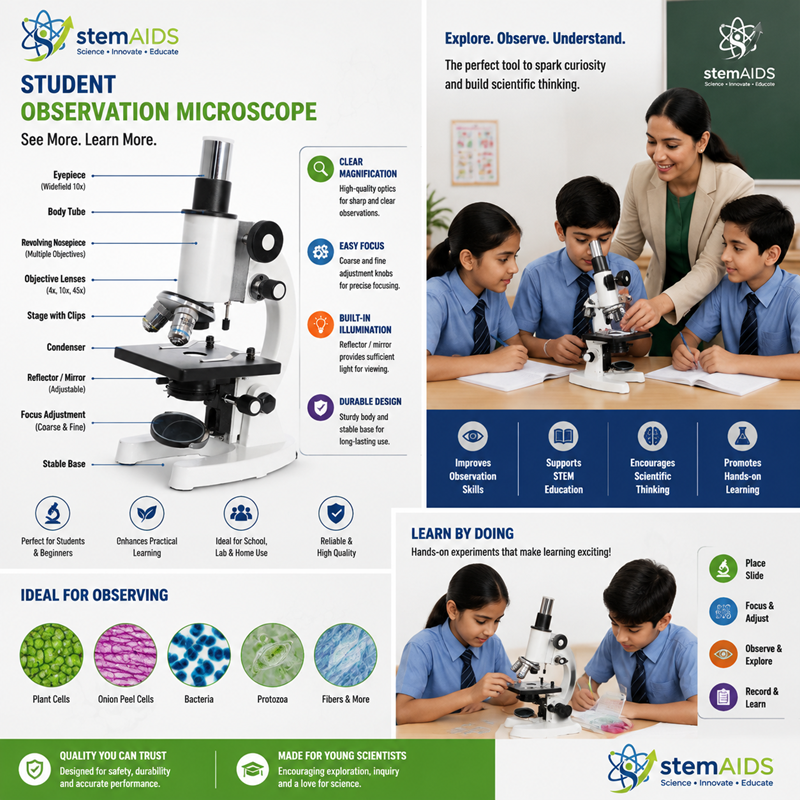
Quick Answer: The Student Observation Microscope is a classroom microscope for pupils making their first observations of specimens on slides and learning to focus, draw and describe what they see. As its name suggests, the student observation microscope is aimed at introductory science lessons rather than detailed laboratory work.
Made for Observation Lessons
Observation is the first scientific skill most pupils practise with a microscope: look carefully, record accurately, describe without guessing. A typical sequence moves from a hair or a thread, to a printed letter e that shows how the instrument orients the image, to a drop of pond water or a piece of onion skin. Each step teaches something about the microscope as well as the specimen.
Drawing is part of the practical. Pupils learn to draw only what they see, with clear single lines, a title, the magnification used and labels placed to one side. The microscope is the tool; the observation record is what teachers assess.
Optical design, head type, objectives and lighting are not given in the listing, so set it beside the Student Compound Biological Microscope and check both against the practicals on your syllabus. Schools that also want low-power 3D views of whole objects often add a binocular dissecting microscope to the set.
Applications
- An introductory lesson on the parts of a microscope and correct focusing
- Comparing natural and synthetic fibres, hair and paper under magnification
- Pond-water observation and simple identification of microorganisms
- Scientific drawing practice with magnification and labels
Care & Handling
- Teach pupils to carry the student observation microscope with both hands and set it well back from the bench edge.
- Remove the slide and move the stage or tube to its lowest safe position before putting the cover on.
- Wipe spilt water or stain from the stage at once so it does not dry into the mechanism.
- Check each microscope at the end of the lesson for missing parts, loose eyepieces and smudged lenses.
Specifications
| Instrument | Student microscope for classroom observation |
| Intended users | School pupils learning microscope skills |
| Typical specimens | Hair, fibres, pond water, onion skin, prepared slides |
| Classroom role | Observation and scientific drawing practicals |
| Optical design, objectives and illumination | Confirm at enquiry |
Why Choose LabEquip
Primary and secondary schools starting microscope work, and science clubs that need a pupil’s instrument, are the usual buyers. LabEquip offers it in the Microscope & Optics range; send your class size through the contact page to plan a set.
Frequently Asked Questions
What is the letter e test?
Pupils cut a small printed e from a newspaper, mount it on a slide under a coverslip and look at it through the microscope. They draw it, compare its orientation with the paper, then move the slide and note which way the image moves.
How should pupils draw what they see?
Use a sharp pencil, draw single clear lines without shading, keep the drawing large, and add labels with ruled lines that do not cross. Record the specimen, any stain used and the magnification beside the drawing.
What are good first specimens for observation lessons?
Things that are easy to prepare and interesting at low power: a hair, cotton and polyester fibres, salt or sugar crystals, onion epidermis and a drop of pond water. They build focusing skill before stained sections are introduced.
How can I stop pupils damaging slides and lenses?
The rule is that the lens only moves towards the slide while you watch it from the side. Once looking through the eyepiece, pupils should only move it away. Combined with starting at the lowest power, this makes cracked coverslips rare.
How many pupils can share a microscope?
Pairs work well: one pupil focuses and observes, the partner writes and draws, and halfway through they change roles. Larger groups spend more time waiting than observing.
Is this microscope suitable for insects or rocks?
If your lessons centre on solid, opaque objects, a binocular dissecting microscope suits them better, because it gives a 3D view with light from above. Slide microscopes are designed for thin specimens that light can pass through.
Last Updated: September 2026
Bestsellers



