





Sale
In Stock
Optical Projection Microscope
Original price was: ₹12,500.00.₹6,240.00Current price is: ₹6,240.00.
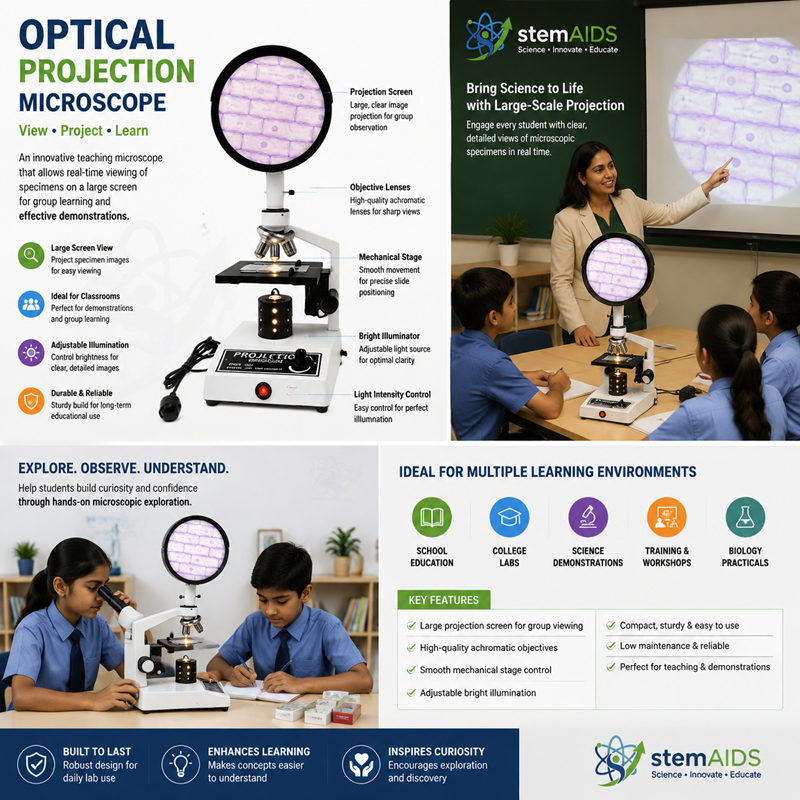
Quick Answer: The Optical Projection Microscope is a microscope that projects the magnified image of a specimen onto a screen or wall using lenses and a light source, instead of sending it only to an eyepiece. An optical projection microscope lets a teacher show one slide to a whole group at the same time.
Projecting a Specimen for the Whole Room
Before digital cameras became common, projection microscopes were how a class was shown what was on a slide, and they remain useful because they need no computer. A bright lamp lights the slide, the objective forms a magnified image, and a projection lens, often with a mirror, sends that image to a screen. The teacher points to structures while talking, and every pupil sees the same field.
The word optical distinguishes this from digital versions that capture the image with a camera and show it on an LCD, such as the Projection Microscope with LCD Screen. A purely optical projection shows the colour and movement of live specimens with no delay, which suits Paramecium swimming, cytoplasm streaming in Elodea leaf cells or the heartbeat of a Daphnia.
Projected images need a dimmed room, and the larger the image on the wall, the fainter it becomes. The listing does not give the lamp type, magnifications or projection distance, so plan the room layout once those are known. For a smaller wall-screen model, compare the Junior Projection Microscope.
Applications
- Whole-class demonstrations of prepared slides before pupils use their own microscopes
- Showing live protists, Daphnia or Elodea cells moving in real time
- Teaching cell and tissue structure with a pointer on the projected image
- Science fairs and open days where visitors watch without handling equipment
Specifications
| Instrument | Projection microscope, optical |
| Output | Magnified image projected onto a screen or wall |
| Viewing | Whole group at once, no computer needed |
| Room | Dimmed room for a bright projected image |
| Lamp, magnifications and projection distance | Confirm at enquiry |
Care & Handling
- Let the lamp of the optical projection microscope cool fully before covering or packing it.
- Leave live mounts on the stage only as long as needed; concentrated light warms the slide and dries the mount.
- Clean the projection lens and any mirror with a blower and lens tissue, since dust shows clearly on the screen.
- Handle a replacement halogen bulb, if that is the lamp type, with a tissue rather than bare fingers.
Why Choose LabEquip
Schools that want every pupil to see a demonstration slide, and teachers working without dependable projectors or computers, choose an optical projection microscope. LabEquip lists it in the Microscope & Optics range; ask about lamp type and screen size on the contact page.
Frequently Asked Questions
How does an optical projection microscope differ from a digital one?
An optical model projects the image directly with lenses and light, so it needs no camera or computer and shows movement with no delay. A digital model uses a camera and screen, which works in brighter rooms and can save images.
How dark does the room need to be?
Dim enough for the projected image to stand out clearly. Close curtains or blinds and switch off the lights near the screen. A smaller image is brighter, so move the microscope closer to the screen if the picture looks faint.
Can live specimens be projected?
Yes, and it is one of the instrument’s strengths. Keep live mounts thin under a coverslip and limit the time under the lamp, because concentrated light warms the slide and can slow or kill small organisms.
Why might the projected image appear inverted?
Lenses invert the image. Some projection microscopes correct this with a mirror or prism; if the image appears inverted, turn the slide round or explain to pupils that movements appear reversed.
What screen works well?
A matt white wall or screen gives the brightest, most even image. Glossy surfaces create a hot spot, and coloured walls tint the specimen.
Can students also use it as an ordinary microscope?
Some projection microscopes have an eyepiece for individual viewing as well as the projection path; others are projection only. Confirm which design this model uses at enquiry if you need both.
Last Updated: September 2026
Bestsellers



