


Sale
In Stock
Decimal Abacus Model
Original price was: ₹500.00.₹240.00Current price is: ₹240.00.
Quick Answer: The Decimal Abacus Model extends the classic bead-and-rod abacus idea to decimal place value, letting students physically represent tenths, hundredths and whole-number positions together to build a concrete sense of the decimal system. It is designed for upper-primary and middle-school classrooms and is part of the LabEquip Maths Kit range.
Product Description
This Decimal Abacus Model from LabEquip is built specifically around the base-ten place-value system as it extends past the decimal point. Where a standard abacus focuses on whole-number counting, this model includes positions for decimal fractions such as tenths and hundredths, so students can see how the same positional-value idea that applies to units, tens and hundreds also applies below the decimal point.
In a typical classroom session, a teacher represents a decimal number on the abacus and asks students to read it back in words, or gives a written decimal for students to build bead by bead. This physical, positional approach is especially useful when students are moving from whole-number place value into decimals for the first time, since it keeps the same visual logic they already know.
The model is intended as a focused decimal place-value manipulative for upper-primary and middle-school mathematics lessons. Exact bead count, decimal-position range and overall dimensions are best confirmed directly with LabEquip if your lesson plan depends on precise values.
What This Kit Helps Students Learn
- Understand place value as it extends past the decimal point into tenths and hundredths.
- Build and read decimal numbers using a physical, positional model.
- Compare decimal numbers by examining their place-value positions.
- Connect whole-number place value to decimal place value as one continuous system.
- Practise basic decimal arithmetic with a concrete visual reference.
Specifications
| Attribute | Detail |
|---|---|
| Product Name | Decimal Abacus Model |
| Brand | LabEquip |
| Product Type | Decimal place-value bead-and-rod manipulative |
| Primary Concept | Decimal place value and base-ten number representation |
| Learning Applications | Place value, decimal notation, number comparison and basic arithmetic |
| Recommended For | Upper-primary and middle-school mathematics classrooms, maths labs |
| Bead Count, Decimal Range & Dimensions | Contact us for detailed specifications |
Care & Maintenance
- Wipe the frame and beads with a soft, dry cloth to remove dust.
- Check that beads move freely along rods and report any sticking beads before class use.
- Store the abacus away from excess moisture and direct heat.
Why Choose LabEquip
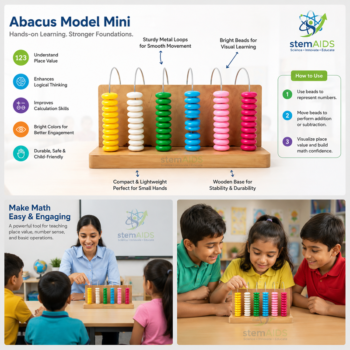
LabEquip supplies a full range of Maths Kit manipulatives for schools, including the standard Abacus Model and Place Value Cards. Browse our full Maths Kit category for more place-value and number-sense teaching aids.
Frequently Asked Questions
How is this different from the standard Abacus Model?
The standard Abacus Model focuses on whole-number counting, while this Decimal Abacus Model is built specifically to represent tenths, hundredths and other decimal positions.
What age group is this suitable for?
It is most commonly introduced in upper-primary or early middle-school classrooms once students already understand whole-number place value.
Can this help with comparing decimal numbers?
Yes, physically representing two decimal numbers side by side on the model makes it easier for students to see which is larger by comparing matching place-value positions.
Is this suitable for whole-class demonstration?
Yes, teachers commonly use it at the front of the class to introduce a decimal concept before students practise with their own materials.
Can this be paired with other maths manipulatives?
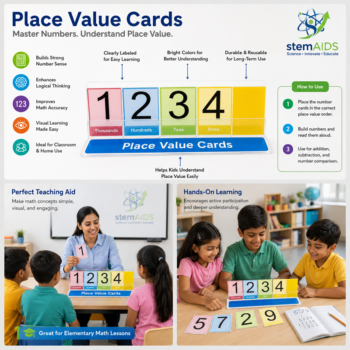
Yes, it pairs well with other kits in our Maths Kit range, such as Place Value Cards, for a broader place-value and decimals unit.
Last updated: September 2026
Bestsellers

Sale

Sale
Sale

Sale
Sale
Sale

Sale

