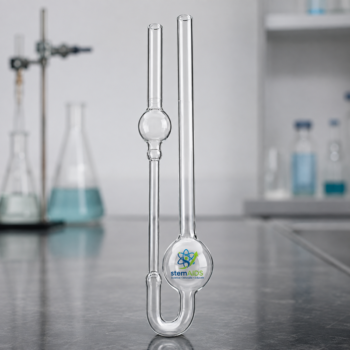
The Laboratory Stalagmometer Tube is a capillary laboratory instrument used for determining or comparing the surface tension of liquids by controlled drop formation. It is intended for supervised chemistry, pharmacy, college, university, and research laboratory experiments where users study surface tension using established stalagmometric drop-count or drop-weight methods.
Product Description
The STEMAids Laboratory Stalagmometer Tube is designed for practical investigations of surface tension. A stalagmometer contains a narrow capillary outlet and an enlarged liquid-holding section that allows drops to form and detach under controlled conditions. Measurements are commonly made by comparing the number or mass of drops produced by a test liquid with those from a reference liquid.
Accurate stalagmometric work depends on a clean capillary, consistent temperature, vertical positioning, and correct experimental technique. The exact STEMAids glass grade, nominal volume, calibration marks, capillary dimensions, tolerance, and overall size are [confirm]. Related products are available under Laboratory Glassware and General Lab Products.
Key Features
- Designed for surface-tension experiments: Supports stalagmometric comparison of liquids using controlled drops.
- Capillary drop formation: The narrow outlet enables repeatable drop formation when used correctly.
- Suitable for comparative measurement: Can be used with a reference liquid of known surface tension.
- Manual operation: Requires no electrical power or electronic controller.
- Educational value: Demonstrates the relationship between intermolecular forces, drop formation, and surface tension.
- Reusable laboratory format: Suitable for repeated experiments when cleaned and handled correctly.
- Critical dimensions: Capacity, capillary bore, graduations, and glass specification are [confirm].
Technical Specifications
|
Specification |
Detail |
|
Product Name |
Laboratory Stalagmometer Tube |
|
Brand |
STEMAids |
|
Product Type |
Capillary surface-tension measuring apparatus |
|
Primary Application |
Determination or comparison of liquid surface tension |
|
Measurement Method |
Stalagmometric drop-count or drop-weight method, according to laboratory protocol |
|
Material |
Glass; grade |
|
Product-Specific Certification |
None verified |
What’s Included in the Kit
- Laboratory Stalagmometer Tube
- Rubber tubing or suction arrangement
- Support or clamp
- Instruction sheet
- Additional accessories
Applications / Uses
- Determining relative surface tension of liquids.
- Comparing a test liquid with a reference liquid.
- Performing drop-count stalagmometry experiments.
- Performing suitable drop-weight investigations.
- Studying effects of concentration on surface tension.
- Teaching surface chemistry and intermolecular-force concepts.
- Supporting physical chemistry and pharmacy laboratory practicals.
How to Use the Laboratory Stalagmometer Tube
- Clean the stalagmometer thoroughly so the internal surface and capillary tip are free from contamination.
- Mount the tube vertically using a suitable laboratory support.
- Draw the reference liquid above the required upper reference level according to the approved laboratory method.
- Allow the liquid to flow slowly through the capillary under gravity.
- Count the drops formed between the specified reference marks or collect them for weighing, depending on the selected method.
- Repeat the procedure with the test liquid under the same temperature and experimental conditions.
- Calculate the surface tension using the appropriate stalagmometric equation and reference data.
Safety note: Secure the glass tube vertically before use and handle the capillary tip carefully. Follow appropriate chemical-handling procedures for every test liquid. Do not apply excessive suction or pressure to fragile glassware.
Care & Maintenance
- Clean the stalagmometer immediately after use because contamination can alter drop formation and measurement results.
- Rinse with an appropriate laboratory cleaning procedure and ensure the capillary remains unobstructed.
- Inspect the tip and tube for chips, cracks, deposits, or blockage before each measurement.
- Store vertically or in protective laboratory storage to prevent damage to the capillary tip.
Why Choose STEMAids
STEMAids supplies scientific laboratory products, educational apparatus, STEM kits, and practical-learning equipment for institutional users. Its current catalogue includes dedicated Lab Glassware and General Lab Products categories for laboratory procurement. Buyers can also source supporting experimental equipment through Lab Experiment Practice Kits and review the complete STEMAids product catalogue.
Frequently Asked Questions
What is a Laboratory Stalagmometer Tube used for?
A stalagmometer is used to determine or compare the surface tension of liquids by analysing drops formed from a capillary tip.
How does a stalagmometer measure surface tension?
A known volume or interval of liquid is allowed to form drops through the capillary. The drop count or drop mass is compared with reference data to calculate surface tension using the selected stalagmometric method.
Why must a stalagmometer be kept clean?
Surface contamination can alter wetting and drop formation at the capillary tip. A clean tube is therefore essential for consistent experimental results.
Can a stalagmometer be used for the drop-count method?
Yes. Drop-count stalagmometry is a standard application in which the number of drops formed between defined reference levels is measured and compared with a reference liquid.
What material is the STEMAids Stalagmometer Tube made from?
The apparatus is a glass tube, but the exact glass grade for this STEMAids model is [confirm]. A specific borosilicate grade should not be claimed until verified.
Is a stalagmometer suitable for college laboratories?
Yes. Stalagmometry is suitable for supervised college, university, pharmacy, and physical chemistry practicals involving surface tension and liquid properties.