



Sale
In Stock
Paramecium Biology Chart
Original price was: ₹340.00.₹160.00Current price is: ₹160.00.
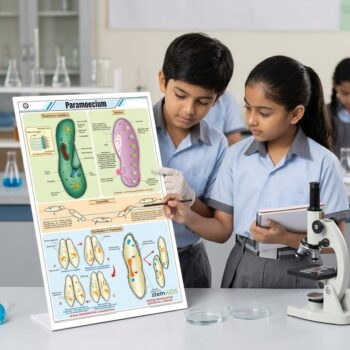
Quick Answer: The Paramecium Biology Chart is a zoology wall chart showing the structure of Paramecium, a slipper-shaped single-celled ciliate, with labelled cilia, pellicle, oral groove, food and contractile vacuoles, macronucleus and micronucleus. This paramecium chart often adds reproduction by binary fission and conjugation, and is used for lessons on protozoa and unicellular life.
One Cell Doing Everything
Paramecium is the classic example of a single cell carrying out every function of life, and the chart is organised around that idea. The main drawing, usually of Paramecium caudatum, shows a slipper-shaped cell covered in rows of cilia beneath a flexible pellicle. A groove along one side, the oral groove, leads to the cytostome and gullet, where food particles such as bacteria are swept in and enclosed in food vacuoles that travel round the cell as digestion proceeds; wastes leave at a fixed anal pore.
Two star-shaped contractile vacuoles, one near each end, collect excess water through radiating canals and expel it, which is how a freshwater cell avoids bursting. Two kinds of nucleus are labelled: a large macronucleus that runs everyday cell activity and a small micronucleus involved in reproduction. Trichocysts, small rods just under the pellicle, are often marked as well.
Reproduction panels, where included, show transverse binary fission, in which the cell divides across its middle, and conjugation, in which two cells pair temporarily and exchange micronuclear material. Check that the edition includes these panels if your syllabus covers them.
Specifications
| Organism | Paramecium (typically P. caudatum), a ciliate protozoan |
| Structures labelled | Cilia, pellicle, oral groove, cytostome, food vacuoles, anal pore |
| Water balance and control | Contractile vacuoles with radiating canals; macronucleus and micronucleus |
| Reproduction (many editions) | Binary fission and conjugation |
| Level | Secondary biology and zoology |
| Size and finish | Confirm at enquiry |
Applications
- Preparing students to observe live Paramecium from a hay infusion under the microscope
- Teaching osmoregulation through the contractile vacuole
- Comparing a unicellular organism with multicellular life in the classification unit
- Explaining asexual and sexual processes in protozoa
Care & Handling
- Keep the Paramecium chart beside the microscopes during the hay-infusion practical, where students will look back at it often.
- Hang it away from the culture jars; hay infusions develop a strong smell and can spill.
- Clean it with a dry cloth only, and store it rolled when not in use.
Why Choose LabEquip
Biology teachers buy this chart for the protozoa and unicellular-life lessons, often with prepared slides so students can compare the diagram with a stained specimen. LabEquip lists it in the Educational Charts range, and orders can be arranged through the contact page.
Frequently Asked Questions
How does Paramecium move?
Thousands of cilia beat in coordinated waves, pushing the cell through the water. Because they beat at a slight angle, Paramecium rotates along its long axis as it swims. When it bumps into an obstacle it reverses, turns slightly and moves forward again, the so-called avoiding reaction.
What does the contractile vacuole do?
Paramecium lives in fresh water, which enters the cell constantly by osmosis. Radiating canals collect the excess water into the contractile vacuole, which then contracts and expels it through a pore in the pellicle, stopping the cell from swelling and bursting.
Why does Paramecium have two nuclei?
The two nuclei divide the work. The large macronucleus controls everyday functions such as feeding, growth and movement, while the small micronucleus is involved in reproduction, including the exchange of genetic material during conjugation.
How does Paramecium feed?
Cilia in the oral groove sweep bacteria and small food particles towards the cytostome. At the end of the gullet the food is enclosed in a food vacuole, which moves around the cell while enzymes digest its contents. Undigested waste is expelled at the anal pore.
How can students see a live Paramecium?
Make a hay infusion by soaking dry hay or grass in pond water for about a week, then take a drop from the surface film. Adding a little methyl cellulose, or a few cotton fibres, slows the cells enough to observe cilia and vacuoles under low and then high power.
What is conjugation in Paramecium?
It is a sexual process in which two Paramecia join temporarily at their oral grooves and exchange micronuclear material. After separating, each cell reorganises its nuclei and later divides, producing offspring with new combinations of genes.
Last Updated: September 2026
Bestsellers


Sale

