







Sale
In Stock
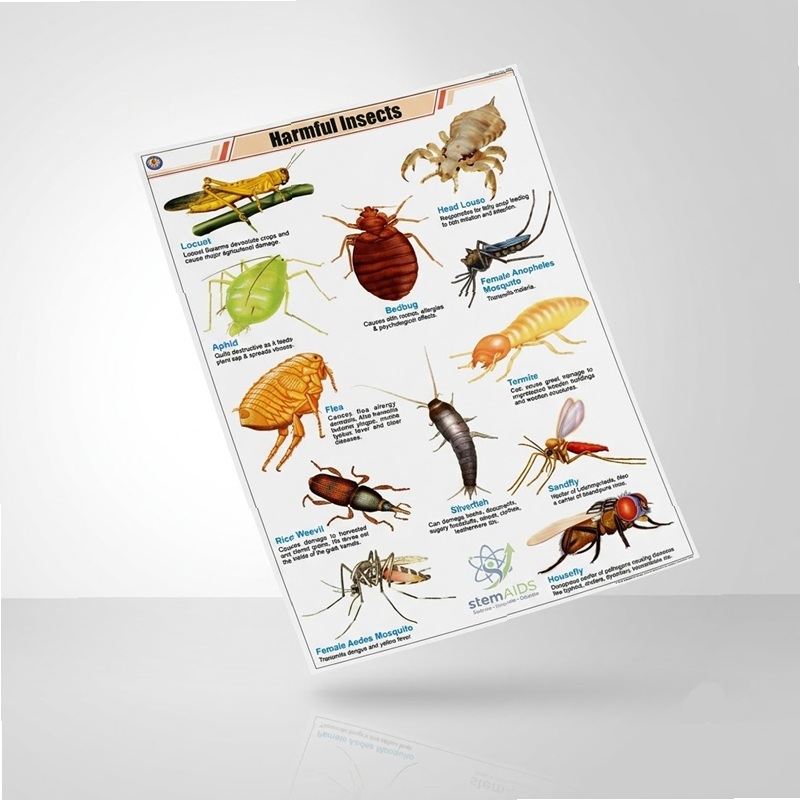
Harmful Insects Learning Chart
Original price was: ₹340.00.₹160.00Current price is: ₹160.00.
The Harmful Insects Learning Chart is an educational teaching aid used to help students identify insects considered harmful in specific human, agricultural, household or environmental contexts. It supports visual learning in biology, environmental science and general science lessons by presenting insect-related concepts in a classroom-friendly reference format.
Product Description
The STEMAids Harmful Insects Learning Chart is designed as a visual classroom resource for introducing learners to insects that may affect crops, stored materials, human environments or health in particular circumstances. A learning chart allows teachers to reinforce insect identification and discuss why an insect may be considered harmful in a given context.
The exact insects illustrated, scientific names, chart dimensions, printing substrate, lamination, language and mounting arrangement are . These details should be verified before publishing specific species, waterproof, laminated or tear-resistant claims.
Key Features
- Visual insect learning: Supports recognition and discussion of insects considered harmful in particular contexts.
- Biology teaching aid: Suitable for lessons covering insects, ecology, agriculture and environmental science.
- Classroom reference: Can be used during teacher-led explanation, revision and science discussions.
- Concept-based learning: Helps connect insect identification with effects on crops, stored materials, households or health.
- Reusable educational resource: Suitable for repeated classroom reference when stored and handled appropriately.
- Supports scientific vocabulary: Can reinforce insect names and related biological concepts when these are printed on the chart.
- Specification transparency: Exact species coverage, dimensions, material and language are .
Technical Specifications
|
Specification |
Detail |
|
Product Name |
Harmful Insects Learning Chart |
|
Brand |
STEMAids |
|
Category |
Teaching Learning Material – Biology & Environmental Science Teaching Aids |
|
Subject Area |
Biology / Environmental Science |
|
Learning Topic |
Harmful insects and their identification |
What’s Included in the Kit
- Harmful Insects Learning Chart
- Hanging strip / eyelets
- Teacher guide or activity sheet
- Protective packaging
Applications / Uses
- Teaching students to recognize selected harmful insects.
- Introducing insect diversity in biology lessons.
- Discussing agricultural insects and crop damage.
- Supporting environmental science and ecology discussions.
- Comparing harmful insects with beneficial insects.
- Supporting classroom revision, quizzes and oral identification activities.
- Displaying science-learning content in laboratories and classrooms.
Teachers can combine the chart with STEMAids Biology Models for broader life-science instruction. Related anatomical and biological teaching aids are available in the STEMAids Anatomy Models range.
How to Use the Harmful Insects Learning Chart
- Display the chart where students can clearly see the illustrations and labels.
- Introduce the concept that an insect may be considered harmful because of its effect in a particular agricultural, household, ecological or health context.
- Ask students to observe and identify the insects shown on the chart.
- Discuss the characteristic effects or problems associated with each illustrated insect where scientifically appropriate.
- Compare harmful insects with insects that provide beneficial ecological functions.
- Use the chart for revision, identification exercises or classroom questioning.
- Store the chart flat or appropriately supported after use to prevent physical damage.
Teaching note: Avoid presenting all insects as harmful. Insects perform important ecological roles, including pollination, decomposition and participation in food webs. The term “harmful” should be explained in relation to the specific context shown on the chart.
Care & Maintenance
- Keep the chart dry unless its material is specifically confirmed as water-resistant.
- Avoid folding, creasing or placing heavy objects on the teaching surface.
- Clean only with methods compatible with the confirmed printing and surface material.
- Store flat or hang securely in a dry classroom or laboratory area.
Why Choose STEMAids
STEMAids is the STEM education brand of Eduscope Smart Learning Solutions Private Limited, a New Delhi-based manufacturer of STEM kits, Teaching Learning Material, laboratory products and educational science models. Its current catalogue includes dedicated biology models and anatomy teaching products for school and institutional learning. The company publishes ISO 9001:2015 and ISO 14001:2015 management-system credentials and maintains an active Importer-Exporter Code. These company credentials should not be presented as product-specific certification for this learning chart.
Frequently Asked Questions
What is a Harmful Insects Learning Chart?
A Harmful Insects Learning Chart is a visual educational aid used to teach students about selected insects considered harmful in agricultural, household, environmental or health-related contexts.
Which insects are shown on the STEMAids chart?
The exact insect list is . Individual species should not be named on the product page until the final chart artwork or specification has been verified.
What subject can this learning chart be used for?
The chart is relevant to biology, environmental science, general science, ecology and introductory agricultural-science teaching.
Is the Harmful Insects Learning Chart suitable for schools?
Yes. It is designed as a visual teaching aid for supervised classroom and science-learning activities. The exact recommended grade or age range is .
Is the chart laminated?
Lamination is . Do not advertise the chart as laminated, waterproof or washable until its material specification is verified.
Why is it important to explain the term “harmful insects” carefully?
Because insects can have different ecological roles. An insect may be harmful in one context, such as crop damage, while insects as a group also perform essential functions including pollination, decomposition and supporting food webs.
Bestsellers


Sale



