




In Stock
Ultraviolet Light
₹350.00
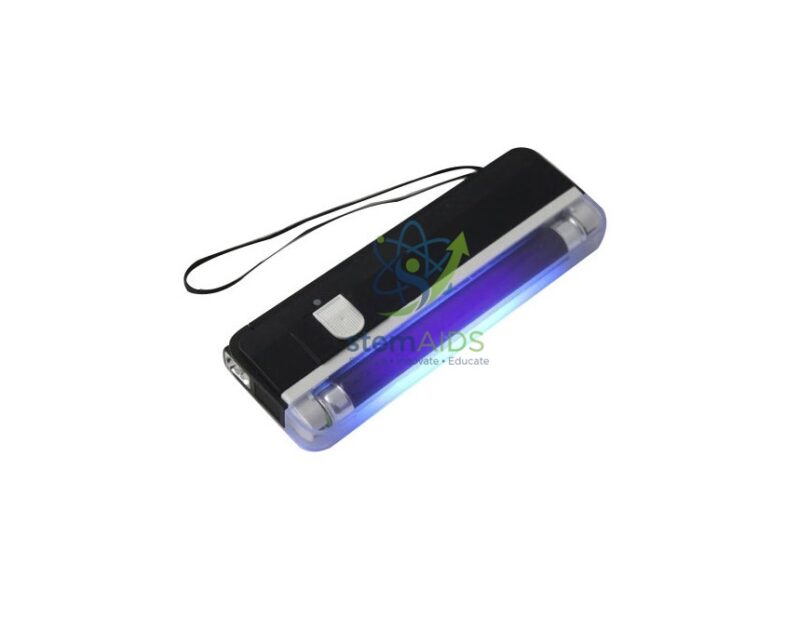
Quick Answer: The Ultraviolet Light is a portable hand-held UV lamp used in science classes to make fluorescent materials glow. The listing photograph shows a compact lamp with a UV tube behind a window and a wrist strap, used for fluorescent minerals, hidden security marks, tonic water and plant pigment demonstrations.
How Fluorescence Demonstrations Work
Ultraviolet light is invisible, but some substances absorb it and re-emit the energy as visible light. In a darkened room, that makes them glow in colours that have nothing to do with their appearance in daylight. A portable ultraviolet light turns this into a series of quick demonstrations: the security fibres and printed marks on banknotes and identity cards appear, tonic water glows blue from its quinine, and an extract of green leaves in alcohol glows deep red as chlorophyll fluoresces.
Wavelength matters, and the title does not state it. Long-wave UV-A, often around 365 nm, is the most common in hand lamps and suits most classroom demonstrations. Short-wave UV-C, around 254 nm, is needed for many fluorescent minerals and for thin-layer chromatography plates with a fluorescent indicator, and it is more hazardous to eyes and skin. Confirm which band this lamp emits, and its power source, before planning practicals around it.
Earth-science classes use UV lamps for identifying fluorescent specimens: some fluorite and calcite glow under UV, as do willemite and scheelite. Response varies from specimen to specimen, so it is worth testing a collection before the lesson and keeping the ones that glow well as a demonstration set.
UV Safety and Care
- Never look into the lamp or shine it at anyone’s face; use UV-protective glasses or goggles for everyone close to the lamp.
- Keep exposure of skin brief and point the lamp only at the sample.
- Switch the lamp off between demonstrations, and remove batteries before long storage if it is battery-powered.
Applications
- Showing fluorescence of minerals in a rock and mineral lesson
- Revealing hidden security features on banknotes and documents
- Chlorophyll fluorescence from a leaf extract in a photosynthesis lesson
- Quinine fluorescence in tonic water as an introduction to light and energy
Specifications
| Item | Portable hand-held ultraviolet lamp |
| Form | Compact housing with UV tube window and wrist strap (listing photograph) |
| Uses | Fluorescence demonstrations in biology, chemistry and earth science |
| Safety | UV-protective eyewear; no direct viewing of the lamp |
| Wavelength band and power source | Confirm at enquiry |
Why Choose LabEquip
Schools buy a portable UV lamp once and use it across biology, chemistry and earth-science lessons. LabEquip lists it in Biology Lab Products, and it pairs with the Mineral Test Kit for identification practicals. Confirm the wavelength and power supply through the LabEquip contact page.
Frequently Asked Questions
Is this a UV-A or UV-C lamp, and why does it matter?
The title does not say, so confirm it at enquiry. Long-wave UV-A suits most classroom demonstrations and is less hazardous. Short-wave UV-C is needed for many fluorescent minerals and some chromatography plates but is more harmful to eyes and skin.
Is the lamp safe for students to use?
Only with precautions. Nobody should look into the lamp, and everyone near it should wear UV-protective eyewear. The teacher or a trained student should aim the lamp at the sample, not at people.
Why must the room be dark?
Fluorescent glow is faint compared with daylight or room lighting. Closing blinds and switching off lights makes even weak fluorescence clearly visible.
How can the lamp show chlorophyll fluorescence?
Grind green leaves with a little alcohol, filter the extract into a clear tube and shine the lamp on it in the dark. The green solution glows red, because chlorophyll re-emits absorbed energy as red light.
Which minerals fluoresce under UV light?
Some specimens of fluorite, calcite, willemite and scheelite fluoresce, but not every sample does, and many need short-wave UV. Test specimens before class to find the ones that respond.
Can a hand-held UV lamp be used to view DNA gels?
Hand lamps are usually too weak and uneven for this. Stained gels are normally viewed on a transilluminator, or stained with a dye that is visible in ordinary light.
Last Updated: September 2026
You must be logged in to post a review.
Bestsellers




Reviews
There are no reviews yet.