


In Stock
The Movement Model
Maquette Le mouvement features a dual-tension cord system that simulates the physiological contraction and extension of the biceps and triceps brachii, providing a realistic representation of hinge joint dynamics.
High-Impact Articulated Chassis Constructed from laboratory-grade polymers with a reinforced pivot point that replicates human elbow range of motion, ensuring structural longevity during repetitive instructional cycles.
$11.92
Quick Answer: The Movement Model is a working model that shows how muscles and bones produce movement at a joint: muscles pull on bones by contracting, and pairs of muscles act against each other to bend and straighten a limb. It is used in biology and physical education lessons on the musculoskeletal system.
How the Movement Model Explains Muscle Action
Muscles can only pull. A contracting muscle shortens and pulls on the bone it is attached to by a tendon, but it cannot push the bone back again, which is why muscles work in antagonistic pairs. At the elbow, the biceps on the front of the upper arm contracts to bend, or flex, the forearm while the triceps at the back relaxes; to straighten the arm, the triceps contracts and the biceps relaxes.
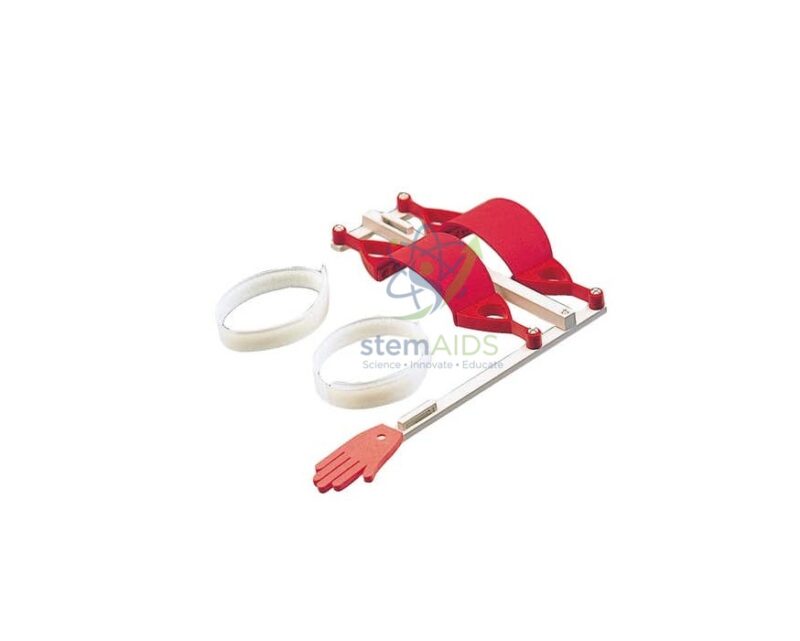
The product photo shows a jointed limb ending in a hand, red muscle pieces and elastic loops, a common way for such models to represent muscles that shorten and stretch. Moving the forearm lets students watch one muscle shorten while its partner lengthens, and see that the attachment points, not the muscle bellies, decide which way the bone moves. The listing does not give the parts list, size or material.
The same model introduces levers. In elbow flexion the joint is the pivot and the biceps pulls between the pivot and the load in the hand, so the forearm acts as a third-class lever, trading force for speed and range of movement. For a closer look at the joint surfaces and ligaments, see the functional elbow joint model.
Specifications
| Type | Working model of muscle action at a joint |
| Principle shown | Antagonistic muscle pairs pulling on bones |
| Parts shown in the product photo | Jointed limb with hand, red muscle pieces, elastic loops |
| Topics | Flexion and extension, tendons, levers, joints |
| Parts list, size and material | Confirm at enquiry |
Where It Fits in the Syllabus
- Secondary biology lessons on the skeleton, joints and muscles
- Explaining antagonistic pairs such as biceps and triceps, or hamstrings and quadriceps
- Physics and biology links on levers, pivots and forces in the body
- Physical education and sports science lessons on how movement is produced
Care & Handling
- Move the joint through its natural range only; forcing it past the stop strains the elastic parts and fixings.
- Check the elastic loops for cracks or loss of stretch and replace them before they snap during a lesson.
- Store the model with the elastic slack rather than stretched, away from heat and sunlight, which age rubber.
Why Choose LabEquip
Biology and PE teachers use a working model like this because students can see the pull and the result, which a diagram cannot give them. The Movement Model is listed in LabEquip’s biology lab products; for questions about parts or quantities, use the contact page.
Frequently Asked Questions
Why do muscles work in pairs?
A muscle can only contract and pull. It cannot push a bone back, so a second muscle on the other side of the joint is needed to reverse the movement. Such a pair is called antagonistic.
What happens to the biceps and triceps when the arm bends?
To bend the elbow, the biceps contracts and shortens while the triceps relaxes and lengthens. To straighten it, the triceps contracts and the biceps relaxes.
What connects muscles to bones?
Tendons, which are tough, cord-like bands of connective tissue that transmit the muscle’s pull to the bone. Ligaments are different: they join bone to bone across a joint and keep it stable.
What type of lever is the forearm?
When the elbow bends, the forearm works as a third-class lever: the elbow is the pivot, the effort from the biceps acts close to it, and the load is in the hand further away. A small contraction therefore gives a large, fast movement of the hand.
Which other antagonistic pairs can the model help explain?
The same principle applies to the hamstrings and quadriceps at the knee, the muscles that raise and lower the foot at the ankle, and the flexors and extensors of the fingers.
Is the model suitable for younger pupils?
Yes, for a simple demonstration that muscles pull and work in pairs. Older students can go further into levers, tendons and the different types of joint.
Last Updated: September 2026
You must be logged in to post a review.
Bestsellers




Reviews
There are no reviews yet.