



In Stock
RNA Molecular Model
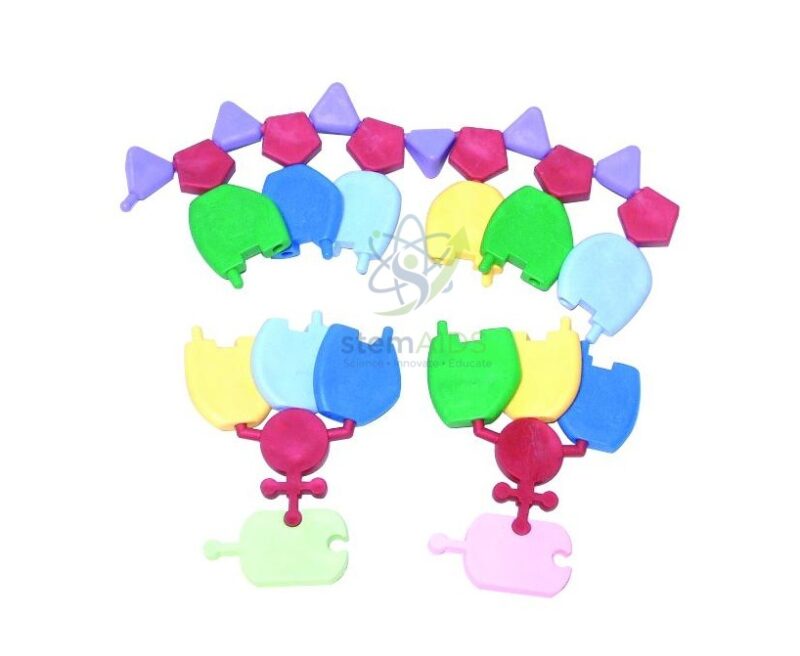
Modèle moléculaire ARN transcription, traduction Features precision-molded molecular units representing the Uracil base with unique mechanical keying, ensuring the physical demonstration of RNA-specific base-pairing and the distinct chemical identity of ribonucleic acid chains.
Dynamic Codon-Anticodon Interface Includes modular tRNA adapters and a multi-part ribosomal housing engineered to simulate the translocation process, allowing for the sequential assembly of polypeptide chains through precise mechanical-fit tolerances.
$11.79
Quick Answer: The RNA Molecular Model is a model of ribonucleic acid built from interlocking pieces, used to show how RNA is structured and how messenger RNA and transfer RNA work together to build a protein. It supports lessons on transcription, translation and the differences between RNA and DNA.
Pieces of an RNA Molecule
The product photo shows interlocking pieces: a backbone of alternating shapes carrying coloured base pieces, and below it separate molecules that pair with those bases and carry further pieces of their own. That arrangement matches how RNA models of this kind are usually used, with an mRNA strand on top and transfer RNA molecules bringing amino acids beneath it. Whether the set includes a ribosome piece or a DNA template is not stated in the listing.
Each RNA nucleotide consists of ribose sugar, a phosphate and one of four bases: adenine, uracil, guanine or cytosine. In a model built this way, students can check pairing rules at a glance, with uracil pairing with adenine, and see that mRNA is a single strand read in groups of three bases. Transfer RNA carries a three-base anticodon at one end that matches a codon on the mRNA, and the corresponding amino acid at the other.
Lining up two tRNA pieces on neighbouring codons shows the key event of translation: the amino acids they carry are joined by a peptide bond, the first tRNA is released and the chain moves on one codon. For a fixed display model of an RNA strand, see the RNA model on board; the high school genetic code set concentrates on reading codons and on mutations.
Lesson Uses
- Comparing the structure of RNA with DNA: sugar, bases and number of strands
- Pairing tRNA anticodons with mRNA codons during translation
- Showing how a peptide bond forms between amino acids carried by neighbouring tRNAs
- Revising the three main types of RNA: messenger, transfer and ribosomal
Care & Handling
- Take the strand apart piece by piece rather than pulling whole sections, so the interlocking tabs do not stretch or crack.
- Sort pieces by type after use; bases, backbone parts and tRNA pieces are easier to count when kept apart.
- Clean with a damp cloth and avoid hot water, which can distort plastic parts.
Specifications
| Model of | Ribonucleic acid (RNA) in protein synthesis |
| Shown in the product photo | Interlocking backbone and base pieces with paired carrier pieces |
| RNA features | Ribose sugar, phosphate, bases A, U, G and C, single strand |
| Processes | Messenger RNA and its translation with transfer RNA |
| Parts list and ribosome or DNA pieces | Confirm at enquiry |
Why Choose LabEquip
Biology teachers use an RNA model when students confuse transcription with translation, because the pieces keep the two steps physically separate. It is part of LabEquip’s biology lab products; for a parts list, use the contact page.
Frequently Asked Questions
Which kinds of RNA take part in protein synthesis?
Three kinds work together. mRNA is the working copy of a gene that travels to the ribosome, tRNA ferries amino acids and matches them to codons, and rRNA makes up much of the ribosome and catalyses the joining of amino acids.
How does RNA differ from DNA?
RNA is built on ribose, not deoxyribose; its fourth base is uracil where DNA has thymine; and it normally exists as one strand rather than two. RNA molecules are also broken down more quickly, which suits a temporary working copy of a gene.
What is an anticodon?
It is a sequence of three bases on a transfer RNA molecule that is complementary to a codon on messenger RNA. The anticodon ensures that each tRNA delivers the correct amino acid to the growing chain.
Where does translation happen in the cell?
On ribosomes in the cytoplasm, either free or attached to the rough endoplasmic reticulum. Transcription, by contrast, happens in the nucleus of eukaryotic cells, and the mRNA then leaves through the nuclear pores.
What pairs with uracil?
Adenine. In RNA, uracil takes the place of thymine, so wherever a DNA template strand has adenine, the new mRNA gets uracil, and codon-anticodon pairing also uses A with U.
Can the model show transcription as well as translation?
Transcription needs a DNA template to copy from. If the set has no DNA pieces, it can be combined with a DNA model to show the mRNA being built along one DNA strand before translation begins.
Last Updated: September 2026
You must be logged in to post a review.
Bestsellers




Reviews
There are no reviews yet.