









In Stock
Radiation Can Kit
₹856.00
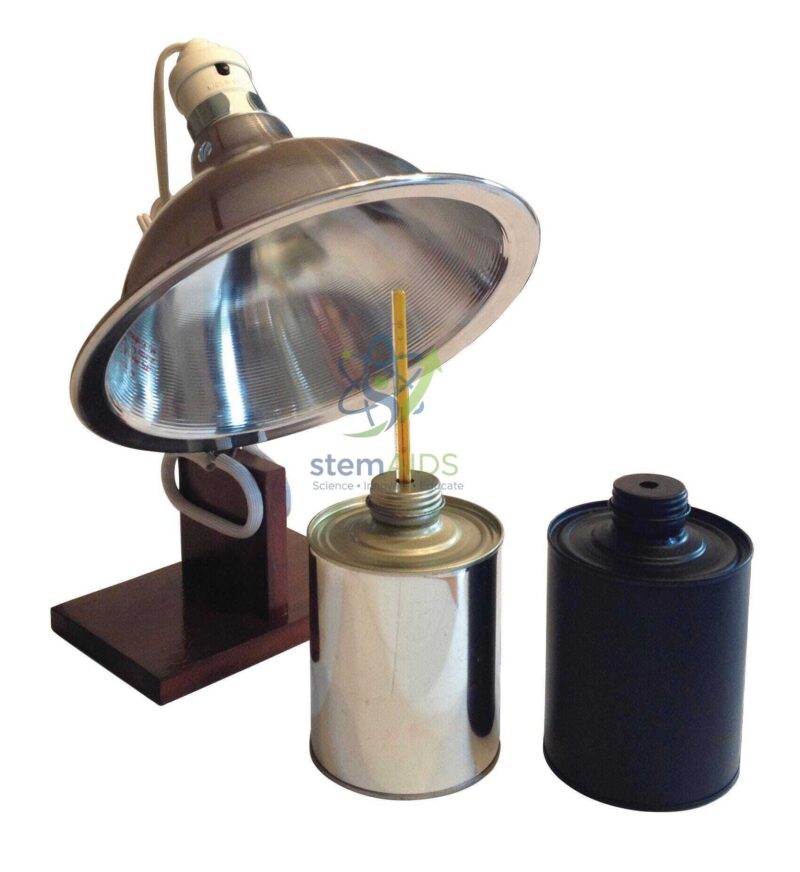
Quick Answer: The Radiation Can Kit is a heat-transfer apparatus for comparing how different surfaces absorb and emit thermal radiation. The listing photograph shows a matt black can, a polished metal can and a reflector lamp on a stand, with thermometers used to follow the temperature of water in each can.
Black Versus Shiny: the Experiment
Heat travels from a hot lamp to a cold can without any material in between, as infrared radiation. How much of it a surface takes in depends on its colour and finish. In the absorption version of the experiment, both cans are filled with the same volume of cold water, placed at the same distance from the lamp, and fitted with thermometers. Readings every minute show the water in the matt black can warming faster than the water in the shiny can, because the black surface absorbs most of the radiation that falls on it while the polished surface reflects much of it away.
The emission version reverses the flow. Both cans are filled with hot water at the same starting temperature and left to cool, away from the lamp. The black can now cools faster: a good absorber is also a good emitter. Plotting both cooling curves on one graph gives a clear result for coursework and links neatly to the Leslie cube, where one hot box with four different faces shows the same idea.
These results explain everyday designs: the silvered walls of a vacuum flask, white-painted houses in hot climates, dark solar water-heater panels and shiny emergency blankets. Biology classes use the same idea when discussing why animal fur and skin colour affect how quickly an animal gains or loses heat. The kit’s exact contents, can size and lamp rating are not stated in the title.
Safe Use
- The reflector lamp and its shade become hot; let them cool before moving or packing the apparatus.
- Check the lamp cable and plug before each use and keep water away from the electrical parts.
- Pour hot water carefully and stand the cans on a heat-resistant mat; if glass thermometers are used, clamp or support them so they cannot roll.
Specifications
| Item | Apparatus for comparing absorption and emission of heat radiation |
| Surfaces | Matt black can and polished metal can (listing photograph) |
| Heat source | Reflector lamp on a stand (listing photograph) |
| Measurements | Water temperature in each can over time |
| Exact contents, can volume and lamp rating | Confirm at enquiry |
Experiments and Topics
- Comparing absorption of radiant heat by matt black and shiny surfaces
- Comparing cooling rates, and so emission, from the same two surfaces
- Practising fair-test design: equal volumes, distances and starting temperatures
- Plotting temperature-time graphs and calculating rates of change
Why Choose LabEquip
Physics and general science departments buy this kit for heat-transfer practicals at secondary level. LabEquip lists it in Biology Lab Products alongside the Solar Furnace, which uses a curved mirror to concentrate the same radiation. Confirm contents and lamp voltage through the LabEquip contact page.
Frequently Asked Questions
Why does water in the black can warm up faster?
A matt black surface absorbs most of the infrared radiation that reaches it, while a polished metal surface reflects much of it. More absorbed energy means a faster temperature rise for the same amount of water.
Does the black can also cool faster?
Yes. Good absorbers of radiation are also good emitters. When both cans start with hot water, the black can loses heat by radiation faster and its temperature falls more quickly.
How do students make the experiment a fair test?
Use the same volume of water, the same starting temperature and the same distance from the lamp for both cans. Keep lids on, place thermometers at the same depth and take readings at the same times.
Can sunlight be used instead of the lamp?
It can on a clear day, but passing clouds change the heating rate during the experiment. A lamp gives steady, repeatable conditions indoors, which makes comparison easier.
How long should the experiment run?
Readings every minute for ten to twenty minutes usually give a clear difference. Longer runs show the curves flattening as the cans approach a steady temperature.
Is it the colour or the surface finish that matters?
Both. A dull, dark surface is the strongest absorber and emitter, and a shiny, light surface the weakest. A glossy black surface falls between them, which students can test if a third can is available.
Last Updated: September 2026
You must be logged in to post a review.
Bestsellers




Reviews
There are no reviews yet.