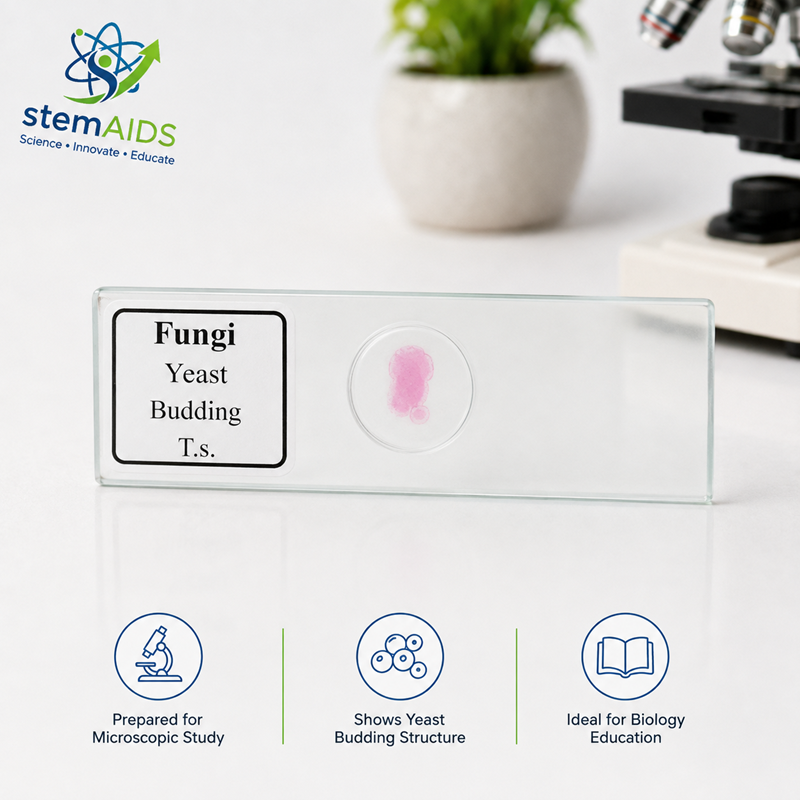
Quick Answer: The Yeast Budding Prepared Microscope Slide is a fixed, permanently mounted specimen of yeast cells prepared to show budding, the asexual reproduction of yeast, for observation under a compound microscope.
Budding in Yeast
Yeasts are single-celled fungi, and budding is their usual way of multiplying. A small outgrowth forms on the parent cell, the nucleus divides and one copy passes into the bud, and the bud grows until it pinches off as a new cell. Each separation leaves a small bud scar on the parent’s wall.
On a budding slide, students search the field for parent cells carrying buds of different sizes, and for short chains where a bud has started a bud of its own before separating. Drawing two or three of these cells in order of bud size is a common practical record.
Budding makes a useful contrast with binary fission. In fission the parent splits into two equal halves; in budding the daughter starts small, so the division of cytoplasm is unequal.
Viewing Tips
- Yeast cells are only a few micrometres across, so locate the stained area of the yeast slide at low power, then move to the 40x objective.
- Close the iris diaphragm slightly to add contrast to such small cells.
- Use the 100x oil-immersion objective, if available, to see where the bud joins the parent.
- Count cells with and without buds in one field to estimate the proportion that are budding.
Applications
- Asexual reproduction lessons comparing budding, fission and spore formation
- Microbiology introductions to fungi as eukaryotic microbes
- Pairing with a live yeast fermentation practical using sugar solution
- Class drawing exercises on budding
Specifications
| Specimen | Yeast cells showing budding |
| Organism group | Fungi (unicellular) |
| Format | Fixed, permanently mounted slide |
| Viewing | Compound microscope, 40x objective or higher |
| Course fit | School biology, botany and microbiology |
Care & Handling
- Keep the slide flat in a slide box, away from humid air.
- Hold it by the edges; fingerprints over the specimen blur fine detail at high power.
- If oil was used, remove it with lens tissue before boxing the slide.
Why Choose LabEquip
Teachers covering asexual reproduction often show the Yeast Budding Prepared Microscope Slide next to the Hydra Prepared Microscope Slide, since Hydra is a multicellular animal that also buds, and the Binary Fission Teaching Slide for contrast. Order through the contact page; all three are in Prepared Slides.
Frequently Asked Questions
How is budding different from binary fission?
Binary fission splits a cell into two daughters of equal size. In budding, a small outgrowth develops on the parent, receives a copy of the nucleus and grows before separating, so parent and daughter start out unequal.
Is yeast a plant, an animal or a microbe?
Yeast is a fungus. Unlike bacteria it has a nucleus and other membrane-bound organelles, so it is a eukaryote, and unlike plants it cannot make its own food by photosynthesis.
Why do some yeast cells form chains?
When budding is rapid, a new bud can begin before the previous one has separated. The cells stay attached in short chains or clusters, sometimes called pseudohyphae.
What magnification is needed?
Yeast cells are small, so the 40x objective is the practical minimum for seeing buds clearly. The 100x oil-immersion objective shows the narrow neck between parent and bud in more detail.
Can I compare this slide with live yeast?
Yes. Mix a little dried yeast into warm sugar solution, leave it for half an hour, and make a wet mount. Live budding cells can then be compared with the stained, fixed cells on the prepared slide.
What is a bud scar?
When a bud separates, it leaves a small ring-shaped scar on the parent cell wall. Each scar marks one completed division, so older parent cells carry more scars.
Last Updated: October 2026