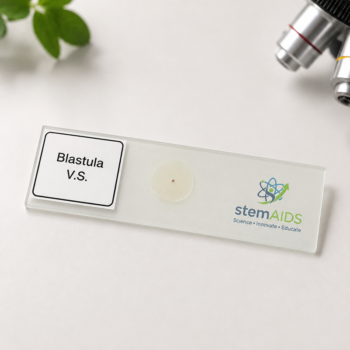
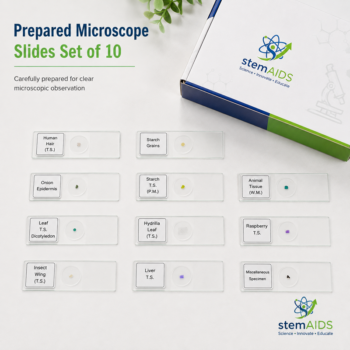
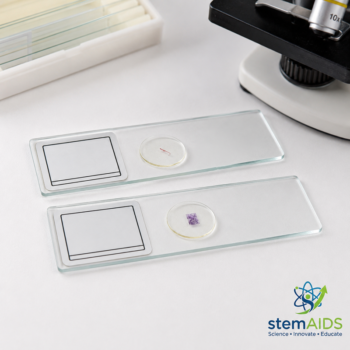
Quick Answer: The Plant Tissue Specimen Slide is a prepared botany slide: a thin section of plant tissue that has already been cut, fixed, stained and mounted, ready for plant anatomy practicals under a compound light microscope.
What Plant Sections Teach
Plant tissues are a core part of botany practicals because their structure explains how a plant stands up, moves water and grows. The plant tissue slide saves the class from hand-sectioning with a razor and staining, so the lesson can go straight to observation.
Lessons divide plant tissues into meristematic tissue, where cells divide, and permanent tissue, where they have specialised. The simple permanent tissues are parenchyma, thin-walled packing cells; collenchyma, with walls thickened at the corners for flexible support; and sclerenchyma, with thick, lignified walls for rigid strength. The complex tissues are xylem, which carries water and minerals, and phloem, which carries sugars.
Students also learn to see these tissues as three systems: dermal tissue on the outside, vascular tissue in bundles or a central cylinder, and ground tissue filling the rest.
Applications
- Botany practicals on identifying simple and complex plant tissues
- Labelled drawings of cell walls, vascular tissue and packing cells
- Comparing monocot and dicot arrangements of vascular tissue
- Contrast with animal tissue to discuss cell walls and vacuoles
Care & Handling
- Return the plant slide to a flat slide tray after each class rather than leaving it on the microscope stage.
- Store it away from moisture and sunlight, which can fade stains.
- Clean the outer glass with lens tissue only.
Specifications
| Slide type | Ready-to-view prepared slide |
| Section | Plant tissue, already sectioned, stained and mounted |
| Used with | Compound light microscope, 10x and 40x objectives |
| Subject | Plant anatomy and botany |
Why Choose LabEquip
Botany teachers often order the Plant Tissue Specimen Slide with the Animal Tissue Teaching Slide for a cells-and-tissues unit, and use the Plain Microscope Slides Set for students’ own hand sections. Both are in Prepared Slides; orders for a whole botany class go through the contact page.
Frequently Asked Questions
What is the difference between meristematic and permanent tissue?
Meristematic tissue consists of small, actively dividing cells found at root and shoot tips and in the cambium. Permanent tissue is made of cells that have stopped dividing and taken on a specific job, such as support or transport.
How can I tell xylem from phloem on a section?
Xylem vessels are wide, empty-looking tubes with thick walls, often stained a different colour because of their lignin. Phloem lies on the outer side of the xylem in a vascular bundle and has narrower, thin-walled sieve tubes and companion cells.
What is the difference between collenchyma and sclerenchyma?
Collenchyma cells are living, with walls thickened unevenly at the corners, giving flexible support to young stems and leaf stalks. Sclerenchyma cells usually have thick, lignified walls and are often dead at maturity, giving rigid support.
How do monocot and dicot stems differ?
In a dicot stem the vascular bundles form a ring, with cambium between xylem and phloem. In a monocot stem they are scattered through the ground tissue and have no cambium, which is why most monocots do not thicken with age.
Can students make their own plant sections too?
Yes. Thin hand sections cut from a stem with a sharp blade, stained and mounted on plain slides, are a classic practical. The prepared slide then serves as a reference for what a well-cut, evenly stained section should look like.
Why do plant cells look so clearly outlined?
Each plant cell is surrounded by a cellulose cell wall, which stains and shows as a sharp boundary. Animal cells lack walls, so their outlines are softer and harder to trace.
Last Updated: October 2026