




In Stock
Plasmid Model Kit
Kit modèle de plasmide Features a flexible, interlocking polymer system that forms a continuous 3D loop, allowing for the precise insertion of foreign DNA segments to demonstrate the construction of recombinant plasmids and cloning vectors.
Restriction Site Mapping includes specifically keyed mechanical segments representing EcoRI, BamHI, and HindIII recognition sequences, facilitating the haptic simulation of enzymatic "sticky end" ligation and antibiotic resistance marker integration.
₹1,240.00
Quick Answer: The Plasmid Model Kit is a kit for building a model of a plasmid, the small circular DNA molecule found in bacteria, and using it to show how genetic engineers cut DNA, insert a gene and put the recombinant plasmid back into a bacterium. It supports lessons on recombinant DNA technology and biotechnology.
Modelling a Plasmid and Recombinant DNA
Plasmids are small rings of double-stranded DNA that bacteria carry in addition to their main chromosome. They replicate independently, often carry useful genes such as antibiotic resistance, and can pass between bacteria. Those features make them the standard vector in genetic engineering, because a gene placed in a plasmid is copied every time the bacterium divides.
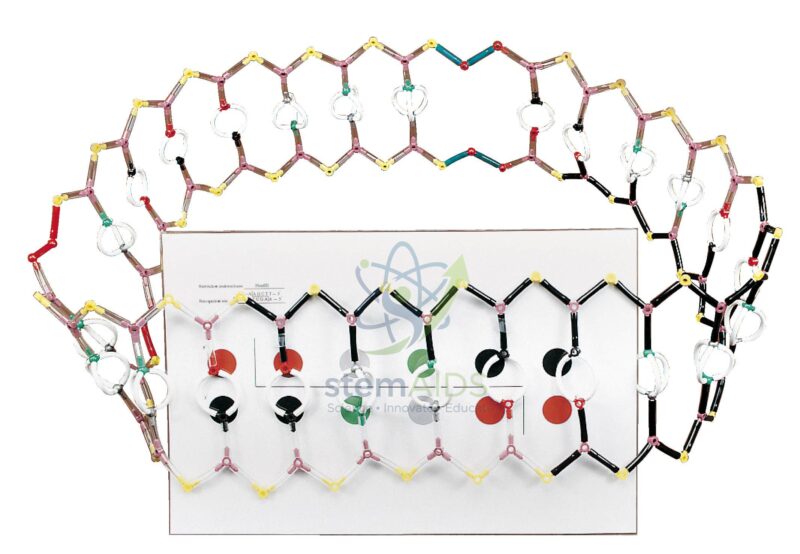
The product photo shows a ring of linked DNA-ladder pieces around a board carrying base symbols, the kind of layout used to act out cloning. A typical sequence runs like this. A restriction enzyme cuts the plasmid at a specific recognition site, often leaving single-stranded sticky ends. The same enzyme cuts out the gene of interest, whose ends are therefore complementary. The gene is placed into the opened ring, the sticky ends pair, and DNA ligase seals the backbone to give a recombinant plasmid.
Students then follow what happens next: bacteria take up the plasmid in transformation, and only those carrying it survive on a medium containing the antibiotic that the plasmid’s resistance gene protects against. The parts list, and whether the restriction and ligase steps are represented by separate pieces, are not stated in the listing. For how copies of a gene are made before cloning, see the DNA PCR principle model.
Specifications
| Model of | Bacterial plasmid (circular double-stranded DNA) |
| Shown in the product photo | Ring of DNA-ladder pieces with a board carrying base symbols |
| Processes | Restriction cutting, sticky ends, ligation, transformation, selection |
| Level | Secondary, pre-university and introductory university biotechnology |
| Parts list | Confirm at enquiry |
Lessons It Supports
- Recombinant DNA technology, from cutting with restriction enzymes to sealing with ligase
- How human insulin is produced by bacteria carrying the human insulin gene
- Antibiotic-resistance markers and the selection of transformed bacteria
- Discussing the ethics and safety rules around genetically modified organisms
Care & Handling
- Keep the ring pieces and base symbols in separate compartments so a plasmid can be rebuilt quickly.
- Photograph each finished recombinant plasmid before dismantling it, as a record for student notes.
- Clean with a slightly damp cloth, dry thoroughly and store away from heat.
Why Choose LabEquip
Biotechnology teachers use a plasmid kit because cloning involves several enzymes and steps that students struggle to put in order from a diagram alone. The kit is part of LabEquip’s biology lab products; ask about the pieces included through the contact page.
Frequently Asked Questions
What is a plasmid?
A plasmid is a small, circular, double-stranded DNA molecule found in bacteria and some yeasts, separate from the main chromosome. It replicates on its own and often carries genes that help the cell, such as antibiotic resistance.
Why are plasmids used as vectors?
They are easy to cut open and reseal, they are copied each time the host cell divides, and bacteria can take them up from their surroundings. A gene inserted into a plasmid is therefore copied and expressed in large numbers of cells.
What are sticky ends?
Many restriction enzymes cut the two DNA strands at slightly different points, leaving short single-stranded overhangs. When two pieces of DNA are cut with the same enzyme, their overhangs are complementary and pair up, which helps a gene fit into a plasmid.
What does DNA ligase do?
It joins the sugar-phosphate backbones of two DNA fragments by forming bonds between them. In cloning it seals the gene into the opened plasmid so the ring is complete again.
How are bacteria with the recombinant plasmid identified?
The plasmid usually carries a marker gene, often for resistance to an antibiotic. Bacteria are grown on a medium containing that antibiotic, and only those that took up the plasmid survive to form colonies.
What products are made with recombinant plasmids?
Human insulin, human growth hormone, some vaccine antigens such as the hepatitis B surface protein, and many enzymes used in industry and research are made by microorganisms carrying recombinant plasmids.
Last Updated: September 2026
You must be logged in to post a review.
Bestsellers




Reviews
There are no reviews yet.