


In Stock
Pea Seed Germination Model
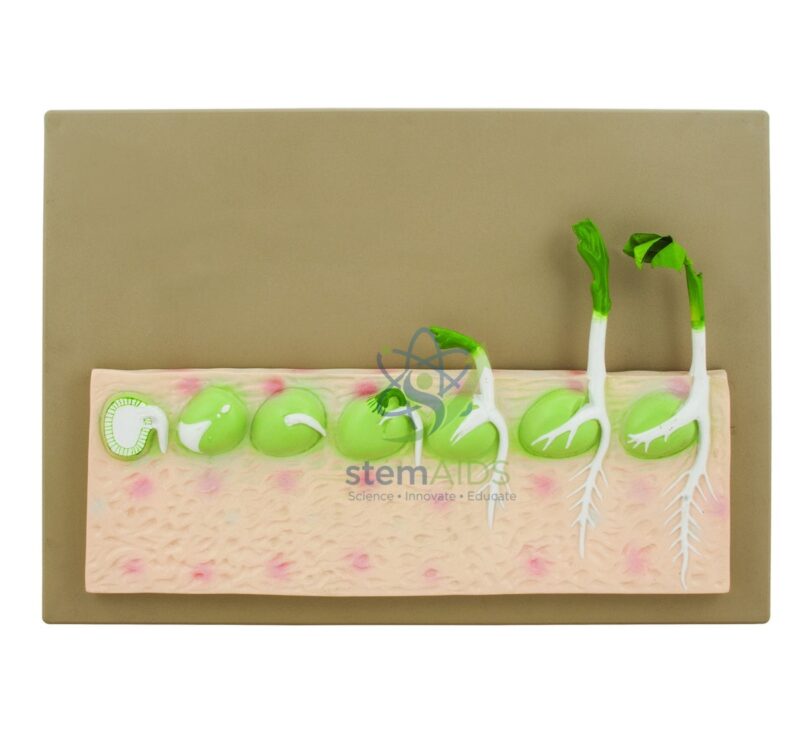
Modèle de germination des graines de pois Features a high-relief interior view of the dicotyledonous structure, illustrating the microscopic differentiation between the radicle, plumule, and nutrient-storing cotyledons in a magnified 3D format.
Sequential Hypogeal Mapping incorporates four discrete chronological stages of Pisum sativum growth on a reinforced base, specifically detailing epicotyl elongation while maintaining the subterranean position of the seed coat as per taxonomic standards.
₹2,350.00
Quick Answer: The Pea Seed Germination Model is a board-mounted pea seed germination model showing the successive stages of a pea seed growing into a seedling, from the soaked seed through the emergence of the root to a young shoot. It is used in biology lessons on germination and on hypogeal seed development.
Stages Shown on the Pea Seed Germination Model
The product photo shows seven stages set in a row on a strip of soil-coloured backing on a board. The first pieces show the seed and the young root breaking out through the seed coat; later ones show the root growing downward with side roots, and the shoot pushing upward as a hook before straightening. The green cotyledons stay at the level of the seed throughout. The listing does not state the size or material of the board or whether the stages are labelled.
Pea germination is hypogeal: the cotyledons stay below ground inside the seed coat. The part of the stem above the cotyledons, the epicotyl, lengthens and carries the shoot tip up through the soil. The tip is protected by bending into a hook, so the tougher curved stem forces a path first; once in the light, the hook straightens and the first leaves open. In an epigeal seed such as the French bean it is the stem below the cotyledons, the hypocotyl, that lengthens and lifts the cotyledons above ground.
Before any growth is visible, the seed takes up water, called imbibition, and swells. Enzymes then break down the starch and protein stored in the cotyledons into sugars and amino acids, which feed the growing embryo until its leaves can photosynthesise. The seed germination process chart makes a useful wall reference alongside the model.
Plant Biology Lessons
- Comparing hypogeal pea germination with epigeal bean germination
- Planning germination experiments on water, oxygen and temperature
- Explaining how food stored in cotyledons supports the seedling
- Revising seed structure: testa, radicle, plumule and cotyledons
Specifications
| Model of | Germination of a pea seed, in successive stages |
| Stages in the product photo | Seven, from seed to young seedling |
| Type of germination | Hypogeal (cotyledons stay below ground) |
| Mounting | On a board with a soil-coloured strip |
| Size, material and labelling | Confirm at enquiry |
Care & Handling
- Hang or stand the pea seed germination model where the thin root and shoot pieces will not be brushed against.
- Dust with a soft brush; the fine side roots catch on cloths.
- Keep it out of direct sunlight so the green and white colours do not fade.
Why Choose LabEquip
Primary and secondary science teachers use a germination board to show in one lesson a sequence that takes days in real seeds, and it pairs well with growing peas on damp paper in class. The model is part of LabEquip’s biology lab products; ask about size and labelling through the contact page.
Frequently Asked Questions
What is hypogeal germination?
It is germination in which the cotyledons stay below ground, inside the seed coat, while the epicotyl lengthens and carries the shoot up into the light. Peas, broad beans and maize germinate this way.
How does pea germination differ from bean germination?
In the French bean the hypocotyl below the cotyledons lengthens and pulls the cotyledons above ground, where they turn green; this is epigeal germination. In the pea the cotyledons stay underground and only the shoot emerges.
What conditions does a pea seed need to germinate?
Water, oxygen and a suitable temperature. Water activates enzymes, oxygen is needed for aerobic respiration to release energy, and warmth lets the enzymes work at a useful rate. Light is not needed for germination itself.
Why does the shoot come up as a hook?
The hook protects the delicate shoot tip and young leaves as they push through the soil. The bent stem forces a path first, and the hook straightens once the shoot reaches the light.
What is imbibition?
It is the uptake of water by a dry seed, which makes it swell and split its coat. It is the first step in germination and triggers the enzymes that break down stored food.
Which part of the seed becomes the root and which the shoot?
The radicle grows into the first root and is the first part to emerge. The plumule develops into the shoot and first leaves, carried up by the lengthening epicotyl in a pea.
Last Updated: September 2026
You must be logged in to post a review.
Bestsellers




Reviews
There are no reviews yet.